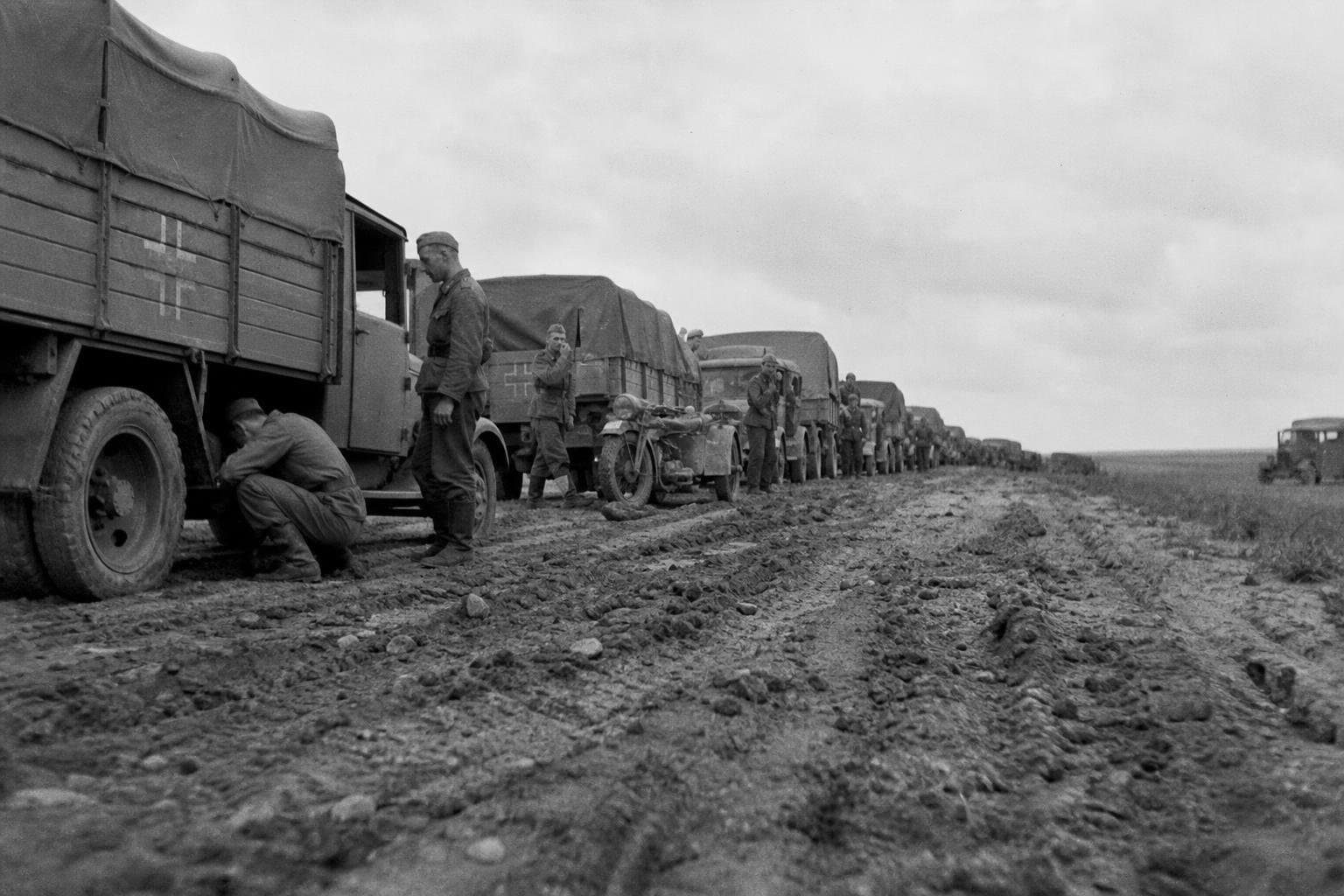

The German army that crossed the Soviet border on June 22, 1941 was, by most measures, the most effective fighting force on earth. It had shattered Poland in weeks, France in six. Its operational doctrine — rapid encirclement, air-ground coordination, exploitation of shock — had no peer. And yet the campaign it launched that morning contained within its own planning assumptions the seeds of a failure that no amount of tactical brilliance could prevent. The Wehrmacht didn't run out of luck in the Soviet Union. It ran out of road, then fuel, then time — in that order, and largely as a predictable consequence of how it had chosen to fight.
This is a piece about structural failure, not bad luck. The weather mattered. Soviet resistance mattered. Hitler's strategic interference mattered. But underneath all of those factors was a logistics doctrine that had been optimized for short, decisive campaigns in Western Europe and was never seriously rethought before being applied to a theater that was categorically different in scale, infrastructure, and depth.
I covered the Wehrmacht's logistics failure in broad strokes in a recent piece on German supply doctrine. What the 85th anniversary of Barbarossa's launch invites is a closer look at the specific mechanisms — the railway gauge problem, the road network, the planning assumptions about campaign duration — that made the collapse not merely possible but close to inevitable.
The Plan Was Built on a Fantasy About Time
Britannica's account of Barbarossa describes the operation as designed for a rapid, decisive campaign — the same template that had worked in Poland and France. The German high command expected to destroy the main Soviet forces in a matter of weeks, well before autumn. This wasn't irrational given their recent track record. It was, however, a planning assumption that was never seriously stress-tested against the actual geography and infrastructure of the Soviet Union.
The Modern War Institute's analysis identifies the core problem with precision: the German high command "failed to account for the immense distances, the lack of paved roads, and the mismatch in railway gauges that prevented German trains from utilizing Soviet rail lines without extensive modification." These were not unknowns. German planners had access to maps. The railway gauge differential between German standard gauge and the broader Soviet gauge was a documented engineering fact. The decision to proceed without resolving it — or rather, to assume the campaign would end before it became decisive — was a choice, not an oversight.
The gauge problem deserves more attention than it typically receives in popular accounts. Soviet rail lines ran on a broader gauge than German or Western European standard. German locomotives and rolling stock could not simply roll east onto captured Soviet track. Every kilometer of captured Soviet railway had to be re-gauged before it could carry German supply trains — a labor-intensive process that consumed engineering resources and time. As German forces advanced hundreds of miles in the first weeks, the gap between the front and the nearest functioning German-gauge railhead grew faster than the conversion teams could close it. Supply had to move by truck over roads that, in many areas, barely deserved the name.
Roads, Mud, and the Tyranny of Distance
The Soviet road network in 1941 was sparse and, outside major cities, largely unpaved. Chronicles Magazine's analysis of the campaign notes that the attacking force of roughly 3 million men, 600,000 vehicles, and half a million horses was advancing along a front of almost 2,000 miles — a front that widened as the attackers pushed eastward. The logistical implications of that geometry were severe. Supply lines lengthened, the number of routes available didn't increase proportionally, and the vehicles doing the hauling were accumulating wear on roads that destroyed them faster than in any previous theater.
German truck columns on Soviet roads in summer 1941 faced conditions that consumed vehicles at rates the Wehrmacht's maintenance and replacement pipeline couldn't sustain. Dust in summer turned to mud in autumn — the infamous Rasputitsa, the "mud season" — and then to frozen ground in winter. Each transition degraded mobility further. The trucks that were supposed to bridge the gap between railheads and forward units were themselves becoming casualties of the terrain.
This is where the planning assumption about campaign duration becomes lethal. If the campaign ended in eight weeks, as the optimistic scenario projected, none of this mattered much. The vehicles would be worn, the horses exhausted, but the war would be over. If it didn't end in eight weeks — if Soviet resistance proved more resilient than anticipated, if the distances were simply too great — then the Wehrmacht would find itself in autumn with a degraded transport fleet, a supply system that couldn't reach the front, and troops who had been issued summer equipment because winter equipment hadn't been prioritized.
That is, more or less, exactly what happened.
The Smolensk Delay and the Culmination Point
The Chronicles analysis invokes Clausewitz's concept of the culmination point — the moment when an offensive has advanced far enough that the attacker's remaining strength is just sufficient to hold what it has gained, and no more. Clausewitz developed the concept partly from his direct observation of Napoleon's 1812 campaign; the argument is that Napoleon reached his culmination point at Smolensk, 260 miles west of Moscow, and should have stopped there. He didn't, and the rest is catastrophe.
The German situation in 1941 had structural parallels. The Battle of Smolensk in July–September 1941) — fought roughly at the same geographic point where Clausewitz argued Napoleon should have halted — consumed weeks and significant German strength. German historiography dates the battle from July 8 to July 31; Soviet historiography extends it to September 10. The casualty figures illustrate the asymmetry of attrition at this stage: German losses in the period ran to roughly 115,500 by one calculation, while Soviet losses by Krivosheev's official data reached approximately 760,000 — a ratio that looks favorable to Germany on paper, but obscures the strategic reality that the Soviet Union had far more men to lose and was fighting on interior lines while Germany was not.
The Smolensk battle also consumed the time that German logistics needed to catch up with the front. When Army Group Center resumed its advance toward Moscow — delayed further by Hitler's controversial decision in September 1941 to divert forces south toward Kiev — it was doing so with a supply system that had never fully recovered from the initial overextension. Chronicles notes that the Kiev encirclement, while producing a spectacular capture of over 600,000 prisoners, meant the German army could not reach Moscow before the Russian winter set in. The operational brilliance of the Kiev operation and the strategic cost of the delay are genuinely contested among historians — some argue the southern flank had to be secured before any Moscow advance; others that the delay was fatal. What is less contested is that by the time Army Group Center resumed its drive east, the logistics situation had deteriorated to the point where the advance was operating on borrowed time.
What Was Knowable, and When
The hindsight trap here is real and worth naming. It is easy, from 2026, to look at the German planning assumptions and call them delusional. They were not obviously delusional in the summer of 1941. The Wehrmacht had just demonstrated that modern mechanized forces could collapse large armies very quickly. Soviet military performance in the Winter War against Finland in 1939–40 had been poor, suggesting institutional problems that German intelligence assessed as severe. The RT analysis of Soviet unreadiness — which should be read as a Russian-perspective source with its own framing — notes that the Red Army had been weakened by political purges, was in the midst of a major reorganization, and was caught in a posture that made the initial German blows devastating. The German assessment that Soviet resistance would collapse quickly was not invented from nothing.
What German planners underweighted — and this is where the institutional failure lies — was the question of what happened if the quick collapse didn't materialize. The logistics plan had no serious contingency for a campaign that ran past autumn. There was no robust plan for re-gauging Soviet railways at scale before the campaign began. Winter equipment was not pre-positioned. The MWI analysis frames this as a recurring pattern in military history: "Operational reach is strictly dictated by logistical and sustainment capacity." The Wehrmacht's operational reach in 1941 was extraordinary. Its sustainment capacity was not designed for the theater it was operating in.
Adam Tooze's framing in Wages of Destruction adds a layer that purely operational analysis tends to miss: the German invasion was also premised on exploiting Soviet resources to sustain the German war economy. The plan was not just to defeat the Red Army but to seize the food and raw materials of the western Soviet Union quickly enough to feed the Reich. When the campaign stalled, that economic logic collapsed too — the Wehrmacht was consuming resources it had expected to capture, not replenishing them.
The Lesson That Keeps Not Being Learned
The MWI piece draws the contemporary parallel explicitly: modern armies, including the U.S. Army, have optimized their sustainment systems for permissive environments with uncontested supply lines and static forward operating bases. The argument is that this creates a structural vulnerability analogous to the Wehrmacht's — a force whose operational brilliance is contingent on logistics conditions that a peer adversary will specifically target.
The parallel has limits. The Wehrmacht's problem was partly doctrinal and partly a genuine mismatch between the theater and the available infrastructure. Modern logistics vulnerabilities are different in character, though the underlying dynamic — operational ambition outrunning sustainment capacity — is recognizable.
What Barbarossa demonstrates, stripped of the mythology that has accumulated around it, is that logistics failure is rarely a surprise. The railway gauge problem was known. The road network was mapped. The distances were calculable. The decision to proceed on the assumption that none of it would matter — because the campaign would be over before it became decisive — was a choice made by people who had been rewarded for exactly that kind of optimism in Poland and France. The Soviet Union was a different problem. The Wehrmacht's command culture had no good mechanism for processing that difference before it was too late.
That gap between what was knowable and what was acted upon is, in the end, the real story of Barbarossa's logistics collapse — and it is a more uncomfortable story than weather or Hitler's interference, because it implicates the institution rather than the circumstances.


