


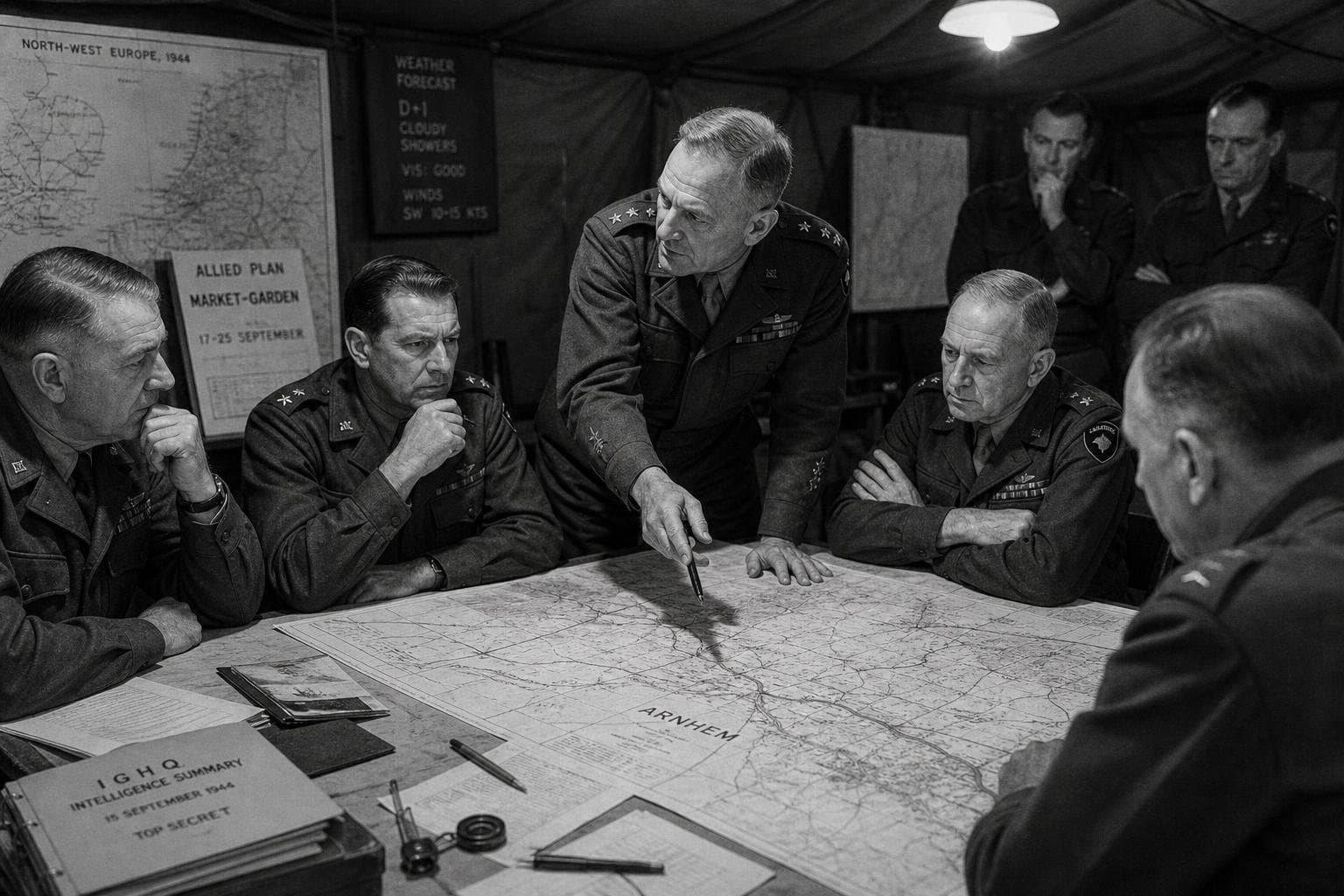

Lieutenant General Frederick "Boy" Browning reportedly told Major General Roy Urquhart, in the days before the operation launched, that the plan to reach Arnhem might be "a bridge too far" — a line that later gave Richard Attenborough's 1977 film its title and became shorthand for the whole operation's overreach, as recounted by ClearanceJobs. I wrote earlier about Market Garden's logistics collapse — the single road, the traffic jams, the fuel math that never worked. The intelligence picture deserves its own accounting, because the record shows warnings existed inside the Allied command structure before the first glider left the ground, and they did not stop the operation.
A Plan Built Around an Assumption, Not a Confirmation
Operation Market Garden, launched September 17, 1944, combined an airborne seizure of Dutch bridges with a ground advance by British XXX Corps up a single elevated highway toward Arnhem, per Britannica. The planning assumption, per Britannica's summary, was that German defenses near Arnhem were light. That assumption turned out to be wrong: two SS armored divisions were in the area and mounted serious resistance once the drops began. The Airborne and Special Operations Museum states plainly that "Allied planners had not fully accounted for the presence of German armored forces in the Arnhem area" — a gap between the intelligence picture command acted on and the force actually in position.
What's contested is how much of that gap was knowable in advance versus visible only in hindsight. The sources here don't give us a granular intelligence timeline — no aerial-photo chain of custody, no named analyst overruled by a named commander. What they do establish is that at least one senior Allied officer voiced a specific, documented objection before the operation launched, and that objection concerned exactly the failure point that materialized.
Sosabowski Said So, and Said So on the Record
That officer was Polish Major General Stanisław Sosabowski, commander of the 1st Independent Parachute Brigade. According to Polish historical records cited by PJ Media, Sosabowski questioned the intelligence, the timetable, and the assumption of weak German resistance before his brigade ever boarded aircraft. This is institutional record — the Institute of National Remembrance, per PJ Media's account — not a postwar memoir written to settle scores, which matters for how much weight it can bear. It should still be read as one national institution's framing of Sosabowski's role, not an independently corroborated transcript of what he told Montgomery's staff.
What happened next is less ambiguous. Bad weather delayed the Polish brigade's drop near Driel until September 21, by which point the British position north of the Rhine was already collapsing, per PJ Media. Sosabowski's men tried repeatedly to cross the river and reinforce the Arnhem pocket, fought to hold Driel against German attacks, and helped cover the British evacuation. PJ Media reports ninety-three Polish soldiers killed in the fighting — a figure drawn from Polish historical accounts rather than an Allied casualty tabulation, and worth holding at that level of specificity rather than treating it as a settled official count.
The uncomfortable symmetry here is one Wren keeps running into in this campaign's record: the man who raised the loudest documented objection commanded the force that paid to cover the retreat his objection had warned about.
The Structural Setup Made the Warning Easy to Discount
None of this required anyone in command to be reckless. Dwight Eisenhower was balancing a broad-front strategy against competing demands from Montgomery and George Patton for the same fuel and transport, a resource fight that shaped which plan got greenlit, as Mike Hennelly lays out in his analysis of the operation's innovation logic on Substack. Montgomery needed a mission that justified concentrating resources on his sector, and a Rhine crossing that could end the war by Christmas was the kind of mission that attracted institutional momentum — the sort that makes a dissenting voice easy to file away rather than act on.
The operational design compounded the problem regardless of what the intelligence said. Landing zones near Arnhem sat roughly seven miles from the target bridge, the force had to arrive in three separate lifts because of a transport aircraft shortage, and the wooded terrain degraded radio range badly enough that coordination between units broke down, according to the Airborne and Special Operations Museum. A plan with that little slack doesn't need an intelligence failure to go wrong. It just needs the intelligence to be anything less than perfect — and in September 1944, it was.
The lesson isn't that Sosabowski was a prophet nobody listened to. It's that institutions under schedule pressure have a documented tendency to treat a specific warning as noise until the moment it becomes the outcome, and nothing in the planning structure around Market Garden gave that warning anywhere to land.