
In late September 1950, Douglas MacArthur stood at the apex of his career. The Inchon landing had worked — spectacularly, against the odds, against the advice of nearly every naval planner who had studied the tidal charts. The North Korean People's Army was disintegrating. Seoul had been retaken. The question was no longer whether the UN Command could survive; it was whether MacArthur would stop at the 38th parallel or drive north to the Yalu River and finish the job.
He drove north. Six weeks later, the war he thought he was winning ceased to exist, and a different, bloodier war took its place.
I wrote about Inchon's operational logic in a previous issue — how MacArthur was correct about the strategic effect and wrong about almost everything else, and how the success insulated him from the institutional feedback that might have tempered what came next. This piece picks up where that one ended: at the moment of triumph, and at the decision that converted triumph into catastrophe.
The Intelligence Picture MacArthur Chose Not to See
The standard narrative frames Chinese intervention as a surprise. The operational record suggests something more uncomfortable: it was a surprise that required active effort to maintain.
According to Britannica's account of the campaign, as UN forces drove north toward the Yalu River in October and November 1950, MacArthur's command was receiving reports of Chinese forces crossing into Korea. The question was never whether the Chinese were present — they were — but what their presence meant. MacArthur's headquarters consistently interpreted the evidence in the most favorable direction: the Chinese were volunteers, not regulars; their numbers were limited; Mao was bluffing.
This was not stupidity. It was motivated reasoning operating inside a command structure that had been rewarded for boldness and had just been vindicated spectacularly. The Inchon gamble had worked. The pessimists had been wrong. Why would this be different?
A Chinese academic analysis published by ANU Press offers a useful corrective from the other side of the hill. Chinese military historians argue that Mao's decision to intervene was neither impulsive nor ideological in the simple sense — it was a calculated strategic response to a perceived existential threat. Beijing had watched UN forces approach the Yalu and concluded that a unified, American-aligned Korea on China's northeastern border was unacceptable. The PRC was eleven months old. Its northeastern provinces were its industrial heartland. Mao's calculus, as the ANU analysis frames it, was that the cost of fighting was high but the cost of not fighting was potentially higher.
What makes the intelligence failure so damning is that this calculus was not hidden. Chinese officials communicated through diplomatic back-channels that crossing the 38th parallel would trigger intervention. A retired U.S. Army colonel's recent account of the period notes that a Top Secret CIA Intelligence Weekly report dated June 27, 1950 — two days after the war began — had already outlined the risks of pushing north of the 38th parallel. That document, per the account, was not declassified until a FOIA request surfaced it in 2007. Whether it was suppressed, ignored, or simply lost in the bureaucratic noise is itself a contested question. What is not contested is that it did not shape the decision to advance.
MacArthur's command structure compounded the problem. His chief of staff, Major General Edward Almond, commanded X Corps — a dual-hatting arrangement that created a parallel chain of command operating outside Eighth Army. Britannica's operational account describes Almond as MacArthur's man, personally loyal and temperamentally aggressive. In a command environment where the boss had already decided the Chinese were not a serious threat, Almond was not the officer who was going to push back.
What 300,000 Soldiers Looks Like When You're Not Expecting Them
On October 19, 1950, Chinese forces crossed the Yalu River. The initial engagements were sharp, localized, and then — puzzlingly — stopped. The Chinese struck hard at isolated UN units in late October, inflicted serious casualties, and then pulled back. MacArthur's headquarters interpreted this as confirmation that the Chinese presence was limited. It was, in fact, a deliberate operational pause: the Chinese People's Volunteer Force was completing its deployment and preparing for a larger offensive.
The ANU analysis of Chinese operations puts the total Chinese deployment in Korea at more than three million troops over the course of the war, with the initial intervention force estimated at over 300,000 soldiers. They moved at night, used terrain for concealment, and maintained radio silence. Against an opponent that had grown accustomed to air superiority as a substitute for ground reconnaissance, these were devastatingly effective countermeasures.
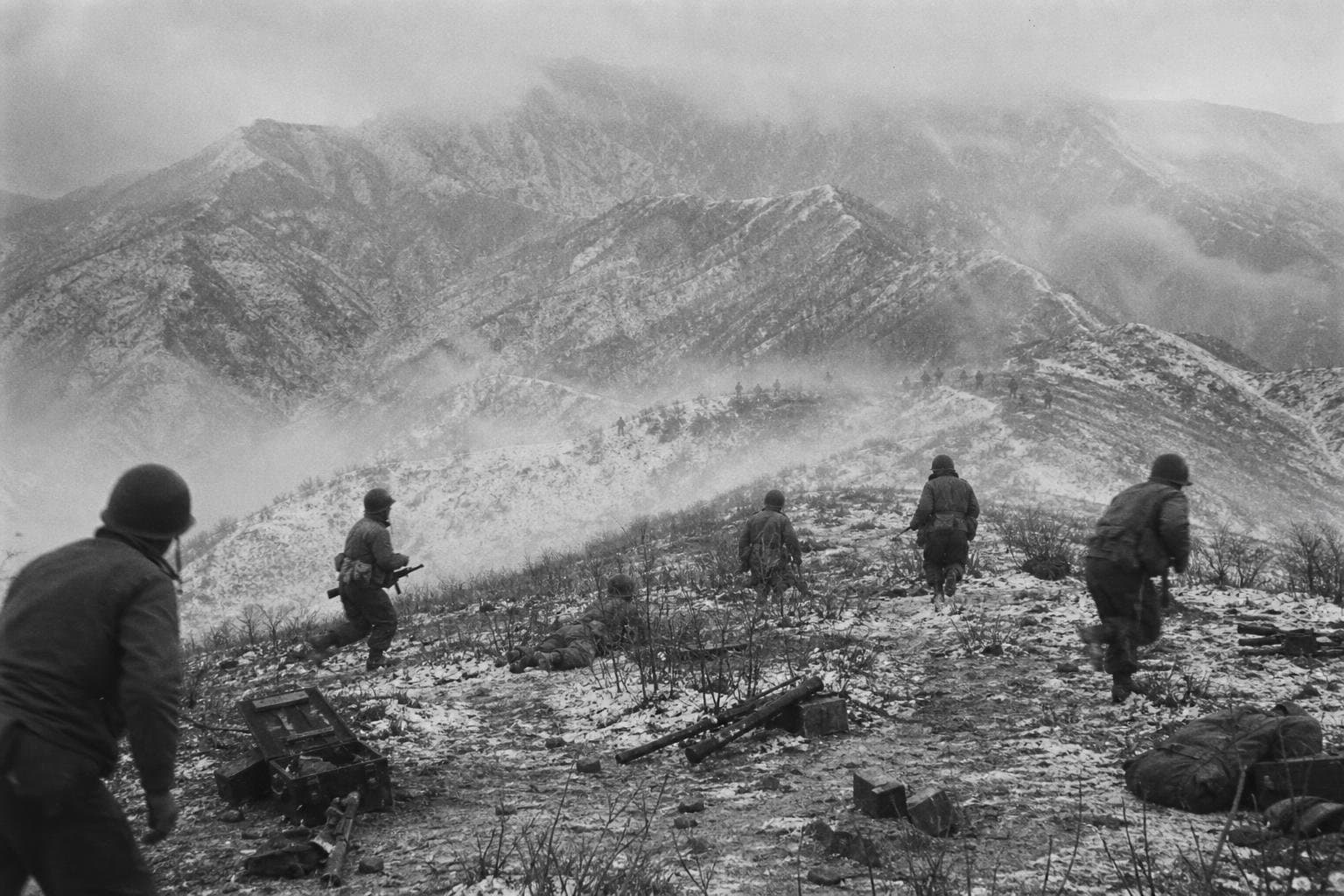
The offensive that began in late November 1950 was not a surprise in the sense that no one knew the Chinese were in Korea. It was a surprise in the sense that MacArthur's command had systematically underestimated both the scale and the competence of the force it was facing. UN units, strung out across mountainous terrain in pursuit of a disintegrating enemy, suddenly found themselves enveloped by a force that had been invisible until it wasn't.
The Substack account of the armistice period captures the strategic inversion that followed: the man who had been on the verge of ending the war had instead started a new one. MacArthur's response — publicly advocating for strikes on Chinese territory, for Nationalist Chinese troops to be unleashed, for a fundamental expansion of the war's scope — was the response of a commander who had lost control of the operational situation and was trying to change the strategic parameters instead.
Truman relieved him in April 1951. The decision was constitutionally correct and operationally necessary. It was also, by that point, closing the barn door.
Ridgway's War: Stabilization as Strategy
The officer who actually stopped the bleeding was Matthew Ridgway, appointed to command Eighth Army on December 26, 1950. The colonel's account of the period credits Ridgway with reversing the demoralization of Eighth Army in roughly 52 days — a claim that requires some scrutiny, since it comes from a source that is explicitly sympathetic to Ridgway's legacy and draws on memoir accounts. What is less contested is the operational record: Ridgway stabilized the front, reimposed discipline on a command that had been shaken to its foundations, and shifted the objective from unification to attrition.
This was a profound strategic reorientation, and it was not universally welcomed. The logic of the Korean War as it had been sold to the American public — and to the troops fighting it — was that the war had a winnable end state. Ridgway's approach implied something different: that the achievable end state was a return to roughly the status quo ante, at the 38th parallel, after another year or two of grinding combat.
He was right. The front stabilized in roughly that position by mid-1951. The Big Think geographic analysis notes that South Korea's net territorial gain from the entire war was an area roughly comparable to the city of Seattle — a figure that, whatever its methodological limitations, captures the essential futility of the positional warfare that consumed the last two years of the conflict.
The Stalemate That Redefined the Rules
The armistice negotiations that began in July 1951 and concluded — after extraordinary delay — on July 27, 1953, produced something that had not existed before in American strategic experience: a war that ended without victory, without defeat, and without peace. The Substack account of the armistice is precise on this point: the document stopped the shooting but settled nothing. The war did not end. It froze.
The human cost of that freezing is worth sitting with. A PBS documentary account estimates total dead — military and civilian, all sides — at approximately five million people, with some estimates running higher. The WarCosts analysis puts American military deaths at 36,574 and civilian deaths across the conflict at approximately two million, while noting that these figures derive from different methodologies and should not be treated as equivalent precision. The range of estimates for total casualties — Big Think cites 2.5 to 4 million — reflects genuine historiographical uncertainty, not rounding error. Anyone who cites a single clean number for Korean War casualties is either working from a specific and limited definition or not being careful.
What the stalemate produced, beyond the casualties, was a new template for Cold War conflict. The Korean War established that the United States would fight limited wars for limited objectives under international authorization, without congressional declarations of war, with nuclear weapons held in reserve, and with negotiated outcomes that left the underlying political dispute unresolved. The WarCosts analysis frames this as a constitutional rupture — Truman's decision to call it a "police action" rather than seek a declaration of war — though that framing carries its own political valence and should be read as argument rather than neutral description.
The precedent held. Vietnam followed the same template, with worse results. The lesson that Korea should have taught — that limited wars for limited objectives require limited aims from the start, not unlimited aims that get walked back after catastrophic overreach — was not the lesson that American strategic culture absorbed. What it absorbed instead was the operational vocabulary: containment, escalation management, negotiated armistice. The harder lesson, about the relationship between political objectives and military means, kept needing to be relearned.
What the Frozen War Actually Settled
The Korean War's most durable consequence was not the armistice line. It was the demonstration, at enormous cost, that the People's Republic of China was a military power capable of fighting the United States to a standstill. The ANU analysis argues that Chinese military historians view the intervention as a foundational moment of national assertion — the first time since the Opium War that China had fought a major power and not lost. That self-understanding shaped Chinese strategic culture for decades.
For the United States, the war produced a different kind of institutional memory: the memory of what happens when a commander's confidence outruns his intelligence picture, when a command structure is designed to confirm rather than challenge, and when a spectacular tactical success is allowed to substitute for strategic judgment. Mac


