


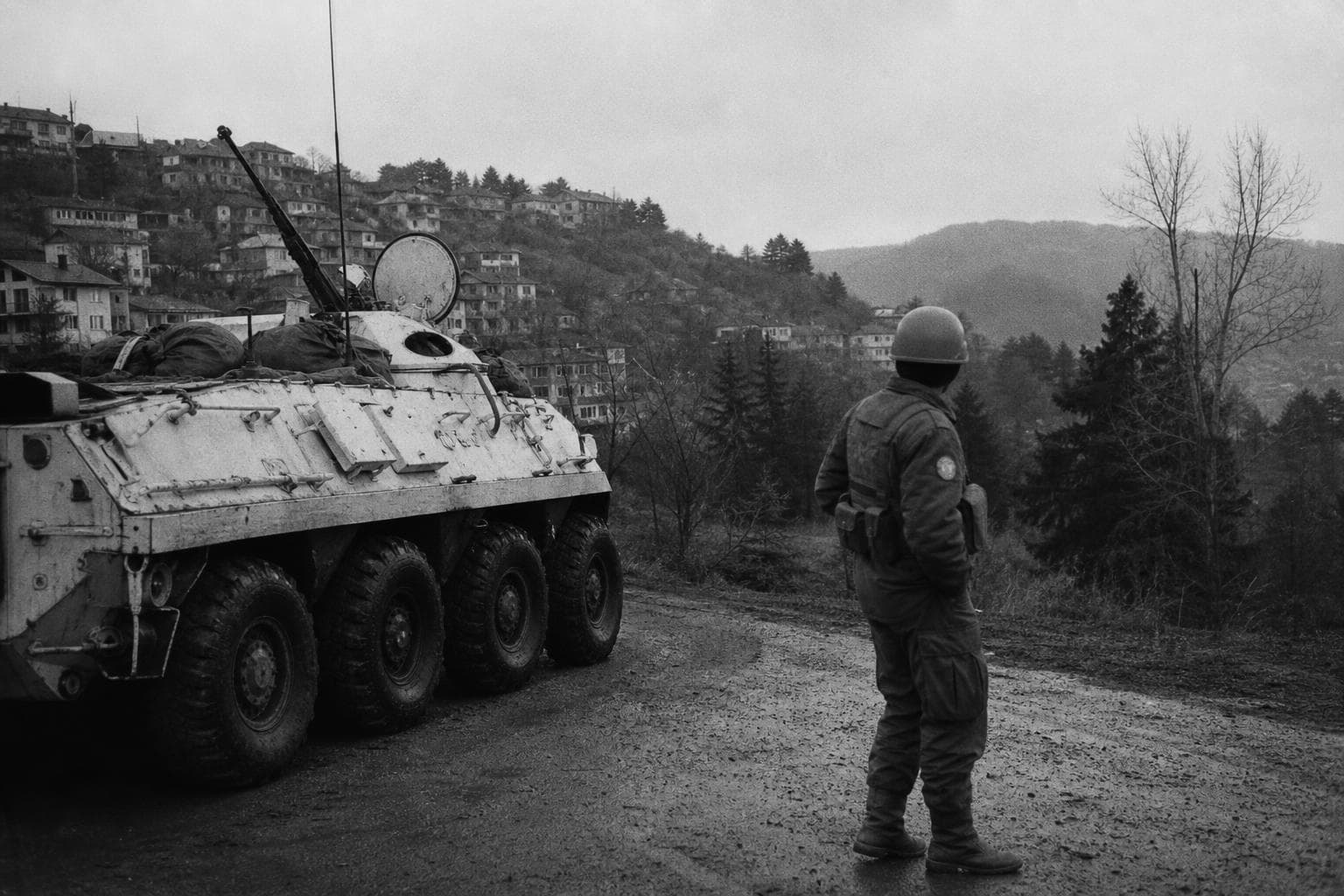

The Dutch battalion at Srebrenica — Dutchbat III — had roughly 400 lightly armed soldiers when Bosnian Serb forces under General Ratko Mladić began their final push on July 6, 1995. Within days, more than 8,000 Bosniak men and boys were dead, killed in what became the worst mass murder in Europe since World War II. The standard account frames this as a failure: the UN was there, the UN did nothing, the UN failed. That framing is too comfortable. It implies the system malfunctioned. The harder truth is that it worked more or less as intended — and the intentions were the problem.
A "Safe Area" With No Safety Mechanism
Srebrenica had been declared a UN "safe area" in 1993. The designation sounds robust. It wasn't. Safe area status under the relevant UN resolutions carried no automatic enforcement mechanism, no defined tripwire for military response, and no clarity about what peacekeepers were authorized to do if the area came under direct assault. Dutchbat's mandate was classic Chapter VI peacekeeping — consent-based, impartial, oriented toward monitoring rather than enforcement. The force was sized and equipped accordingly.
This is the institutional trap. Chapter VI peacekeeping assumes a peace to keep. It assumes parties who have agreed to stop fighting and need a neutral presence to hold the line. Srebrenica in 1995 had none of those conditions. The Bosnian Serb military was not a party that had consented to anything; it was an army prosecuting a war. Deploying a consent-based monitoring force into an active ethnic cleansing campaign and calling the result a "failure" is like blaming a fire extinguisher for not stopping an arson — after someone removed the water.
The gap between mandate and reality was visible well before July. Dutchbat had been denied resupply, its requests for air support had been repeatedly delayed or rejected through a dual-key authorization system requiring both UN and NATO approval, and its commanding officers were operating under rules of engagement that gave them almost no room to act. When Mladić's forces finally moved, the battalion's options were not "defend the enclave" or "abandon it." They were "abandon it" or "die defending it with inadequate force and no guarantee of reinforcement." That is not a failure of nerve. That is a predictable outcome of a structural design.
The Decisions That Mattered Were Made Years Earlier
The chain of decisions that produced Srebrenica doesn't begin in July 1995. It runs back through every Security Council session where member states agreed to declare safe areas without agreeing to defend them, through every NATO planning meeting where the dual-key system was constructed to ensure that air strikes would be maximally difficult to authorize, and through every troop-contributing nation that sent lightly armed soldiers into a war zone under a mandate that prohibited them from fighting.
These were not oversights. They were compromises — between states that wanted to appear to be doing something and states that were unwilling to commit to the costs of actually doing it. The result was a force designed to be present without being effective, visible without being protective. A tripwire that couldn't trip.
The Insider's recent reporting on the Milošević tribunal traces how the international community eventually did respond — through prosecution rather than prevention. The ICTY convicted Mladić and others for what happened at Srebrenica. That accountability matters. But it also underscores the sequence: the institutions capable of punishment were not the same institutions capable of prevention, and the prevention institutions had been deliberately hobbled.
What This Means for the Peacekeeping Model
The lesson isn't that peacekeeping doesn't work. It's that peacekeeping only works when the conditions for peacekeeping exist — and that deploying peacekeepers into conditions where those conditions are absent doesn't create them. It creates hostages, witnesses, and, in the worst cases, a fig leaf that allows outside powers to claim engagement while avoiding intervention.
The Dutch government's own post-mortem, released in 2002, was damning about the structural failures — the mandate, the resupply denials, the air support authorization process. The soldiers on the ground were not the problem. The architecture they were placed inside was.
Thirty years on, the question isn't whether Dutchbat should have fought harder. It's whether the states that designed that architecture have internalized what it produced — or whether the next "safe area" declaration will carry the same hollow guarantee.