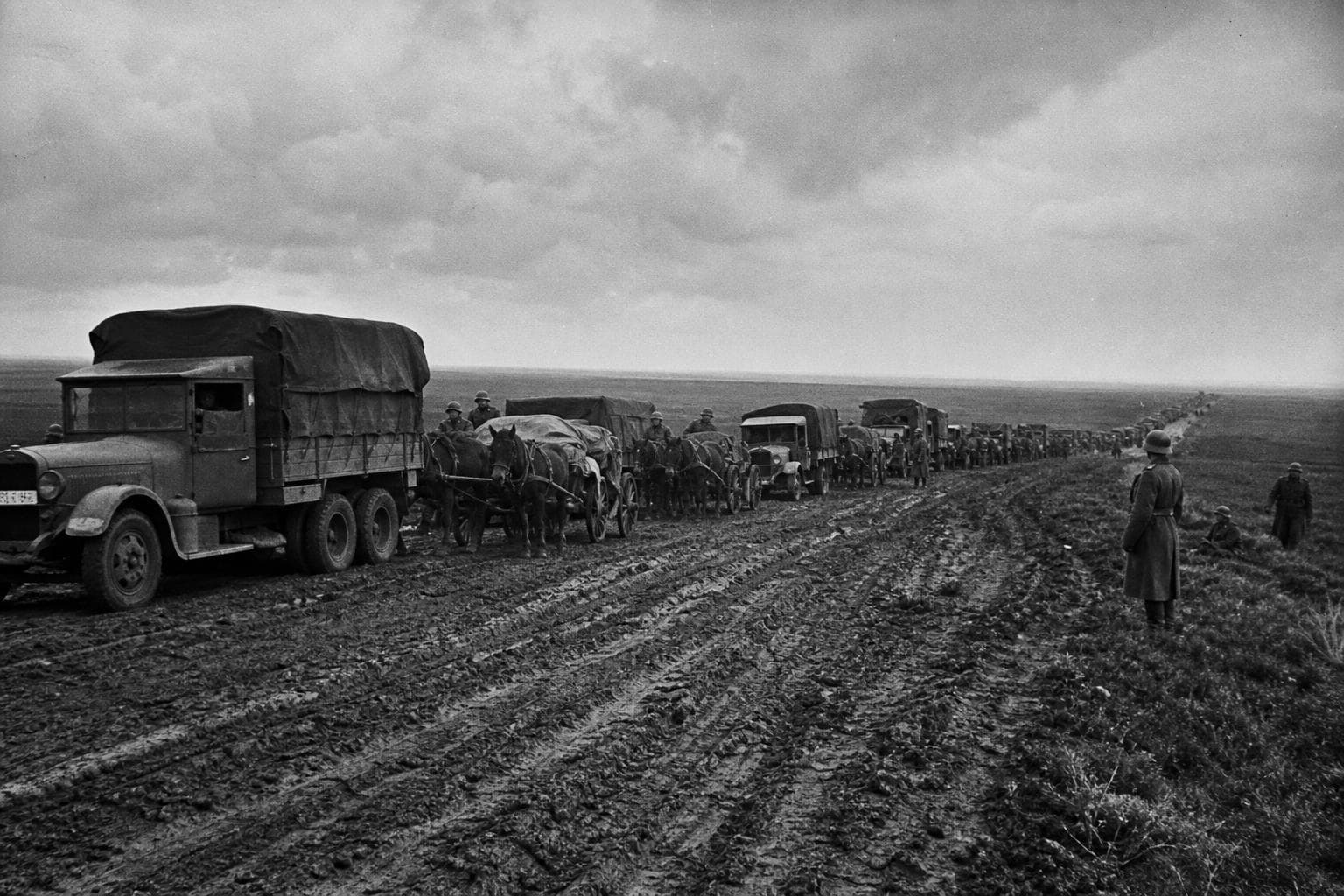

In the summer of 1941, the Wehrmacht was the most tactically sophisticated army on earth. It had dismantled Poland in weeks, France in six. Its command culture, its combined-arms doctrine, its officer corps — all of it had been validated by a streak of victories that seemed to confirm the German way of war as something close to a science. What it had not been tested against was distance. Real distance. The kind that doesn't appear on a map of Western Europe.
Operation Barbarossa would provide that test. The results were not ambiguous.
The popular account frames the German failure before Moscow as a story of weather — the famous Schlammperiode, the autumn mud, then the winter cold that froze engines and frostbit soldiers. Hitler's decision to divert Army Group Center toward Kiev in August gets its share of blame too. These factors were real. But they were accelerants, not causes. The logistics system that was supposed to sustain a campaign across the Soviet Union was structurally broken before the first German soldier crossed the Bug River. The mud and cold didn't create the crisis. They exposed one that already existed.
The Doctrine Was Built for a Different War
German operational planning in 1941 rested on a foundational assumption: the campaign would be decided quickly. Not quickly as in "we hope it goes fast," but quickly as a structural requirement baked into every logistical calculation. The Wehrmacht's supply doctrine was optimized for short, decisive campaigns — the kind it had just fought in Poland, France, and the Balkans. The entire system was calibrated for a war of weeks, not months.
This wasn't ignorance. It was a deliberate bet. German planners understood that sustaining a prolonged campaign deep into Soviet territory would strain their transport infrastructure to the breaking point. The bet was that it wouldn't come to that — that the Red Army would collapse in the border battles, that the Soviet state would fracture, that the campaign would be over before the supply system's limits became operationally relevant.
The bet was wrong, and the consequences were structural.
Simon Forty and Richard Charlton Taylor's German Logistics 1939–1945 makes the arithmetic visible. German doctrine held that a railhead should sit no more than 60 miles from an Army supply point. In Western Europe, that constraint was manageable — the road and rail network was dense, distances were short, and the front moved fast enough that the supply tail could keep pace. In the USSR, the distances between railheads and forward supply points routinely stretched to 100 miles or more. Cargo trucks averaging 300 kilometers of useful daily movement — already a theoretical maximum that assumed daylight, passable roads, and no enemy interference — were being asked to cover distances that consumed their entire operational range just reaching the front, leaving nothing for the return trip or for the lateral flexibility a fluid front demands.
Animal-drawn wagons, which made up a substantial portion of German transport, could manage 12 to 15 miles per day under good conditions. The Soviet Union did not offer good conditions.
The Rail Problem Was Worse Than the Road Problem
The road situation was bad. The rail situation was worse, and it was worse in a way that couldn't be improvised around.
Soviet rail ran on a broader gauge than the European standard. Every kilometer of track the Wehrmacht captured had to be converted before German rolling stock could use it. This wasn't a minor inconvenience — it was a systematic bottleneck that compressed the entire supply system behind the advancing front. The faster the German spearheads moved, the wider the gap between the railheads (which could only advance as fast as conversion crews could work) and the forward units (which were moving at the pace of a blitzkrieg).
The German Logistics 1939–1945 review notes the organizational complexity required just to coordinate industry, transportation, and distribution across Europe — and that was in the West, where the infrastructure was cooperative. In the East, every assumption that made the system function had to be rebuilt from scratch, under fire, against a ticking clock.
By the time Army Group Center was approaching Smolensk in late July, the supply situation was already critical. Ammunition was being prioritized over fuel. Fuel was being prioritized over food. Maintenance parts — the category that determines whether a mechanized force remains mechanized — were at the bottom of a queue that couldn't satisfy the items above it. The panzer divisions that had torn through the Soviet frontier were running on a fraction of their authorized vehicle strength, not because of combat losses alone, but because there was no supply of spare parts to keep the machines running.
What Commanders Knew, and When They Knew It
This is where the institutional failure becomes interesting, and where hindsight needs to be handled carefully.
German senior commanders were not oblivious to the supply problem. The Army's quartermaster-general, Eduard Wagner, had raised concerns about the logistical feasibility of the campaign before it began. His warnings were heard, acknowledged, and overridden — not because Hitler was irrational (though his operational interventions created their own problems), but because the entire German strategic position in 1941 made a long war against the Soviet Union unwinnable on resource grounds. Germany was already importing Swedish iron ore, Romanian oil, and Soviet grain under the Molotov-Ribbentrop trade agreements. A protracted war of attrition was a losing proposition regardless of logistics. The only viable path — from the German perspective — was a short campaign. So the planning was built around that requirement, and the logistics was made to fit the plan rather than the plan being made to fit the logistics.
This is a pattern identified in broader analysis of sophisticated logistics systems: elaborate supply infrastructure is a bet on continuity, on the campaign unfolding roughly as planned. When the campaign demands something different — when the Red Army doesn't collapse, when the border battles don't produce the expected encirclements of the entire Soviet force, when the front stabilizes and then stretches — the logistics system that was built for one kind of war becomes a constraint in another.
The Wehrmacht's command culture compounded this. The same decentralized initiative that made German tactical units so effective — Auftragstaktik, mission-type orders, junior commanders empowered to exploit opportunities — created a systemic problem at the operational level. Forward commanders consumed supplies at rates their logistical tails couldn't sustain, because their orders were to advance and their culture rewarded advance. The supply officers who flagged shortfalls were not wrong. They were simply not the ones making the decisions.
The wargaming history analysis of Enduring the Whirlwind notes that many aspects of the Russo-German war remain obscured by the postwar memoirs of German officers, who had strong institutional incentives to attribute failure to Hitler's interference rather than to structural problems in the army they had built. The logistics failure is a case in point: it's easier to blame a specific decision (the Kiev diversion, the halt before Moscow) than to acknowledge that the supply system was inadequate for the campaign from the first day.
The Autumn Mud Didn't Cause the Crisis — It Revealed It
By October 1941, when the Rasputitsa turned Soviet roads into axle-deep mud, the German supply system was already operating on borrowed time. The panzer groups driving toward Moscow had outrun their logistics by hundreds of kilometers. The rail conversion crews were still working far to the west. The truck columns that were supposed to bridge the gap were breaking down faster than they could be repaired, because the spare parts weren't there.
The broader pattern in military logistics history is instructive here: the side that can sustain its forces in the field wins, regardless of tactical quality. The United States in the Second World War won not through superior weapons — German tanks were generally better, the Me 262 was the world's first operational jet fighter — but through industrial production that overwhelmed the enemy's capacity to replace losses. Germany's problem in the East was the mirror image: tactically superior units that couldn't be sustained, couldn't be reinforced, and couldn't be replaced at the rate they were being consumed.
When the German offensive toward Moscow finally stalled in December 1941, the official explanation — then and in many postwar accounts — centered on the cold. Temperatures dropped to minus 30 Celsius. Engines wouldn't start. Soldiers lacked winter equipment. These things were true. But the Red Army was fighting in the same cold, and it was advancing. The difference wasn't temperature. It was that Soviet forces had supply lines that functioned, and German forces had supply lines that had been broken for months.
The Lesson German Planners Couldn't Afford to Learn
The structural problem with Barbarossa's logistics is that it was, in a narrow sense, the correct bet given Germany's strategic constraints. A long war was unwinnable. A short war required accepting logistical risk. The planners knew the risk and accepted it because the alternative — acknowledging that the campaign was probably unwinnable regardless — was politically and institutionally impossible.
This is the pattern that makes Barbarossa more than a case study in poor planning. It's a case study in what happens when an institution builds its operational doctrine around a best-case scenario and then cannot adapt when the scenario doesn't materialize. The Wehrmacht's logistics wasn't bad by the standards of 1941 European warfare. As Forty and Taylor document, the organizational complexity required to supply millions of men across a continent was genuinely impressive. The system worked — within the parameters it was designed for.
The Soviet Union was outside those parameters. The distances were wrong. The infrastructure was wrong. The enemy's resilience was wrong. And the German military had no mechanism — doctrinal, institutional, or cultural — for translating those facts into a revised operational plan before the campaign was already lost.
The historiographical debate here is genuine. Historians including David Glantz have argued that the Soviet performance in 1941 was far more organized and effective than the standard Western narrative suggests — that the Red Army was not simply absorbing punishment but actively degrading German combat power through a series of costly but deliberate defensive actions. Others emphasize Hitler's operational interference as the decisive factor. The logistics failure sits underneath both arguments: whatever else went wrong, the Wehrmacht arrived before Moscow in December 1941 without the fuel, ammunition, or spare parts to take it. That condition didn't develop in December. It was built into the plan in the spring.
The mud and cold get the headlines. The railhead conversion crews and the truck tonnage calculations don't. That's exactly backwards.
For the broader argument about how sophisticated logistics creates its own vulnerabilities — not just in Barbarossa but across military history — see the prior issue on Operation Bagration, where the Red Army demonstrated what a logistics system actually built for the Eastern Front could accomplish.


