


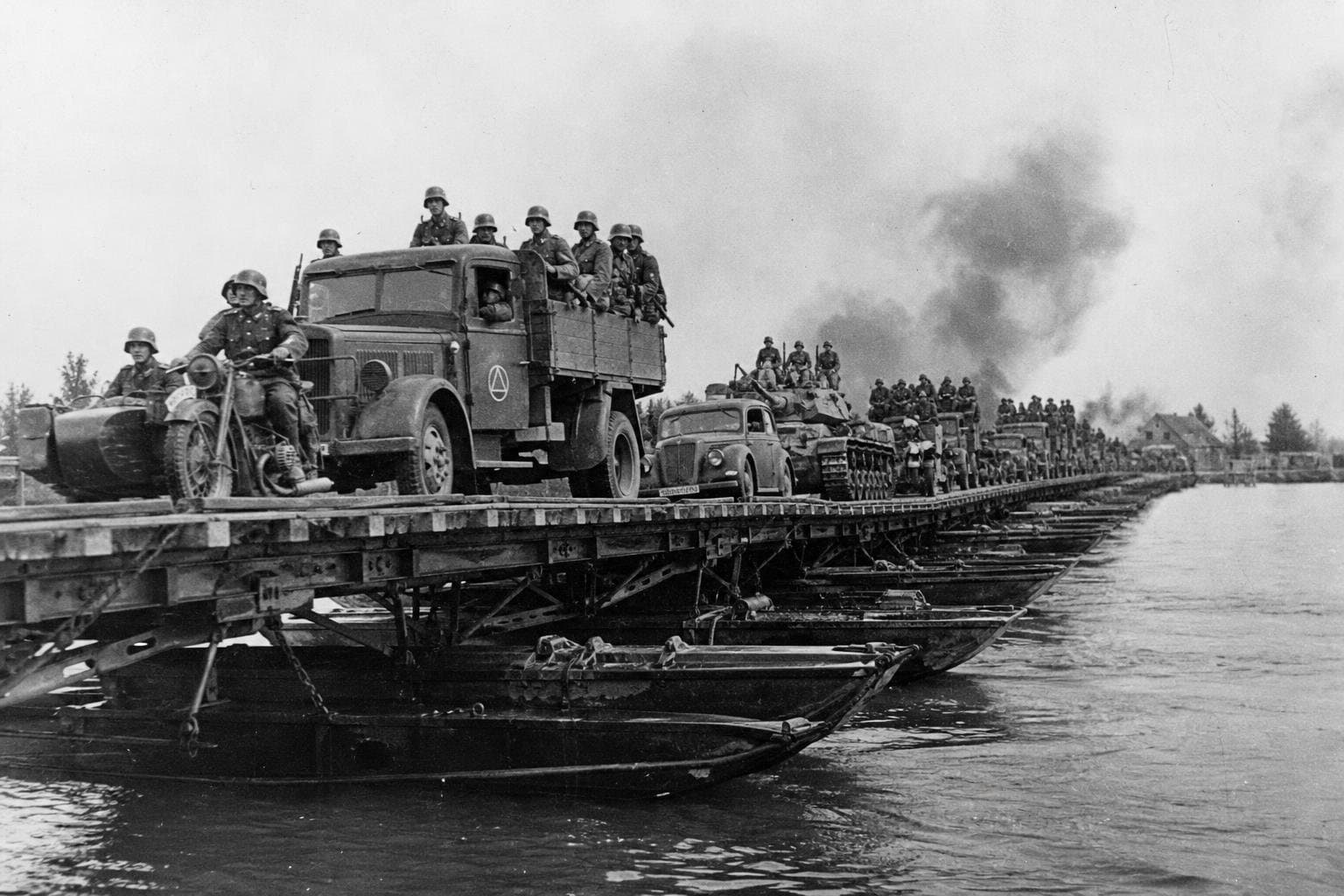

Heinz Guderian crossed the Meuse at Sedan on a front three kilometers wide. That number gets repeated so often it's become shorthand for a whole theory of warfare — concentrate overwhelming force at a single point and the rest of the line doesn't matter. The record backs the number up. What's less settled is whether the lesson people are drawing from it today, by comparing Sedan to a Russian bridgehead at Kherson in 2022, holds up the same way.
What the 1940 record actually shows. Between May 10 and 13, 1940, Panzer Group Kleist moved five armored and three motorized divisions — roughly 41,000 vehicles — through the Ardennes along just four roads, producing what one recent analysis calls the largest traffic jam in military history (War on the Rocks). Guderian narrowed his actual assault frontage at Sedan to three kilometers, backed by over 1,200 Luftwaffe sorties and, once the pontoon bridge went up on May 14, roughly 300 anti-aircraft guns defending the single structure carrying 600 tanks and 60,000 men across the river. Allied bombers attacking that bridge lost 167 aircraft without a hit. These are archival-grade figures about a battle that's been reconstructed from German and French records for eight decades. There's no serious historiographical dispute about the broad shape of what happened at Sedan.
The 2022 half is a different kind of claim. The same War on the Rocks piece draws a direct parallel to a Russian bridgehead at Kherson, where a handful of bridges carried similar logistical weight for a comparable force (War on the Rocks). That's a live war, reconstructed in near-real time from open-source and partial official reporting, not a closed historical record. Treating the comparison as established fact — rather than as an analytical frame still being tested against incomplete evidence — is exactly the move this publication exists to flag. The Sedan numbers are history. The Kherson numbers are current-events analysis wearing history's clothes, and worth exactly that much confidence.
The same instinct resurfaces in the robotic-mass debate, pointed the opposite direction. A separate War on the Rocks piece reaches back to 1914 instead of 1940, arguing that armies which entered World War I built for movement ended up digging in because machine guns and artillery made exposed maneuver lethal — and that drone saturation over Ukraine is producing an "unsettling echo" of that same collapse (War on the Rocks). The piece then argues against the obvious conclusion: it doesn't claim maneuver is dead, it argues the platforms embodying maneuver need to change. That's a legitimate argument. But it's worth noticing that both pieces reach into the same twenty-five-year window of military history — the trenches, the Ardennes — and extract opposite lessons depending on what argument about drones they're trying to win. That's not evidence either analogy is wrong. It's evidence that historical analogy in strategy writing tends to arrive pre-loaded with its conclusion, and the history gets fitted around it afterward rather than the other way around.
A structural pattern that outlives any single war. A recent Texas National Security Review piece on counter-militancy operations in West Africa — outside this publication's usual period but useful as a check — makes a related point without reaching for WWII at all: military forces that mass pressure against an enemy but can't convert that pressure into lasting territorial control tend to see the enemy reoccupy the ground once the force withdraws (Texas National Security Review). Guderian's problem in 1940 was getting mass across a river fast enough to matter. The recurring problem across a century of warfare, trenches to bridgeheads to counterinsurgency, is what happens after the breakthrough — whether anyone can actually hold what the mass bought them.
Watch whether the next wave of maneuver-warfare commentary engages with that holding problem directly, or keeps reaching for a new 1940 to make a point about 2026.