


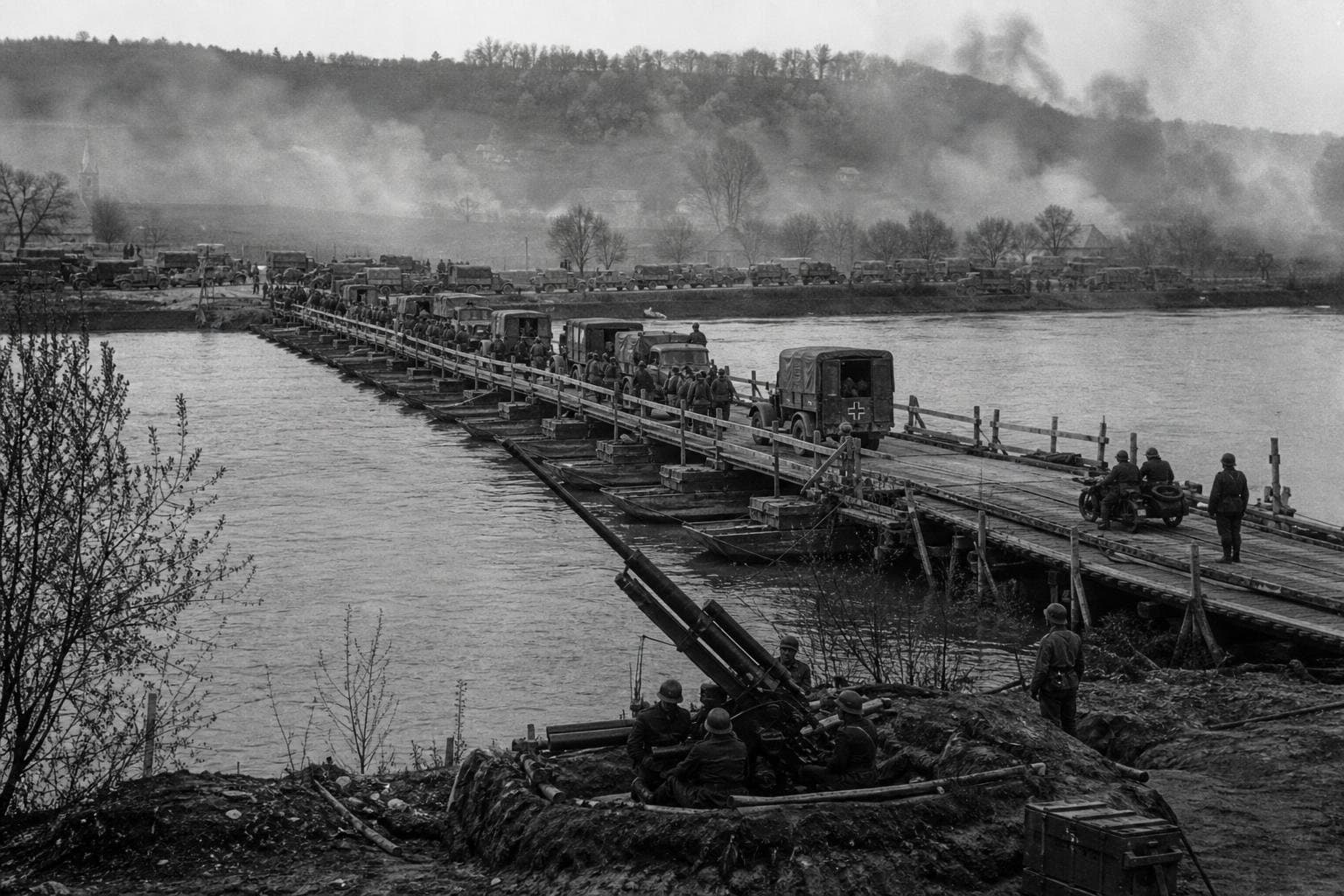

On May 14, 1940, a single pontoon bridge over the Meuse River carried the entire logistical weight of Nazi Germany's war-winning gamble. Lose that bridge, and the breakthrough at Sedan stalls. Hold it, and France's army unravels within weeks. Heinz Guderian understood this well enough to mass roughly 300 anti-aircraft guns around a wooden structure a few hundred meters long — a ratio of defensive firepower to infrastructure that tells you everything about how campaigns actually get decided, which is rarely at the point of the spearhead and almost always at the point where the spearhead has to feed itself (War on the Rocks).
The numbers are worth sitting with, because they explain why Sedan became the textbook case for concentration of force rather than a lucky breakthrough. Panzer Group Kleist pushed roughly 41,000 vehicles — five armored divisions and three motorized infantry divisions — through the Ardennes along just four roads, producing what's been called the largest traffic jam in military history. Guderian then narrowed his actual attack frontage to ten kilometers, and the river-crossing point itself to three. When his artillery got stuck in that jam, the Luftwaffe substituted air power, flying over 1,200 sorties against a four-kilometer sector — its most concentrated bombing effort of the war. The payoff was roughly 600 tanks crossing on a single bridge, supporting an eventual 60,000 men and 22,000 vehicles pouring through the gap, while the Allied counterstrike against that bridge lost 167 aircraft without a single hit (War on the Rocks).
What this operation actually demonstrates, stripped of the mythology that's accumulated around "blitzkrieg" as a doctrine of pure speed, is something narrower and more useful:
1. Mass is a chokepoint problem before it's a maneuver problem. Five armored divisions on four roads isn't fast — it's a logistics nightmare that only works if the enemy fails to exploit the vulnerability. The French didn't.
2. Concentration of effort means accepting risk everywhere else. Narrowing the actual point of attack to three kilometers while the rest of the force queues up on clogged roads is a bet that the enemy's response will be slow enough, or wrong enough, not to matter. It was both.
3. A single piece of infrastructure can be the entire campaign. The pontoon bridge at Sedan carried the weight of the whole operational tempo. Protecting it wasn't a secondary task — it was arguably the main effort, which is why Guderian put more anti-aircraft assets around a bridge than most divisions carried in total.
4. Air power substituting for stuck artillery is an improvisation, not a doctrine. The Luftwaffe's 1,200 sorties covered for a logistics failure rather than executing a planned combined-arms sequence. Treating that substitution as proof of some coherent airpower-plus-armor theory flattens what was, in the moment, an adaptation to a traffic jam.
5. Historical comparison is only useful when you respect the difference in conditions. The same source draws a contrast to a Russian bridgehead at Kherson in 2022, where comparable logistics vulnerabilities played out under drone surveillance and precision strike conditions that didn't exist in 1940. The structural problem — forces dependent on a narrow set of crossings — recurs. The sensor and strike environment around that problem does not, which is exactly the kind of distinction that gets lost when campaigns get reduced to "mass worked" or "mass is dead."
The debate over how much 20th-century armor doctrine translates to a transparent, drone-saturated battlefield isn't new, and it isn't settled. What Sedan offers isn't a template to copy. It's a case study in how thin the margin was between operational brilliance and catastrophic exposure — and a reminder that the thing worth defending with 300 guns is rarely the tank at the front of the column.