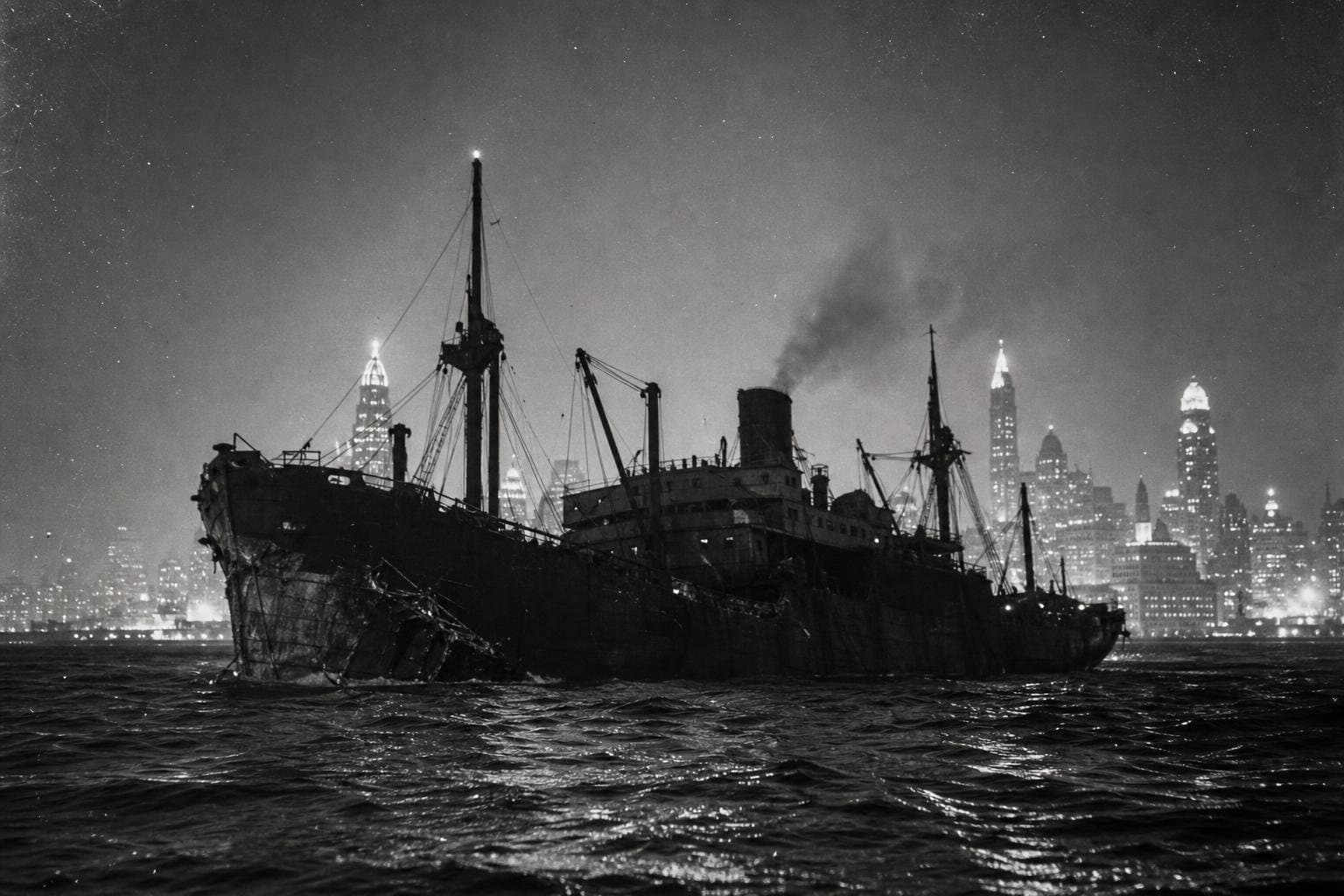

Five U-boats. That's what Admiral Karl Dönitz sent to American coastal waters in January 1942 — just five submarines to test what lay off the Eastern Seaboard. The results were catastrophic enough that German commanders privately called the period the "Second Happy Time." The hunting, they noted, was almost unsporting.
The standard telling frames this as a tactical shock: Pearl Harbor had just happened, the US Navy was stretched, and the Germans exploited a momentary gap. That framing is too generous. What Operation Drumbeat (Unternehmen Paukenschlag) actually exposed was an institutional failure of the first order — a navy that had watched Britain fight U-boats for two years, absorbed the lessons in theory, and then declined to apply them when the threat arrived at its own coastline.
What the US Navy Already Knew and Chose Not to Use
Britain had been running convoys since 1939. The evidence for their effectiveness against submarine attack was not contested — it was the central lesson of the first two years of the Atlantic war. Yet when Dönitz's boats arrived off the American coast, the US Navy had not implemented a convoy system along its coastline. Admiral Ernest King, chief of naval operations, was skeptical of convoys and lacked sufficient escort vessels to run them properly — a genuine constraint, but one that doesn't explain the parallel failure to enforce coastal blackouts.
American cities kept their lights on. Ships sailing at night were silhouetted against the glow of Miami and Norfolk, perfect targets for U-boats operating just offshore. This wasn't a resource problem. It was a decision problem. Someone had to weigh the commercial disruption of a blackout against the cost in merchant lives, and the wrong call was made — repeatedly, for months.
By January 31, 1942, German submarines had sunk 11 ships in American waters, including the Canadian passenger liner Lady Hawkins, which went down with an estimated 250 people killed. The carnage then spread south. In the Gulf of Mexico, U-boats would ultimately sink more Allied vessels than were lost at Pearl Harbor — a comparison that, if accurate, reframes the entire strategic picture of 1942.
The Mid-Atlantic Gap: A Resource Allocation Problem Wearing the Costume of Geography
I wrote about the Mid-Atlantic gap directly in a previous issue, but it bears revisiting here because the Battle of the Atlantic cannot be understood without it. The gap — that stretch of ocean beyond the reach of land-based aircraft — was eventually closed in May 1943 as Very Long Range Liberators and escort carriers became available. But the timeline matters: the aircraft existed earlier. The problem was allocation.
RAF Bomber Command routinely received priority for the best long-ranged aircraft. Coastal Command got the cast-offs. The Lancaster, entering service in early 1942, was Bomber Command's crown jewel and was jealously guarded. The American-built Liberator, which had the range for Atlantic ASW patrols, was prioritized for US Navy reconnaissance in the Pacific. Meanwhile, Coastal Command's shorter-ranged aircraft — Ansons, Whitleys, Hampden medium bombers — couldn't even carry the standard 450-pound depth charge. The gap in mid-ocean coverage was real, but it persisted longer than it had to because the institutional priorities of two air forces pointed elsewhere.
This is the pattern that recurs throughout the Atlantic campaign: the tactical problem was usually solvable with available resources. The obstacle was getting those resources pointed at the right problem by organizations with competing priorities and entrenched doctrinal commitments.
What Actually Turned the Battle
The transformation from near-disaster to Allied dominance by 1944 was not the product of a single breakthrough. It was a combination of technological innovation, industrial output, airpower, and intelligence — each element necessary but none sufficient alone. The Enigma intelligence derived from Bletchley Park mattered enormously when it was available, but the Wikipedia entry on the Mid-Atlantic gap notes that VLR aircraft were of particular importance precisely during periods when cryptographers could not read Kriegsmarine Enigma ciphers. The redundancy was the point. No single system could be relied upon.
Meanwhile, the German U-boat fleet had grown to nearly 250 vessels by the end of 1941, with Dönitz counting on roughly a hundred continuously operational — but the fleet's expansion came with its own constraints. Hitler had diverted submarines to the Mediterranean and to Norwegian and Arctic waters, which meant that even at the height of the American coastal offensive, Dönitz was operating with fewer boats than his strategic situation warranted.
The Battle of the Atlantic was decided less by tactical genius on either side than by which institutional failures proved more correctable. The Allies' failures — the blackout decisions, the convoy delays, the aircraft allocation fights — were eventually overcome by organizational learning and industrial scale. The German failures — strategic dispersion, Hitler's interference with operational priorities, the inability to replace experienced crews fast enough as losses mounted — were structural. They didn't get better. They got worse.
That asymmetry, more than any single technology or commander, is what the outcome reflects.


