
The German retreat from the Marne on September 9, 1914, is usually treated as the moment the war changed — the point where a swift German victory became impossible and the Western Front calcified into four years of attrition. That framing is seductive and mostly wrong. By the time Helmuth von Moltke the Younger ordered Alexander von Kluck's First Army to wheel southeast rather than envelop Paris, the plan had already been broken by forces that no battlefield decision could have repaired. The Marne was where the failure became visible. The failure itself was structural, baked into the plan's assumptions about what armies could physically do.
This is a story about logistics, not genius. And it's a story about what happens when a military institution mistakes an elegant operational concept for a workable war plan.
The Plan That Wasn't Really Schlieffen's
Alfred von Schlieffen served as German Chief of Staff from 1891 to 1906, and during that period he developed the concept that would bear his name: a massive right-wing sweep through Belgium and northern France, encircling Paris, then pivoting to crush the French army against Germany's left-wing forces in a classic double envelopment. The boldness of the concept was real. So was its central flaw.
As Max Hastings observed, Schlieffen "lacked the grasp of logistics fundamental to all modern military operations: the daily weight of supply necessary to support an army in the field had doubled even since 1870. Rather than a strategist of genius, Schlieffen proved to be a fantasist who brought doom upon his foolish disciples." That's a harsh verdict, but the logistics arithmetic supports it. The plan required enormous forces to march hundreds of miles in weeks, maintaining cohesion and supply across a degraded Belgian rail network that German planners assumed they could rapidly convert to their own gauge and use.
They could not. Or rather, they could not do it fast enough.
There is also a historiographical wrinkle worth naming: the "Schlieffen Plan" as executed in 1914 was not identical to Schlieffen's own memoranda. His successor, Moltke the Younger, modified the plan — weakening the right wing to reinforce the left, among other changes. Historians have debated for decades whether the original concept was more viable than what Moltke actually deployed, or whether the modifications were rational responses to changed circumstances. The German invasion of Belgium) proceeded under what is more accurately called the Schlieffen-Moltke Plan, and attributing its failure solely to Moltke's alterations — as some German postwar accounts did — is itself a contested interpretation, not settled history.
Liège and the First Warning the Plan Ignored
The operational sequence began on August 4, 1914, when German troops crossed the Belgian frontier. The next day, they began their assault on Liège, a fortified city whose ring of modern forts guarded the main lines of communication through eastern Belgium. Liège mattered for a reason that cuts to the heart of the plan's logic: the routes through Belgium were not just roads. They were railways, and the railways ran through Liège.
The German plan required passage through Belgium as essential to the opening phase of the campaign, and any delay at a fortified bottleneck carried consequences far beyond the city itself. The forts held out stubbornly. German troops occupied the town of Liège itself in the night of August 5–6 and the citadel on August 7, but the surrounding forts held out until the Germans brought their heavy howitzers into action on August 12. The last forts fell on August 16.
That's nearly two weeks. The plan's timetable had no slack for two weeks. The assumption had been that Belgian resistance would be token — a diplomatic inconvenience rather than a military obstacle. Instead, the opening move of the campaign consumed time the right wing could not afford to lose. The armies that were supposed to be enveloping Paris were still clearing Belgian forts.
The deeper problem was what Liège revealed about the railway assumption. German planners had built their supply calculations around the ability to use Belgian rail infrastructure rapidly. What they encountered was a network that required conversion, repair, and in many cases reconstruction under active resistance. Horse-drawn transport, which would have to bridge the gap, was already operating at the edge of its range before the armies reached France.
The March That Broke the Right Wing
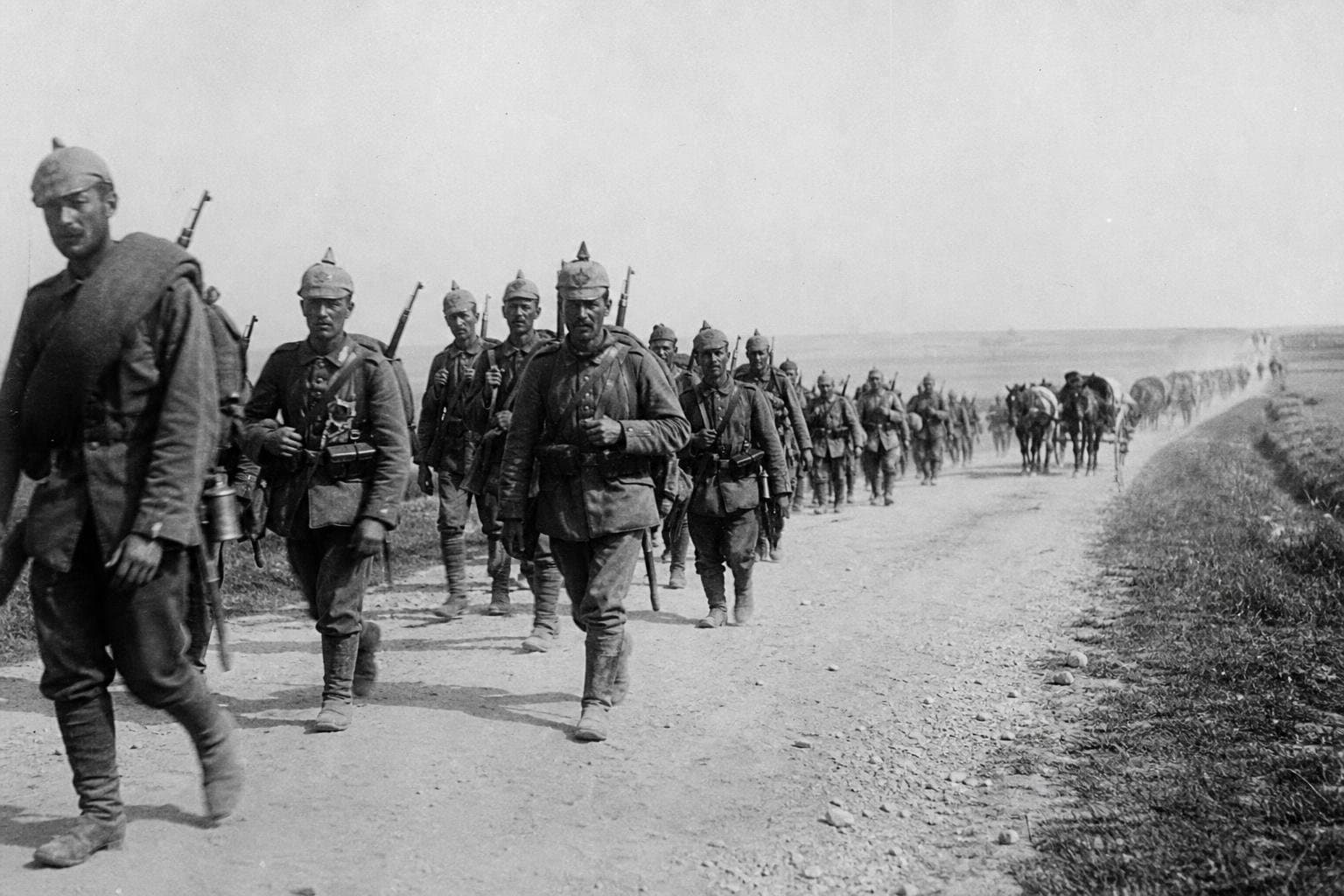
The German First Army under Kluck marched hundreds of miles in the opening weeks of the campaign. Nick Lloyd, in his account of the Battle of the Marne, argues that the German First Army exhausted itself through this sustained advance, and that the Germans were unlikely to win in 1914 due to exhaustion and logistical strain even before the command failures at the Marne compounded the problem.
This is the part of the story that gets lost in the drama of Moltke's orders and Joffre's counterattack. The soldiers' boots wore out. The horses — and the plan was enormously dependent on horses for supply — were dying from overwork and inadequate fodder. Artillery ammunition was being consumed faster than it could be replaced by a supply system that was already stretched to its limit. The right wing was supposed to arrive at the decisive battle in condition to fight. It arrived in condition to collapse.
The French and British forces retreating before the German advance were suffering too, but they were falling back toward their own rail network, shortening their supply lines with every mile they gave up. The Germans were advancing away from theirs, extending lines that were already broken at Liège and improvised across Belgium. Every mile of German advance was, logistically, a mile of German disadvantage.
The Western Front ultimately stretched over 440 miles from the Belgian coast through France to the Swiss border, and the stalemate that produced it was not simply a product of tactical failure. It was the product of two armies reaching the limits of what their supply systems could sustain — the Germans having reached those limits first.
Command Collapse as Symptom, Not Cause
The conventional account of the Marne focuses on Moltke's decision to order Kluck to wheel southeast rather than continue the envelopment of Paris. Lloyd's analysis frames this as a collapse of command and control, with Moltke ordering Kluck to wheel southeast instead of enveloping Paris. The British Expeditionary Force nearly collapsed under the pressure of the retreat, requiring Lord Kitchener to travel to France and personally order Sir John French to hold the line. Joffre, commanding the French, issued his famous order to counterattack — "die on the spot" — and the Battle of the Marne followed. The German retreat began on September 9.
All of this is real. But the command failures at the Marne were operating on top of a logistical situation that had already made the plan's objectives unachievable. Moltke's communications with his army commanders were poor — he was operating from Luxembourg, far from the front, with inadequate information about what his armies were actually doing. But even perfect communications would not have solved the supply problem. Kluck's army could not have enveloped Paris because it did not have the horses, the ammunition, or the physical endurance to do so. The command collapse was the visible symptom of a system that had already exceeded its operational limits.
This matters for how we assign responsibility. Postwar German accounts, many of them written by participants with obvious interests in the outcome, tended to locate the failure in Moltke's nerve — his decision to modify Schlieffen's original plan, his failure to maintain the right wing's strength, his loss of control at the critical moment. This interpretation was convenient because it preserved the plan's theoretical validity while blaming its execution. The logistics evidence does not support it. The plan as conceived required capabilities that did not exist.
What the Failure Actually Produced
The German retreat from the Marne did not end the war. It ended one kind of war and began another. The retreat on September 9, 1914, marked the beginning of trench warfare along the Aisne River, and the subsequent Race to the Sea — both sides attempting to outflank each other to the north — produced the continuous front that would define the war's character until 1918.
Germany now faced precisely the strategic situation the Schlieffen Plan had been designed to prevent: a two-front war with no prospect of rapid decision on either front. The naval blockade that Britain imposed — which would eventually contribute to significant German civilian mortality over the course of the war) — was already tightening. The war of attrition that German planners had considered unwinnable had arrived, and it had arrived because the plan designed to prevent it had failed in its first six weeks.
The institutional lesson that should have been drawn — that operational planning must be grounded in logistics reality, that timetables built on optimistic assumptions about supply and movement will fail under contact with actual conditions — was not drawn. German military culture continued to prize operational elegance over logistical rigor. That preference would appear again, in different form, in 1941.
The Schlieffen Plan's collapse in 1914 was not a near-miss that better execution might have salvaged. It was the predictable result of a plan that asked armies to do what armies in 1914 could not physically do. The tragedy is not that it failed. The tragedy is that the institution that produced it mistook the concept's boldness for evidence of its soundness — and that the men who paid for that mistake were the ones doing the marching.


