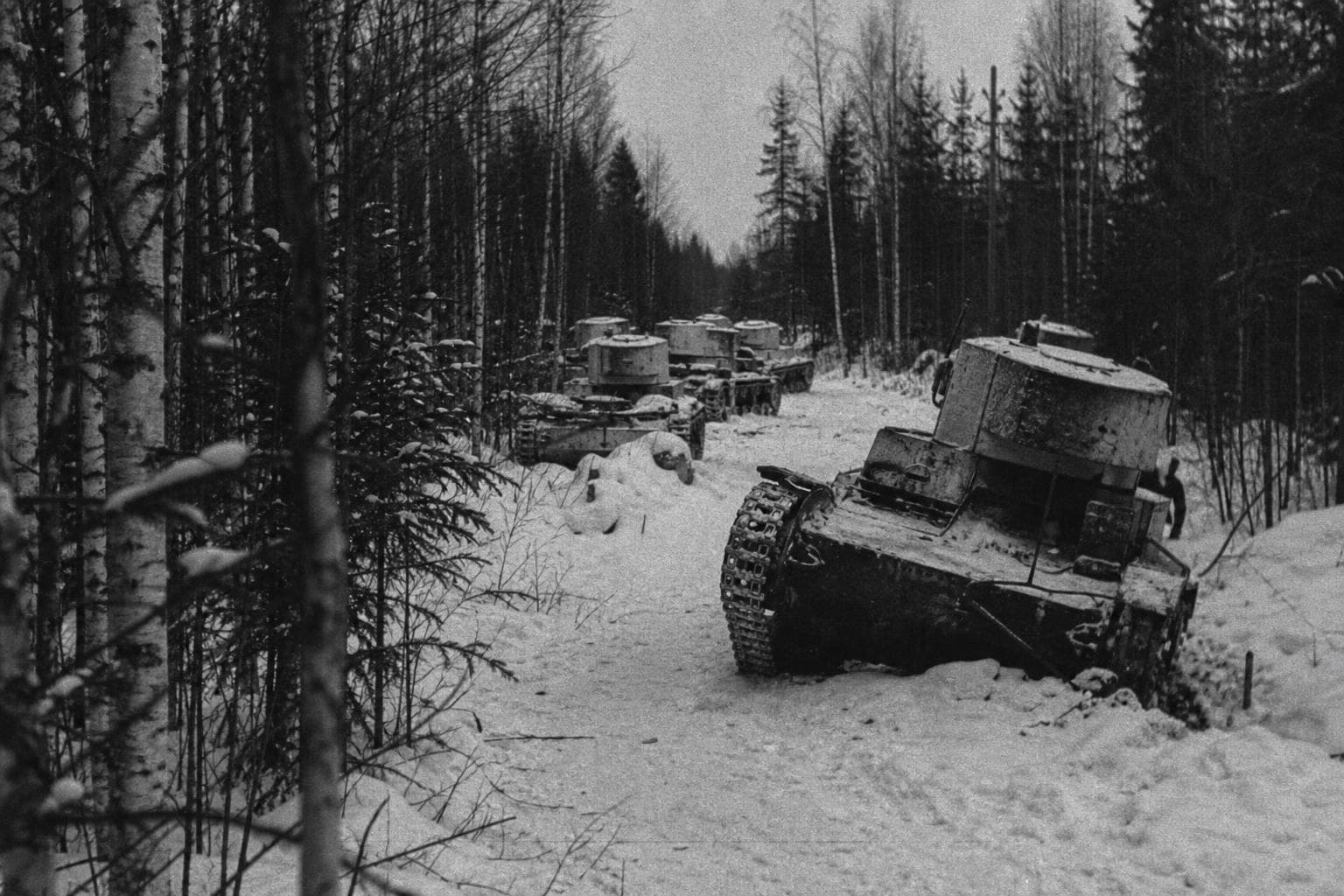

The orders were clear enough. On December 7, 1939, the 90th Independent Tank Battalion was directed to attack in the first echelon toward heights 38 and Nameless, with the 95th Battalion following in support. The division and brigade commanders had not thought the offensive through. The HQ chief had not checked whether the battalions were actually ready. The result, as a subsequent NKVD report drily noted, was that these failures were only discovered during the attack itself — at which point the tanks were already moving into Finnish positions without infantry coordination, without reconnaissance, and without any clear understanding of what they were driving into.
That scene, repeated across dozens of Soviet units in the first weeks of the Winter War, is the actual story of Finland's survival. Not Finnish heroism alone — though the Finnish soldier's performance was genuinely extraordinary — but Soviet institutional failure so comprehensive that it turned numerical superiority into a liability.
The Terrain Didn't Defeat the Soviets. The Soviets Defeated Themselves in the Terrain.
The standard Western account of the Winter War — small democracy, skis, sniper rifles, plucky resistance — is not wrong so much as it is incomplete. Finland did not win the Winter War. It fought the Soviet Union to a costly stalemate, then signed away roughly 11 percent of its territory in the March 1940 peace. The Karelian Isthmus, the Hanko naval base lease, the islands in the Gulf of Finland — the Soviets got what they came for, eventually. Framing the conflict as a Finnish victory requires ignoring the outcome.
What the terrain actually did was expose the gap between what Soviet doctrine assumed and what Soviet units could execute. The Karelian Isthmus and the forests of eastern Finland are not merely cold and wooded — they channel movement. Roads are few. Off-road movement for wheeled vehicles is nearly impossible in winter. Armor cannot maneuver freely; it follows the roads, and the roads are predictable. A force that knows the terrain and has prepared defensive positions can hold ground against a numerically superior attacker who is confined to those same corridors.
Soviet planners understood this in the abstract. What they failed to account for was that their tactical units — conditioned by doctrine that emphasized mass, speed, and centralized command — could not adapt when the terrain negated those advantages. Tanks advanced without infantry. Infantry advanced without tanks. Artillery fired without adequate observation. Units that lost communication with higher headquarters stopped moving rather than exercising initiative, because initiative had been systematically punished out of the Red Army officer corps during the purges of 1937–38.
The forest didn't defeat the Soviet 44th Division at Suomussalmi. The 44th defeated itself by stringing out along a single road, failing to establish all-around defensive positions when Finnish forces cut the column, and waiting for orders that never came while Finnish ski troops systematically destroyed the unit in detail. The terrain was the condition. Soviet command culture was the cause.
What the Mannerheim Line Actually Was — and Wasn't
The Mannerheim Line has been mythologized into something resembling the Maginot Line — an impenetrable wall of concrete and steel that stopped the Soviet juggernaut cold. The reality was considerably more modest, and the gap between myth and reality matters for understanding what actually happened.
Soviet after-action documentation reveals that Mannerheim Line bunkers were often difficult to identify even at close range — concrete fortifications built into hillsides, with firing ports disguised as rock outcroppings, armored turrets recessed into terrain. The line was not a continuous wall but a series of mutually supporting strongpoints with prepared fields of fire, integrated with natural obstacles: lakes, rivers, swamps frozen solid enough to cross on foot but not always solid enough to support armor.
What made the line effective in the first phase of the war was not its physical strength but the interaction between its design and Soviet tactical failures. Tanks sent to reduce bunkers arrived without infantry support, without engineers to clear obstacles, and frequently without accurate maps of what they were attacking. The NKVD reports on tank operations are a catalog of coordination failures: attacks launched before reconnaissance was complete, second-echelon units committed before first-echelon results were known, commanders who had not personally observed the ground they were ordering men to cross.
When the Soviets reorganized in January 1940 — replacing the failed commanders, concentrating forces under Timoshenko, establishing proper combined-arms coordination, and conducting systematic artillery preparation — the Mannerheim Line fell within weeks. The line had not changed. Soviet doctrine had been, temporarily and under extreme pressure, corrected. The lesson the Soviets drew was operational: better preparation, better coordination, better fire support. The lesson they should have drawn was institutional: a command culture that punished initiative and rewarded obedience to orders had nearly lost a war against a nation of roughly 3.5 million people.
Logistics as the Binding Constraint
The forest ambushes and the Mannerheim Line get the attention. The supply situation gets less, and it was arguably more decisive in the first phase of the war.
Soviet divisions advancing into Finland in late November and December 1939 were operating at the end of supply lines that ran through terrain with almost no road infrastructure. The same forests that channeled their advance channeled their resupply. When Finnish forces cut a road behind an advancing Soviet column, they did not merely isolate the unit tactically — they cut off its food, fuel, and ammunition. Units that had advanced confidently in the first days found themselves stationary within a week, burning through supplies they could not replace, in temperatures that dropped below minus 40 degrees Celsius.
The principle that wars are decided by who can sustain their forces in the field applied with brutal clarity in the Finnish forests. Soviet armor was not inferior to Finnish armor — Finland had almost no armor. Soviet artillery was not outranged by Finnish artillery. Soviet numerical superiority in every category of equipment was real and substantial. None of it mattered when units could not be fed, fueled, or reinforced because the single road behind them was held by Finnish ski troops who could move through terrain that Soviet soldiers, in their standard winter kit and without ski training, could not follow.
Finnish logistics, by contrast, were operating on interior lines in familiar terrain with prepared supply caches and a population that understood winter movement. Finnish units could be resupplied by ski courier across terrain that was impassable to Soviet wheeled vehicles. The asymmetry was not in equipment or numbers — it was in the match between each force's capabilities and the environment in which it was operating.
What the Winter War Actually Proved
The Western narrative of the Winter War as a Finnish triumph has always served political purposes more than analytical ones. In 1939–40, it encouraged the belief — in Berlin especially — that the Red Army was a hollow institution, a conclusion that fed directly into the planning assumptions behind Operation Barbarossa. That inference was not entirely wrong, but it was catastrophically incomplete. The Red Army that struggled in Finland was the Red Army immediately after the purges, operating under doctrine it had not trained for, in terrain it had not prepared for, with command relationships that actively suppressed the initiative needed to adapt.
The Red Army that fought at Kursk in 1943 had absorbed those lessons, at enormous cost. Finland itself understood this — which is why Helsinki's postwar strategic culture was built not on the mythology of 1939 but on the sober recognition that it had survived by a margin far narrower than the heroic narrative suggested, and that the Soviet Union had demonstrated, in the end, the capacity to correct its failures.
The Winter War's real lesson is not that small nations can defeat great powers through courage and terrain. It is that doctrine which cannot adapt to conditions will fail regardless of numerical advantage — and that the same institutional failures which produce tactical disaster in one war will be corrected, given sufficient motivation and time, before the next one. Finland's survival depended on the Soviets running out of time before they ran out of failures to fix.
They almost didn't.


