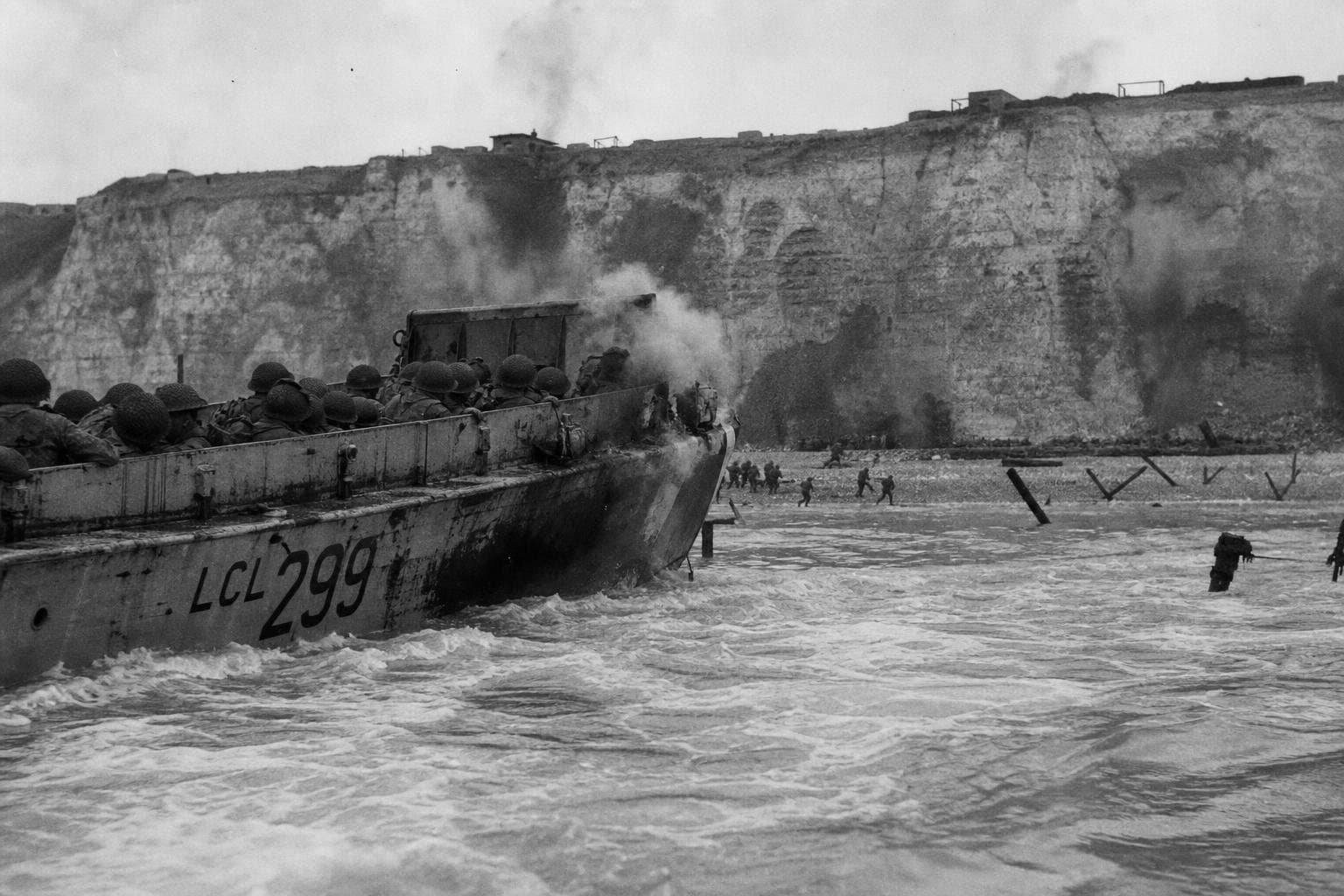

At 5:22 a.m. on August 19, 1942, Lieutenant Jack Gartshore led 13 Platoon of the Royal Hamilton Light Infantry toward White Beach at Dieppe. His regiment would suffer 82 percent casualties before the morning was out. The operation had been running for less than two hours, and it was already over.
The standard consolation — that Dieppe was a necessary rehearsal, a bloody classroom that made D-Day possible — contains enough truth to be dangerous. It lets the planning failures disappear into retrospective purpose. The more uncomfortable question is whether the lessons required this particular price, or whether the plan was broken in ways that were visible before the first landing craft left England.
A Plan That Depended on Everything Going Right
Operation Jubilee's design was structurally fragile from the start. The objective was to seize Dieppe temporarily, destroy its defenses and port facilities, gather intelligence, and withdraw — all in daylight, against a defended coastline hemmed in by high ground on both flanks. The beach itself was shingle, not sand, and the terrain gave German defenders near-vertical fields of fire onto anyone who made it ashore.
The plan depended on surprise because it lacked the firepower to compensate for its absence. Heavy bombing was rejected — advance.hr's reconstruction of the planning notes that concern for French civilian casualties and worry that rubble would block the town's streets drove that decision. Naval gunfire support was minimal. What remained was a scheme that required simultaneous flank landings, precise timing, and the defenders to be caught unprepared. Remove any one of those conditions and the whole thing collapsed.
The operation had already been cancelled once. Its predecessor, Operation Rutter, was scrubbed in July 1942 after bad weather intervened — and after thousands of men had already been briefed on its details. General Bernard Montgomery concluded that security had been irreparably compromised and the operation should be abandoned permanently. Lord Louis Mountbatten, heading Combined Operations, revived it anyway under the new name Jubilee. The decision to proceed after a security breach of that scale was not a calculated risk. It was an institutional failure wearing the costume of boldness.
The political pressures were real. In the summer of 1942, Germany controlled most of Western Europe, its armies were driving deep into the Soviet Union, and Stalin was demanding a second front. Canadian units had spent years training in Britain without seeing combat. The combination of political necessity and soldiers' frustration with inaction created exactly the conditions in which bad plans get approved. That context explains the decision. It doesn't excuse it.
What the Beach Actually Taught
The operation unraveled almost immediately. Before most of the force reached shore, craft carrying No. 3 Commando encountered a German coastal convoy at 3:47 a.m., scattering the flotilla and alerting defenders on the eastern flank. The disruption didn't automatically compromise surprise everywhere — troops at Pourville still landed without immediate opposition — but on an operation timed to the minute, a single flank failure cascaded. At Puys, members of the Royal Regiment of Canada came ashore in daylight beneath steep cliffs and directly in front of prepared German positions. They were trapped.
More than 6,000 Allied personnel took part, including 4,963 Canadians. The casualty figures vary by source and methodology — Legion Magazine's account focuses on regimental-level losses, while broader estimates of dead, wounded, and captured run into the thousands. What is not contested is that the operation was effectively over by early afternoon, with tanks abandoned along the waterfront and landing craft burning on the beach.
The lessons that followed were genuine. The Mulberry harbours — the artificial ports towed across the Channel for the Normandy landings — emerged directly from Dieppe's demonstration that attacking a defended port was prohibitively costly. The concept gained urgency after the 1942 raid highlighted the challenges of assaulting defended ports, with Churchill reportedly writing that year about the need for floating piers. The fire support doctrine for D-Day was substantially heavier. The intelligence preparation was more thorough. The timing margins were wider.
But here is the problem with the "necessary disaster" framing: it assumes the lessons required Dieppe specifically, at that scale, with that plan. A German officer's assessment — cited in the advance.hr reconstruction — was blunter than most Allied after-action reports: the operation was too large to be a raid and too small to establish a genuine foothold. That wasn't a lesson learned from the failure. It was a structural flaw visible in the planning documents.
The Gap Between Knowable and Known
What distinguishes Dieppe from a genuinely unforeseeable catastrophe is how much of what went wrong was predictable from the information available at the time. The terrain was known. The dependence on surprise was explicit in the plan. The security compromise from Rutter's cancellation was documented. Montgomery saw it clearly enough to recommend abandonment.
The institutional pressure that overrode those concerns — the political need to show action, the Canadian desire for combat, Mountbatten's ambition — is what made the disaster structurally likely rather than merely possible. Those pressures didn't emerge from the fog of war. They were visible in London before a single ship sailed.
The real lesson of Dieppe isn't about amphibious technique. It's about what happens when the pressure to do something outweighs the discipline to ask whether this particular something is sound. That question didn't get answered honestly in 1942. The Canadians on White Beach paid the difference.


