


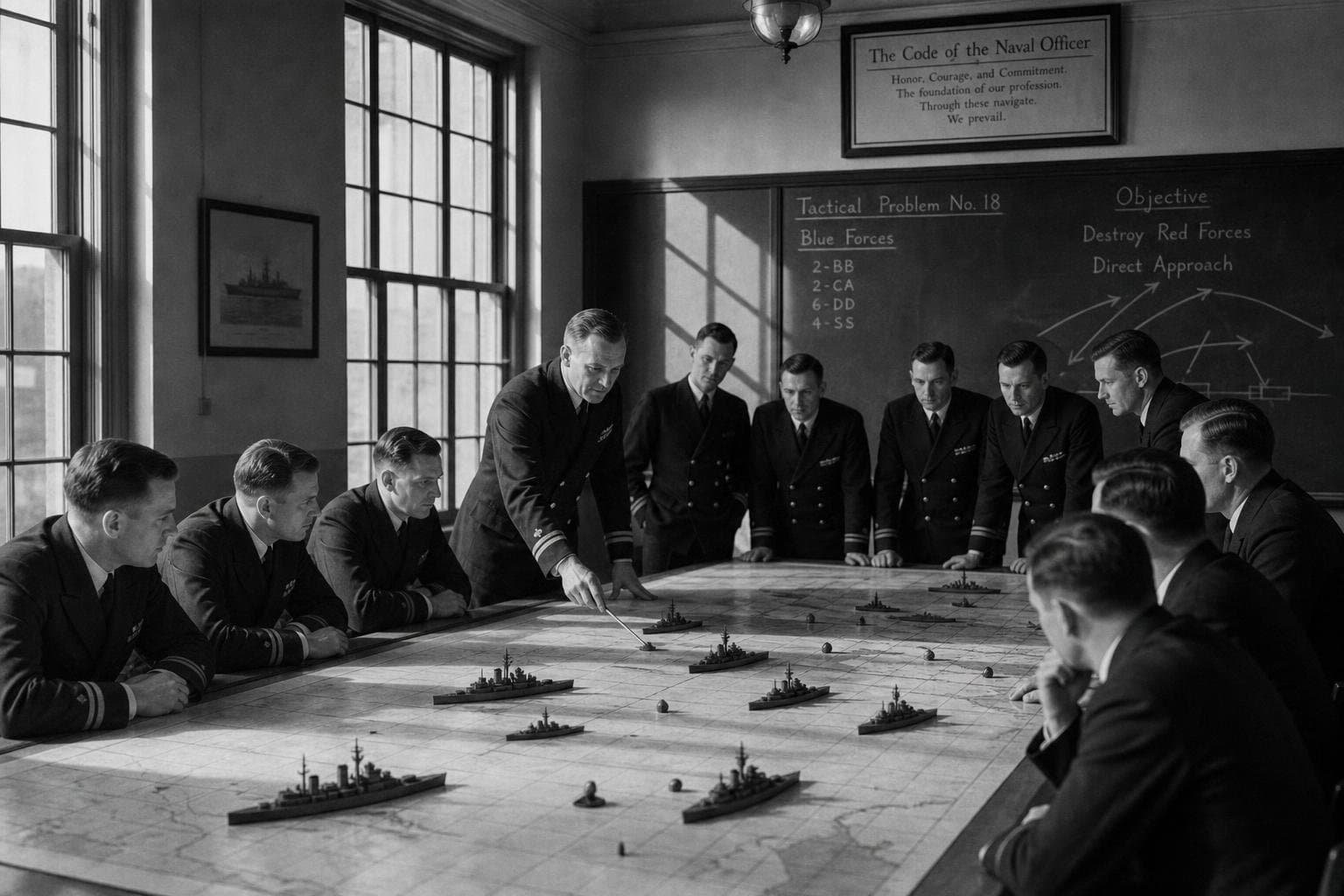

Before World War II, students at the US Naval War College assumed a future Pacific war would be settled by a single decisive clash of battleship fleets — and Japanese planners reached the identical conclusion independently, according to a recent essay in the Quincy Institute's analysis of battle-study fallacies. Carrier aviation and submarines, the two platforms that would actually decide the Pacific War, got comparatively little attention in that planning, even though German submarines had already demonstrated their offensive potential in the First World War. That's not a failure of intelligence. It's a failure of imagination operating on good evidence — the evidence just pointed backward.
This is worth dwelling on because it's the cleanest illustration I've seen of a problem that bedevils every after-action analysis: the gap between what a commander or planner could know at the time and what we now know happened. A recent piece on historical battle pedagogy makes the underlying case well — stopping a battle's narrative at the decision point, before revealing the outcome, forces you to ask what the commander actually believed, not what the record later vindicated or condemned. Frederick the Great studied Alexander and Hannibal not because their victories were instructive but because their situations were — problems his own career hadn't yet handed him.
Apply that discipline to the Naval War College case and the lesson sharpens. The decisive-battle assumption wasn't stupid in 1935. It was the rational extrapolation of Jutland-era naval thinking, built from the best available doctrine and the most recent major fleet action anyone had to study. The mistake wasn't the reasoning — it was treating a historically contingent pattern as a structural law of naval warfare, the same mistake 19th-century navies made when they kept bolting ram bows onto battleships for thirty years after Lissa because one ship sank that way once.
The structural problem recurs: institutions study the last war's confirmed lessons more rigorously than they study the next war's unconfirmed possibilities, because the former has evidence and the latter doesn't. Carrier aviation and submarine warfare weren't secret in 1935 — they were underweighted. That's a harder institutional failure to fix than ignorance, because it doesn't look like a failure until the war starts.