


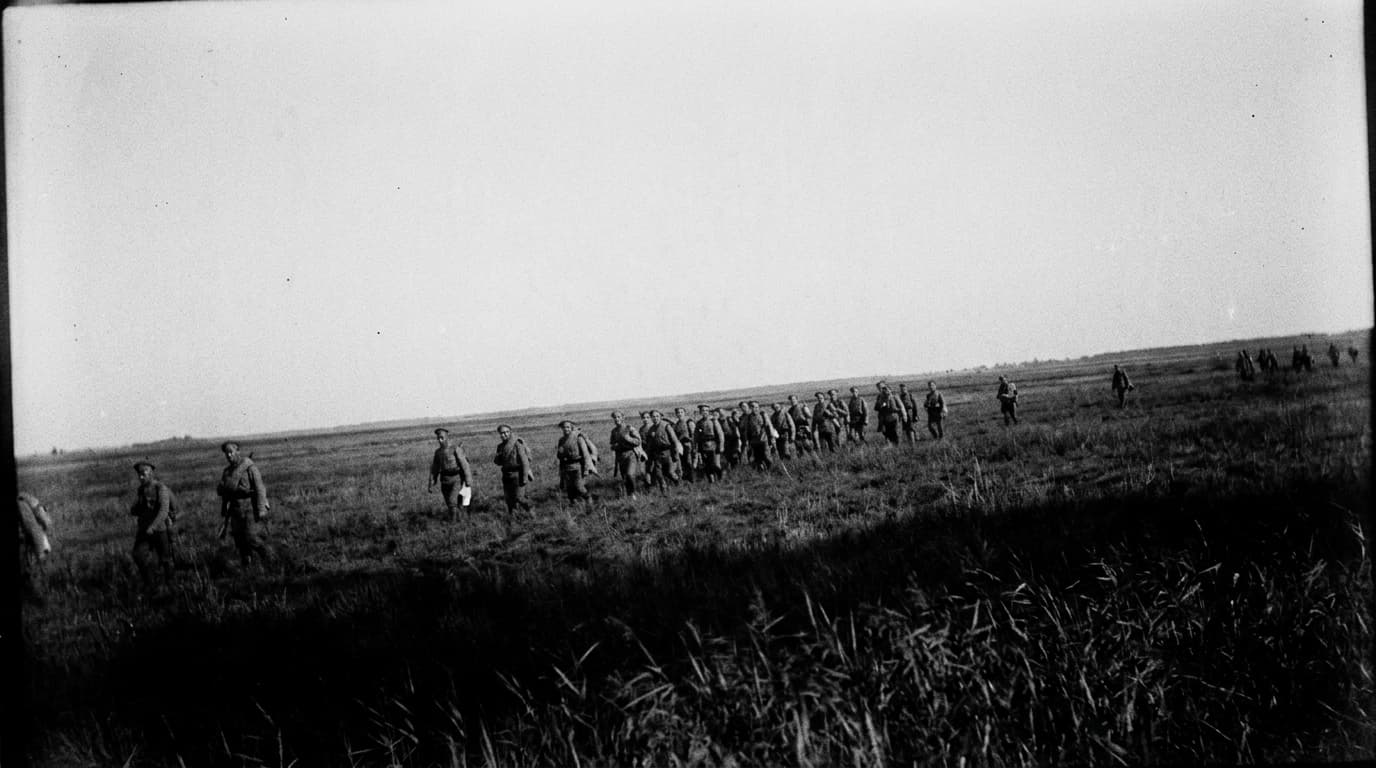

The battle was over before Hindenburg arrived. That's not quite true — but it's close enough to be damning. Max Hoffmann, the 8th Army's deputy chief of staff and the man who actually drafted the operational orders, reportedly told visitors touring the battlefield in later years that he would point to a particular spot and note, with theatrical discretion, that this was where Field Marshal von Hindenburg slept before the battle, after the battle — and, between you and me, during the battle also. The anecdote is probably embellished. It is also probably true in the ways that matter.
Tannenberg in August 1914 became one of the foundational myths of German military culture: the encirclement battle, the Kesselschlacht, executed against a numerically superior enemy in the opening weeks of the war. Hindenburg and Ludendorff were made. The German army spent the next three decades trying to replicate the result. What the myth obscured — and what the historical record makes plain — is that Russia handed Germany that victory before a single encirclement order was issued.
The Russians Broadcast Their Own Destruction
The operational situation in East Prussia in late August 1914 was genuinely difficult for Germany. The 8th Army faced two Russian armies — Rennenkampf's First Army to the north and Samsonov's Second Army pushing up from the south — and the initial instinct of the German command was to retreat. What changed the calculation was intelligence, and the intelligence was extraordinary: Russian commanders were transmitting operational orders by radio in the clear, without encryption. The Germans intercepted them and read them in real time.
This is the operational ground truth beneath the Tannenberg legend. The German command didn't outthink the Russians — they read the Russians. They knew Samsonov's axis of advance, his supply situation, the gap between his corps, and the fact that Rennenkampf's army was not moving to support him. The encirclement that followed was tactically bold, but it was executed against an enemy whose intentions were an open book.
Why were the Russians transmitting in the clear? The explanations vary — insufficient cipher equipment, inadequate training, the pressure of a fast-moving campaign that outran staff procedures — but the underlying cause was institutional. The Russian army in 1914 had not built the communications discipline that modern warfare required. The failure wasn't Samsonov's alone. It ran through the entire command structure.
What the Myth Erased
The German army drew the wrong lesson, and drew it immediately. Tannenberg became proof of concept for the encirclement battle as a war-winning instrument — the idea that superior operational art could destroy an enemy force through maneuver rather than attrition. Hindenburg and Ludendorff became the men who had done it. The actual enabling condition — that Germany had possessed near-perfect intelligence of enemy intentions — was not the lesson anyone wanted to learn, because it wasn't replicable by doctrine.
The name itself was a piece of myth-making. The battle was not fought at Tannenberg — the village of that name was some miles from the actual fighting. It was renamed retroactively, a deliberate echo of a medieval battle at the same location where Teutonic Knights had been defeated by Polish and Lithuanian forces in 1410. The German high command understood that battles acquire meaning through naming. They were building a legend in real time.
What the legend required was a story about German operational genius. What it couldn't accommodate was a story about Russian institutional collapse — because that version of events made the victory contingent, lucky, unrepeatable. The Kesselschlacht as doctrine needed Tannenberg to be about what Germany did right, not about what Russia did catastrophically wrong.
The Ledger Entry That Kept Compounding
The myth had a long half-life. The encirclement ideal shaped German operational planning through 1940 and beyond — and in France in 1940, against an enemy whose command culture was also failing in real time, it worked again. The Wehrmacht's planners could be forgiven for concluding that the doctrine was sound.
The Eastern Front after 1941 provided the correction. The conditions that made Tannenberg possible — an enemy broadcasting its intentions, corps-level gaps that could be exploited before they closed, a supporting army that didn't move — were not structural features of Russian military incompetence. They were the specific, contingent failures of one campaign in one month of one war. The Russian army that fought at Kursk in 1943 was not the army that marched into East Prussia in 1914.
Tannenberg's real lesson was always about the cost of institutional dysfunction — and it belonged to both sides. Russia paid it in August 1914. Germany paid it across the following three decades, having mistaken a gift for a proof.