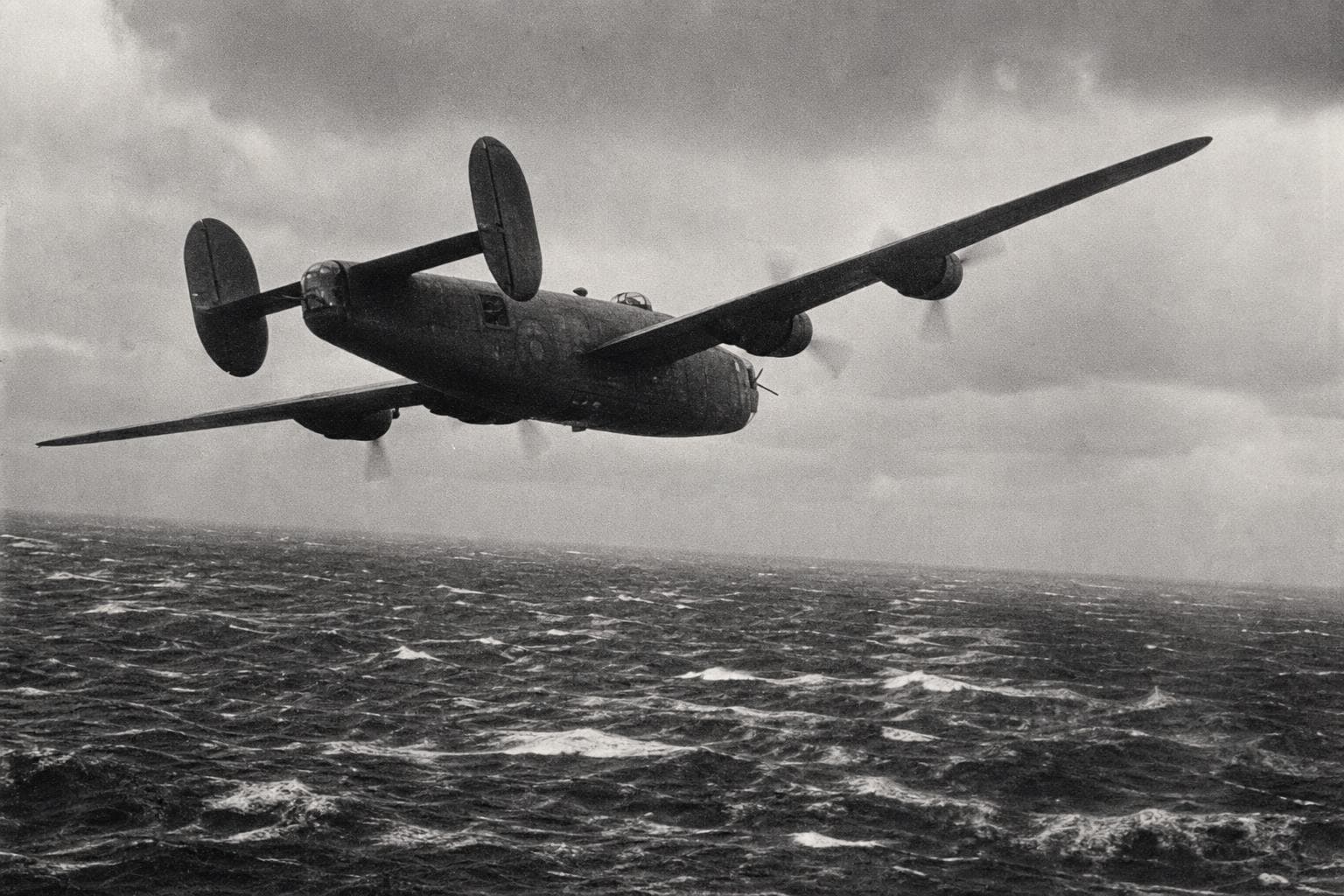

By the spring of 1943, the Battle of the Atlantic had been running for nearly four years. The U-boat campaign had come closer than almost any other Axis operation to breaking Britain — not through a single decisive engagement, but through the slow arithmetic of tonnage. According to Britannica, the battle peaked in late 1942 and early 1943, when German submarines were sinking Allied merchant shipping faster than it could be replaced. The question historians still argue about is why it took so long to close the gap — and the answer is less flattering to Allied command than the standard narrative suggests.
Dönitz Had a Theory. He Never Got the Resources to Test It Properly.
Karl Dönitz's wolfpack doctrine rested on a specific numerical premise. As the 7th U-boat Flotilla's history records, Dönitz famously argued that three hundred Type VII submarines could force Britain to surrender. When war broke out in September 1939, Germany had fifty-six submarines total — and twenty-four of those were small Type II coastal boats, unsuitable for sustained Atlantic operations. The ocean-going Type VIIs that his wolfpack concept required were still in short supply.
This matters for how we read the early years of the campaign. The U-boat threat that nearly strangled Britain was operating at a fraction of its theoretical capacity. The German naval establishment had prioritized surface warfare — the Bismarck-class battleships and heavy cruisers — over submarine construction. Dönitz got his doctrine into the war; he never got the fleet he said he needed to execute it. That the campaign came as close as it did to succeeding is a measure of how badly the Allies initially responded, not of how well the Germans were resourced.
The Gap Was a Bureaucratic Failure Before It Was a Military One
The "Black Pit" — the mid-Atlantic stretch beyond the reach of land-based aircraft — is usually described as a geographical problem that technology eventually solved. The actual history is more damning. RAF Coastal Command had been assigned anti-submarine warfare responsibility when it was created in 1936. It was equipped with short-ranged, often obsolete aircraft. The Anson was obsolete by the start of the war. The Vildebeest was obsolete. At one point, the shortage of suitable aircraft was so severe that "scarecrow patrols" using Tiger Moths were employed — aircraft that could do nothing to a submarine except observe it.
The aircraft that could have closed the gap existed. The Very Long Range Liberator — the VLR — had the range and payload for sustained Atlantic ASW patrols. The problem was priority. Bomber Command had first claim on the best long-ranged aircraft; Coastal Command received cast-offs only as Bomber Command converted to four-engined types. The Lancaster, which could carry the standard depth charge, entered service in early 1942 and was, as the historical record puts it, "Bomber Command's crown jewel and jealously guarded." Coastal Command got Wellingtons and Sunderlands — adequate, but not enough of them.
The VLR Liberators that did reach Coastal Command proved their value immediately. When they were overhead, convoy losses dropped. Source records show that 120 Squadron VLRs sank U-597 on 12 October 1942 while protecting Convoy ON 136, and four days later, VLRs guided by shipborne high-frequency direction finding drove off three shadowing U-boats from Convoy SC 104. The technology worked. The question was always how many aircraft were allocated to the problem — and that was a decision made in Whitehall, not the North Atlantic.
The Intelligence War Complicated Everything It Was Supposed to Simplify
The Enigma codebreaking operation at Bletchley Park is the part of this story that gets the most popular attention, and it genuinely mattered. The Bombe — the electromechanical device built on Polish mathematical foundations and developed by Alan Turing's team — gave Allied convoy routing officers the ability to read German submarine signals traffic, sometimes within hours of transmission. When it worked, convoys could be steered around wolfpack patrol lines.
But the intelligence picture was never stable. The German Navy took greater care with its Enigma procedures than other Wehrmacht branches, and there were extended periods when Bletchley could not read Kriegsmarine traffic at all. During those blackout periods, VLR aircraft became the primary defensive tool — which is precisely why the resource allocation argument matters. The two systems were complements, not substitutes. When Ultra went dark, aircraft had to compensate. When aircraft were unavailable, convoys had to rely on routing intelligence that might itself be interrupted.
The standard narrative frames the Battle of the Atlantic as a technological race that the Allies eventually won through superior innovation. The operational record suggests something less tidy: a campaign where the tools to reduce losses existed earlier than they were deployed, where bureaucratic priority disputes kept effective aircraft away from the theater that needed them most, and where the intelligence breakthrough that gets the most credit was itself intermittent and dependent on the very physical assets that kept getting deprioritized.
The gap closed in May 1943. It could have closed sooner. That's not hindsight — it was the argument Coastal Command was making throughout 1942.


