


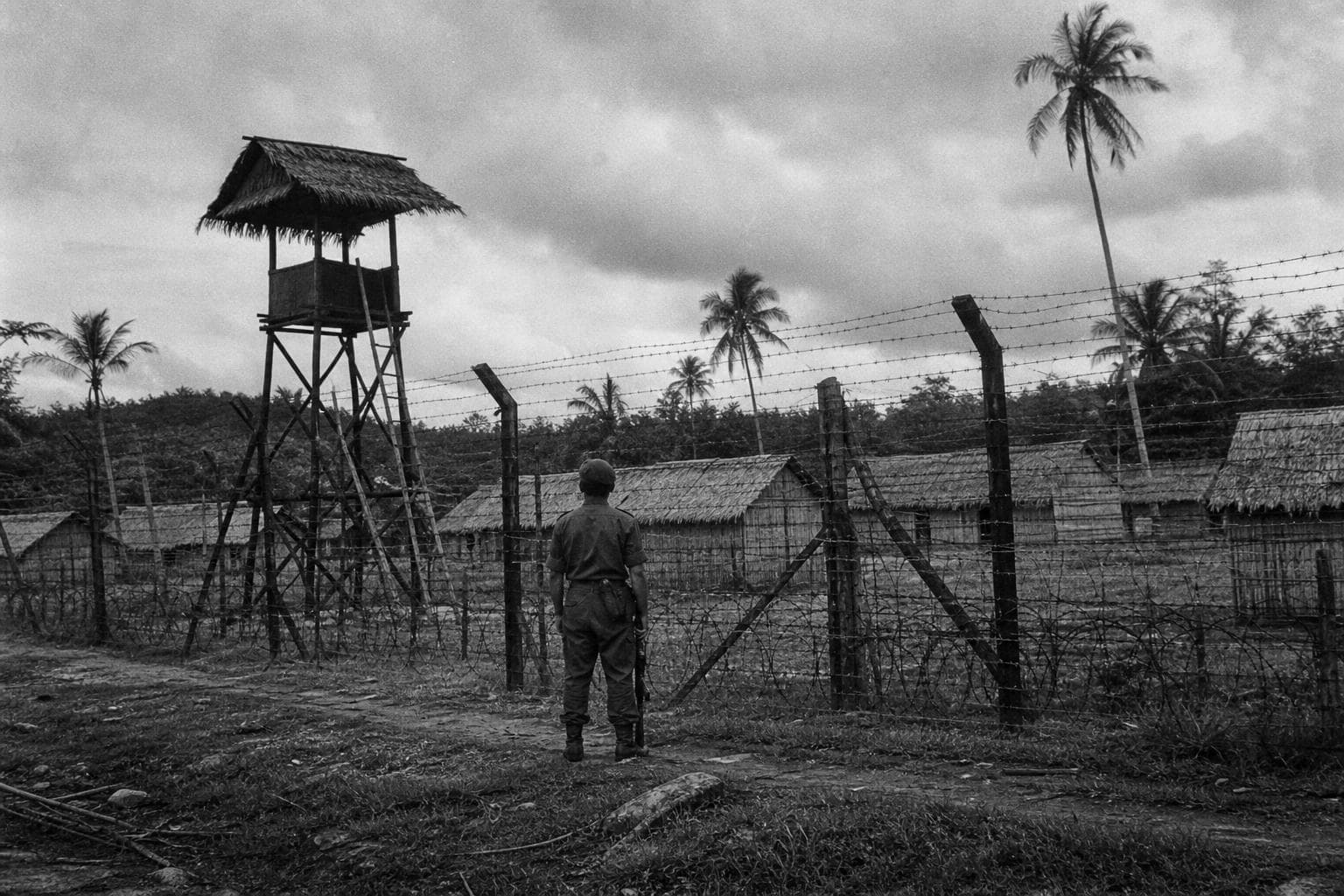

The standard telling goes like this: the British faced a communist insurgency in Malaya, applied a sophisticated blend of military pressure and political reform, won the population over, and handed the country to an independent government in 1960. A template for counterinsurgency. The model other powers should have followed in Vietnam, in Algeria, in Iraq.
The template is real. The sanitization is doing a lot of work.
What the British Actually Did
The Communist Party of Malaya launched its insurgency in 1948, and the colonial government declared a state of emergency that June. The CPM was composed largely of ethnic Chinese — many of them veterans of the wartime MPAJA resistance that had fought the Japanese occupation — and drew its rural support base from the same community. The British response, once it moved beyond ineffective sweep operations, targeted that support base directly.
The centerpiece was forced relocation. Hundreds of thousands of rural Chinese were moved into fortified "New Villages" — settlements ringed with wire, subject to curfew, with food supplies controlled and monitored. The logic was clean: deny the insurgents food, intelligence, and recruits by physically separating them from the population. Britannica's account of the Emergency describes these relocations as "unpopular" and designed to deny rebels "a source of food and manpower." That's accurate as far as it goes.
What it doesn't capture is the coercive architecture underneath. The New Villages weren't communities that chose to cooperate with the government. They were populations that had been moved, confined, and made dependent on colonial administration for basic subsistence. Cooperation, under those conditions, is a complicated word.
The Templer Myth and What It Obscures
High Commissioner Gerald Templer arrived in 1952 and became the face of the campaign's success — the administrator who combined military pressure with political concession, who accelerated the path to Malayan independence, who understood that you couldn't shoot your way to victory. The "hearts and minds" phrase is often attributed to him, though the attribution is contested.
Templer did shift the campaign's emphasis. Political reforms accelerated. The promise of independence gave the Malay political establishment a stake in defeating the insurgency. The CPM's ethnic composition — predominantly Chinese in a Malay-majority country — meant it could never build a genuinely national coalition. These are real factors.
But the Templer narrative tends to crowd out the coercive infrastructure that preceded him and continued under him. The New Villages were already built. The Emergency Regulations — which allowed detention without trial, collective punishment, and deportation — remained in force. The political reforms were genuine, but they operated on top of a security apparatus that had already broken the insurgency's rural logistics through mass displacement. Attributing the outcome primarily to winning hearts and minds is a retrospective reframing that the operational record doesn't fully support.
The Ethnic Fault Line Nobody Wants to Discuss
The Emergency's resolution also depended on something counterinsurgency doctrine rarely acknowledges: the insurgency was ethnically isolated. The CPM's Chinese composition meant the Malay population — and crucially, the Malay political elite — had no particular reason to support it and strong reasons to oppose it. The British could credibly offer Malay leaders a path to independence that preserved their political position. That offer had no Chinese equivalent.
The figure of Leong Boon Swee — a Chinese police officer who fought the Japanese with the MPAJA and later served the colonial administration — illustrates the complexity the clean narrative erases. His story, recounted in the New Straits Times, shows that the wartime resistance and the postwar insurgency drew from the same community, the same networks, the same grievances about colonial treatment. The British won, in part, by successfully framing a Chinese communist insurgency as alien to a Malay national project — a framing that served British interests and Malay elite interests simultaneously, and that left the Chinese community's political position unresolved for decades.
What the Template Actually Transfers
The Malayan Emergency gets cited constantly in counterinsurgency literature because it's one of the few cases where the colonial power didn't simply lose. That's a low bar dressed up as a model.
The conditions that made it work — an ethnically isolated insurgency, a colonial administration with genuine leverage over independence timing, a rural population that could be physically relocated and controlled, a terrain that limited external resupply — don't transfer cleanly. Vietnam's planners noticed the New Villages and built Strategic Hamlets. The program failed, for reasons that had everything to do with the differences and nothing to do with the similarities.
The harder question isn't whether Malaya worked. It's whether "worked" means what the doctrine manuals say it means — or whether it means the British left on acceptable terms while the deeper contradictions got handed to someone else.