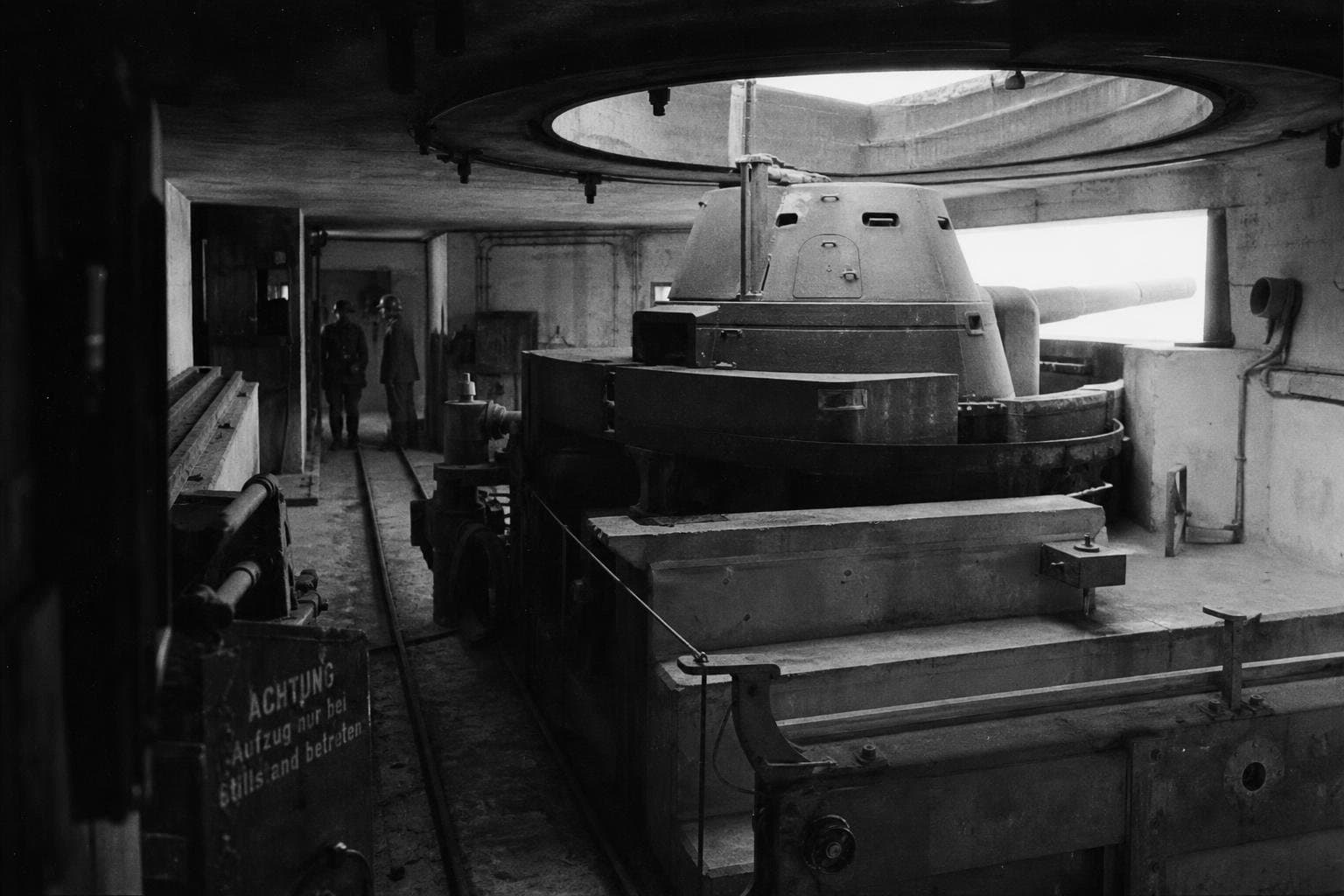

The French army that faced Germany in May 1940 was not, by most measurable standards, an inferior force. Nader Elhefnawy's reassessment of the campaign makes the point plainly: the Western Allies were "hardly at a disadvantage in either numbers or quality of equipment" when the battle began. France had roughly as many tanks as Germany, and in several categories more powerful ones. Its standing army of 800,000 was considered at the time to be the most powerful in Europe. The Maginot Line itself was an engineering marvel — retractable turrets, underground railways, electrical networks, life-support systems capable of sustaining a four-week isolation, interlocking fields of fire across a fortified depth that genuinely dazzled military observers.
Six weeks later, France signed an armistice in a railway car at Compiègne — the same car, at the same location, that Germany had used to surrender in 1918. Hitler had chosen the site deliberately. The symbolism was not subtle.
The standard explanation for what happened between those two data points is "blitzkrieg." German armor moved fast, French command moved slow, and the rest is history. That explanation is not wrong, exactly. But it obscures the more interesting and more damning story: that the French command system failed not despite its strategic logic but because of it. The Maginot Line performed almost exactly as designed. The plan for the mobile battle north of it was coherent on paper. What collapsed was the institutional capacity to process information that contradicted both.
The Maginot Line Was a Political-Military Bet, Not a Blunder
Before assigning stupidity to the men who built it, it's worth reconstructing what they thought they were doing — and why the reasoning was not unreasonable given what they knew.
France in the 1920s faced a demographic and industrial problem it could not solve by willpower. The First World War had killed roughly 1.4 million French soldiers and wounded millions more. The birth rate had been declining for decades. Germany, even a defeated and disarmed Germany, had a larger population and a larger industrial base. French planners understood that in a straight attritional contest, France would eventually lose. The Maginot Line was their answer: a force multiplier that could replace mass manpower with hardened protection, freeing mobile reserves for offensive action elsewhere while the eastern frontier held itself.
The historical context matters here too. France's relationship with Germany had been defined by a century of border disputes, the humiliation of 1870–71, the loss of Alsace-Lorraine, and the trauma of 1914–18. The Ruhr occupation of 1923 had deepened German resentment without solving French security. The Line was built in that context — not by men who couldn't imagine mobile warfare, but by men who had watched static warfare kill a generation and were trying to make sure it killed fewer Frenchmen next time.
The Line also worked, in the narrow sense. Army Group C under General von Leeb was kept facing the Maginot Line specifically to deter the French from pulling forces away from it. The Germans never seriously attempted to breach it. The fortifications held throughout the campaign. If the battle had gone as French planners expected — a German thrust through Belgium, met by French and British mobile forces advancing north — the Line would have anchored the southern flank of exactly the kind of defensive battle France wanted to fight.
The problem was not the Line. The problem was everything the Line's logic required the French to believe about where the Germans would attack.
The Ardennes Assumption Was Not Irrational — Until It Was
French war planning assigned 41 divisions to man or back the Maginot Line, while only 39 divisions watched the longer stretch of frontier from Montmédy through the Ardennes and across Flanders to the Channel. The disproportion reflects a genuine strategic judgment: the Ardennes, a heavily forested and hilly region on the Franco-Belgian border, was considered by French planners to be largely impassable for a major armored thrust. The terrain was difficult. The roads were few and narrow. Moving a large mechanized force through it would take time, and time meant vulnerability to air attack and artillery.
This was not an absurd assessment. French planning under General Maurice Gamelin anticipated the main German effort through Belgium — the historical invasion route — and designed the Dyle Plan accordingly, advancing Allied forces into Belgium to meet it. The plan had a certain logic: hold the Maginot Line in the south, advance to the Dyle River in the north, and fight the decisive battle on Belgian soil rather than French.
What Gamelin's plan could not accommodate was the possibility that the Germans had identified the Ardennes sector as precisely the hinge point of the Allied deployment — the place where the mobile forces advancing into Belgium would be most exposed on their southern flank. The German operational plan, Fall Gelb in its final form, drove Rundstedt's Army Group A through the Ardennes toward Sedan, aiming to cut behind the Allied forces advancing north. It was a high-risk gamble. The German armored columns were vulnerable during the crossing. If the French had detected the movement early and responded with armor, the outcome might have been different.
They didn't. And the reasons why illuminate the deeper failure.
The Command System That Couldn't Process Bad News
I've written before about how the French army lost to a command system that couldn't process bad news, and the Fall of France is the clearest case study in that pathology. The intelligence picture in May 1940 was not blank. German armor moving through the Ardennes generated reports. The problem was what happened to those reports once they entered the French command apparatus.
French doctrine emphasized methodical battle — careful coordination, deliberate planning, centralized decision-making. This was not incompetence; it was a considered response to the chaos of 1914–18, when improvised attacks had produced catastrophic casualties. But methodical battle required time, and time was exactly what the German operational tempo was designed to deny. German radio communication allowed commanders to redirect forces instantly as battles unfolded, exploiting gaps before French headquarters could even confirm they existed.
The result was a command system that was structurally incapable of responding to the speed of events. By the time a report of German armor at Sedan had traveled up the French chain of command, been assessed, and generated orders, the situation it described had already changed. Counterattacks were ordered against positions the Germans had already vacated, or against flanks that had already been turned. The French were, in a precise operational sense, always fighting the last hour's battle.
Elhefnawy's reading of William Shirer's account frames this as part of a larger pattern of overdetermined disaster — diplomatic failures, strategic miscalculations, and military rigidity compounding each other. That framing is correct, but it risks making the collapse seem inevitable in a way that obscures individual decision points where different choices were available. The Ardennes sector was thinly held not because French planners were blind to the possibility of an attack there, but because they had assessed the probability as low and the terrain as prohibitive. That assessment was wrong. The question is whether it was unreasonably wrong given what was knowable in 1940 — and the honest answer is: it was a defensible judgment that the Germans had specifically designed their plan to exploit.
What the Armistice Actually Revealed
The armistice signed on June 22, 1940 established a German occupation zone covering roughly three-fifths of France's European territory, including all Channel and Atlantic ports. The Third Republic voted itself out of existence on July 10, with 569 votes to 80 authorizing Pétain to draft a new constitution. General de Gaulle had already flown to London and issued his appeal on June 18, but few heard it in those first weeks. Most of the nation looked to Pétain.
The speed of the political collapse matched the speed of the military one, and for related reasons. The French state, like the French army, had been organized around assumptions that the campaign had shattered in six weeks. When those assumptions failed, neither institution had the adaptive capacity to generate a new framework fast enough. The army's methodical doctrine had no contingency for a battle moving faster than its command cycle. The republic's political culture had no contingency for a defeat this total, this fast.
What the Maginot Line's failure actually teaches — and the lib.ink analysis of static defense strategy makes this point carefully — is not that fixed defenses are inherently foolish. It's that any fixed defense creates a corresponding rigidity in the thinking of the people who rely on it. The Line required the French to believe certain things about where the Germans would attack. Those beliefs shaped force dispositions, planning assumptions, and command culture. When the Germans attacked somewhere else, the Line didn't fail — the thinking that had grown up around it did.
The deeper lesson is about institutional adaptation under pressure. The French army of 1940 was not filled with cowards or fools. It was filled with men whose training, doctrine, and command structure had been optimized for a war that didn't happen. When the actual war arrived, moving faster than their decision cycle and through terrain their planning had discounted, the system couldn't adapt quickly enough to matter.
That's a failure mode that doesn't require stupidity. It requires only the very human tendency to prepare brilliantly for the last war — and to build institutions so thoroughly around those preparations that they can't recognize the next one until it's already won.


