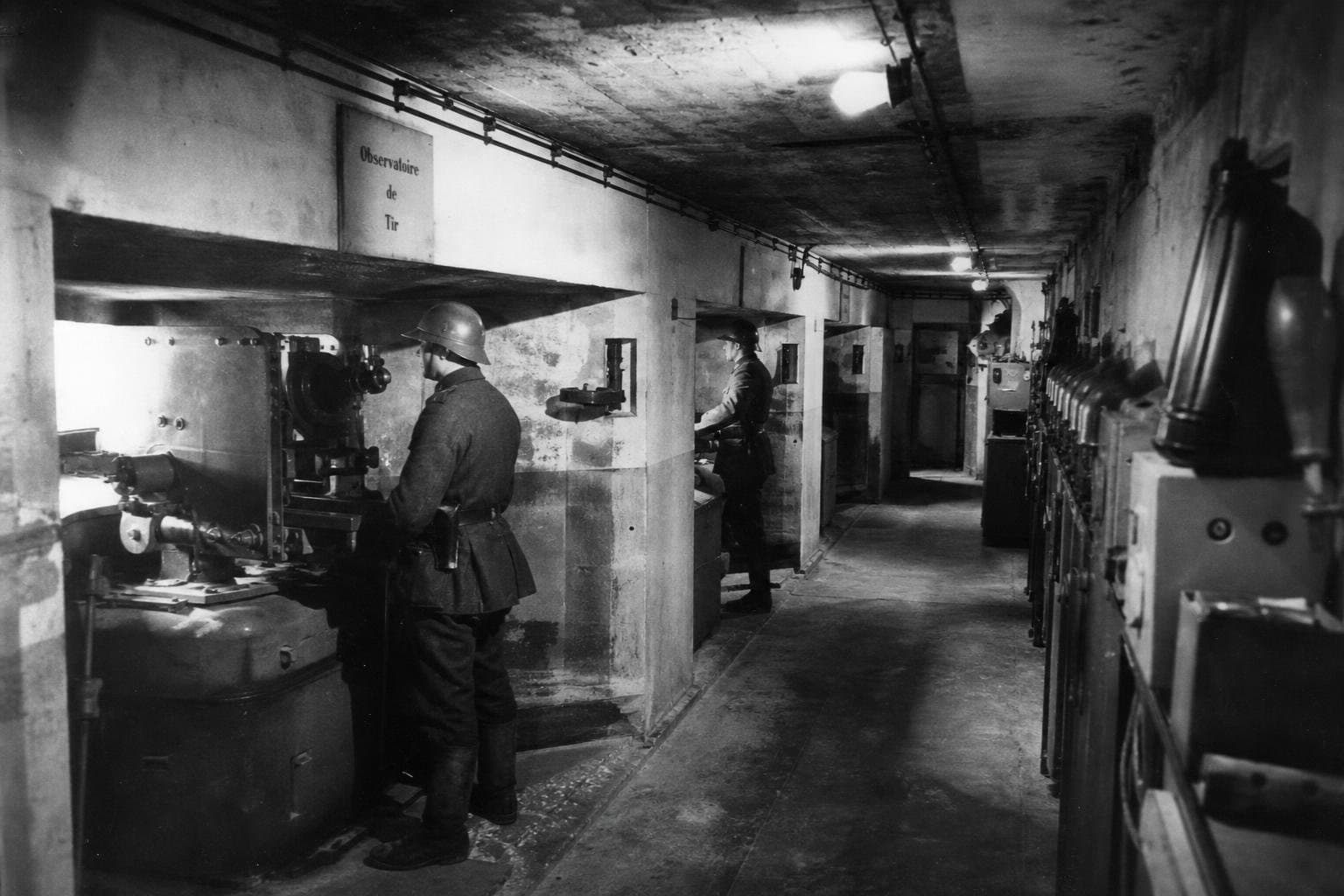

I've covered this ground before. In August's piece on the Maginot Line, I argued that the fortifications themselves performed as designed — the problem was the strategic theory built around them. The assigned topic frames this as a story about blitzkrieg doctrine and command paralysis, which is the popular version. It's not wrong, exactly. But it flattens what was actually a more interesting failure: the French didn't lose because German armor was unstoppable. They lost because French planners had constructed an entire operational worldview that made the German breakthrough at Sedan not just possible but structurally predictable — and then couldn't process the information fast enough to recover when it happened.
This piece goes deeper into the mechanism. The Maginot Line is the entry point, but the real subject is how institutional assumptions calcify into doctrine, and how doctrine shapes what commanders can even perceive.
The Line Was a Political Settlement Wearing Military Clothing
The Maginot Line's origins are inseparable from French domestic politics after 1918. History is Now traces the strategic logic back through the Franco-Prussian War of 1870–71, when a defeated France surrendered Alsace and much of Lorraine to the new German Empire. The humiliation produced a generational revanchism that shaped French security thinking for the next seven decades. When the First World War ended with Germany defeated but not destroyed — its industrial base intact, its population larger than France's — French planners faced a structural problem they couldn't solve through offensive means alone.
The Maginot Line, as History is Now describes it, was France's answer: a decade of construction and billions of francs invested in a fortified belt along the German frontier, designed to channel any future German attack away from the industrial northeast and into Belgium, where it could be met by mobile Allied forces. This was not irrational. The logic was coherent given French demographic and economic constraints after 1918. A defensive anchor on the German border freed French forces to maneuver. The problem wasn't the fortifications. The problem was what the fortifications did to French strategic thinking over the decade they were being built.
When you spend ten years and enormous national treasure on a fixed defensive system, you don't just build concrete. You build an institutional commitment. The Line became the organizing principle of French military planning — the fixed point around which everything else rotated. By 1940, it was nearly impossible for French commanders to think about the German frontier without the Line as the conceptual anchor. That's not a character flaw. It's how institutions work. The Line was real, it was expensive, and it was there. Of course it shaped the plan.
The Ardennes Assumption Was the Load-Bearing Error
The French plan for 1940 — the Dyle Plan, which sent the best Allied mobile forces north into Belgium to meet the anticipated German main effort — was not stupid. It was a reasonable response to the intelligence picture as French commanders understood it. The Germans had invaded through Belgium in 1914. The Maginot Line covered the Franco-German frontier. The Ardennes, the forested hill country between Luxembourg and the Meuse River, was assessed as an obstacle too difficult for armored forces to traverse in strength.
That assessment was the catastrophic error, and it's worth being precise about what kind of error it was. It wasn't ignorance — French planners knew the Ardennes existed. It was a failure of imagination about what armored forces could do in difficult terrain, combined with an institutional incentive to believe the assessment. If the Ardennes was passable, the entire strategic architecture of the Maginot Line and the Dyle Plan collapsed. The Line covered the wrong frontier. The mobile reserve was in the wrong place. The whole edifice required the Ardennes to be impassable, so it was assessed as impassable.
Britannica's account of the Battle of France identifies Erich von Manstein as the architect of the German plan that exploited exactly this assumption — the armored thrust through the Ardennes that French planners had discounted. The German operation that began on May 10, 1940 drove Army Group B into Belgium and the Netherlands, pulling Allied mobile forces north exactly as the Dyle Plan prescribed, while the main armored effort came through the Ardennes in the center. The French weren't surprised by the attack on Belgium. They were surprised by where the weight actually was.
Command Paralysis Was a Symptom, Not the Disease
The popular narrative emphasizes French command paralysis — the famous OODA loop argument, that German commanders cycled through decisions faster than French headquarters could process information and respond. There's truth in this. Britannica's broader World War II account describes the German armored breakthrough and the subsequent race to the Channel that cut Allied forces in two. The speed of the German advance was genuinely disorienting to French commanders operating on a slower decision cycle.
But "command paralysis" as an explanation is too convenient. It locates the failure in individual commanders — in their psychology, their age, their rigidity — rather than in the system that produced them. French generals in 1940 were not uniquely incompetent. They were products of a command culture that had been shaped by the same institutional assumptions as the Maginot Line strategy. A command system built around a fixed defensive anchor, with planning horizons measured in days rather than hours, was not designed to process a fluid armored breakthrough. The paralysis wasn't personal failure. It was the system performing exactly as it had been designed — for a war that wasn't happening.
There's a useful comparison here with what I wrote about the French army's command culture in the June piece on 1940. The French system filtered bad news upward slowly and incompletely. Reports of the Ardennes breakthrough arrived at higher headquarters fragmented and delayed. By the time the picture was clear enough for senior commanders to act, the German armored columns were already across the Meuse. The information processing failure wasn't a bug in the French command system — it was a feature, designed to prevent panic and maintain centralized control. In a slow-moving attritional war, those properties are assets. Against a fast-moving armored penetration, they were fatal.
What "Blitzkrieg" Actually Was — and Wasn't
The word "blitzkrieg" deserves some skepticism here. It's become a catch-all explanation that obscures more than it reveals. German armor in 1940 was not uniformly superior to Allied armor. The French had tanks that were, by various measures, technically competitive. The German advantage was doctrinal and organizational — the integration of armor, motorized infantry, artillery, and air support into combined-arms formations that could exploit breakthroughs faster than defenders could respond.
But it's worth noting, as historians have increasingly argued, that "blitzkrieg" as a coherent pre-planned doctrine is partly a retrospective construction. The Polish campaign of September 1939 — which Germany executed with roughly 3,000 tanks across two army groups — is often cited as the proving ground for the doctrine. The historical debate, as that source notes, is whether the Polish campaign actually displayed anything doctrinally new, or whether it was a conventional campaign that succeeded for more conventional reasons: overwhelming force, strategic surprise, and the Soviet invasion from the east on September 17. The field has moved away from treating Poland as the debut of a finished doctrine.
What this means for France is important. The German commanders who drove through the Ardennes were not executing a perfected system. They were improvising within a framework that rewarded initiative and accepted risk at the operational level. Heinz Guderian, whose panzer corps led the Meuse crossing, pushed forward against orders that told him to halt and consolidate. The German success depended partly on commanders who were willing to exceed their instructions when opportunity appeared. The French system, by contrast, was designed to prevent exactly that kind of unauthorized initiative. One system was calibrated for exploitation; the other for control.
The Lesson That Keeps Getting Misread
The standard lesson drawn from 1940 is about technology and speed — that modern warfare requires faster decision cycles and more flexible doctrine. That lesson is real, but it's incomplete. The deeper lesson is about the relationship between strategic assumptions and institutional design.
France in 1940 had a strategy. It had a plan. The plan was coherent given the assumptions built into it. The catastrophe came not from the absence of planning but from the way the planning process had locked in a set of assumptions that couldn't be revised when reality contradicted them. The Ardennes was impassable because it had to be impassable. The German main effort was in Belgium because that's where the French plan required it to be. When the evidence said otherwise, the system couldn't integrate it fast enough to matter.
History is Now frames the Maginot Line as a byword for "preparing brilliantly for the wrong war." That's accurate as far as it goes. But the more precise formulation is this: the Maginot Line was the physical expression of a strategic theory, and the theory was self-sealing. Every element of French planning in the 1930s reinforced the assumption that the Line was the anchor and Belgium was the decisive theater. There was no institutional mechanism for questioning that assumption, because questioning it would have required dismantling the entire planning edifice — and the Line itself, already built, already paid for, already the organizing principle of French defense policy.
That's the pattern worth watching for. Not the specific tactical failures of May 1940, but the way large institutional investments — in doctrine, in infrastructure, in strategic theory — create their own gravitational field. Commanders don't ignore inconvenient intelligence because they're stupid. They ignore it because the system they operate within has already decided what the war looks like. The Maginot Line didn't fail France. France built a system that couldn't survive contact with a war it hadn't planned for — and then called the fortifications the problem.
The distinction matters every time a military institution looks at a fixed investment and asks whether the strategy built around it still makes sense.


