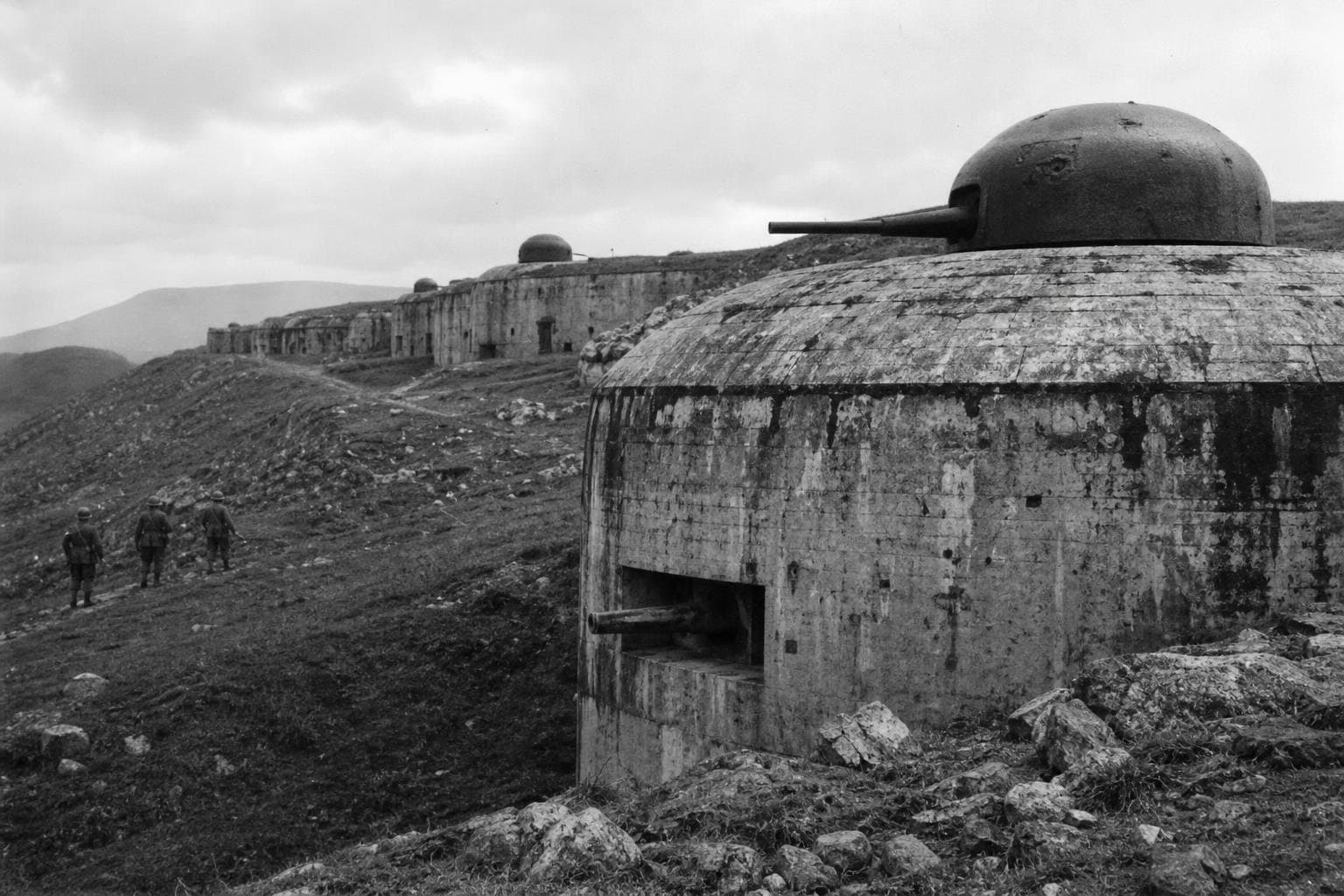

The Maginot Line held. Every fortification it defended, it defended. Not a single German soldier broke through its concrete and steel in May 1940. The French had built exactly what they intended to build, and it performed exactly as designed. That fact sits at the center of one of the most persistent misreadings in 20th-century military history: the idea that France fell because its generals put their faith in a fixed defensive line that German armor simply bypassed or overwhelmed.
The line wasn't the problem. The strategy that treated the line as a substitute for operational flexibility was. And the German plan that exploited that strategy wasn't a triumph of blitzkrieg doctrine so much as a precise surgical strike against a single catastrophic vulnerability — one that French planners had, in a sense, created themselves.
This is worth revisiting carefully, because the popular version of the story — Germany's unstoppable armored spearheads shattering a static French defense — obscures the actual decision-making on both sides and makes the outcome look more inevitable than it was.
The French Weren't Stupid — They Were Solving the Wrong Problem
Start with what French planners actually knew and believed in the spring of 1940. They had fought the last war on French soil, at catastrophic cost. The imperative to keep the next war off French territory, or at minimum to bleed the attacker before he reached the industrial heartland, was not irrational — it was the dominant lesson of 1914–18. The Maginot Line was the institutional answer to that lesson: fortify the Franco-German border so thoroughly that any German attack there becomes prohibitively expensive, then concentrate mobile forces in the north to handle the expected thrust through Belgium.
As I argued in the earlier piece on the French command system, the deeper failure wasn't tactical but organizational — a headquarters culture that couldn't process bad news fast enough to respond. But the strategic setup deserves its own examination, because the command failure had a structural precondition: French forces were deployed in a configuration that left almost no margin for error.
According to Britannica's account of the campaign, the Allied position in May 1940 was not obviously weak on paper. Between the Dutch and Belgian armies, the British Expeditionary Force, and the French armies along the northern frontier, the Allies could field roughly 750,000 troops as potential reinforcements for the Low Countries, backed by a considerable air presence. German military strength amounted to some 3.5 million men, more than 5,500 aircraft, and 10 panzer divisions. The Allies could field a comparable number of tanks — the disparity wasn't primarily numerical.
The disparity was architectural. As the Britannica account of the Low Countries invasion details, while the Allies could match German tank numbers, they were distributed differently — spread across infantry divisions rather than concentrated into armored formations capable of independent operational action. That distinction mattered enormously when the German plan became clear.
The Ardennes Assumption Was Reasonable — Until It Wasn't
The French assessment that the Ardennes was impassable for a major armored thrust was not a fantasy. The terrain is genuinely difficult: dense forest, narrow roads, steep river valleys. Military planners in 1940 were working from the same maps and the same engineering assumptions that had governed European warfare for decades. The Ardennes had not been a major axis of advance in 1914. French cavalry reconnaissance had probed the area and reported it unsuitable for large armored formations.
The Substack analysis by Michael Magoon at From Poverty to Progress makes the crucial structural point: France's defeat resulted from a strategy that appeared reasonable piece by piece but contained a fatal vulnerability when implemented. The French army was strong in the wrong places, weak in the decisive one, and — critically — lacked the flexibility to recover once its assumptions proved wrong.
That last clause is where the real failure lives. Assumptions get broken in war. The question is whether a command system can absorb the shock and adapt. The French system, as it turned out, could not.
The German plan — Fall Gelb in its final form, shaped significantly by Erich von Manstein's operational concept — sent Army Group B into Belgium and the Netherlands in a move that confirmed French expectations. The Allied mobile forces, including the BEF, advanced into Belgium exactly as planned. Then Army Group A drove its armored spearheads through the Ardennes, crossed the Meuse at Sedan, and turned west toward the Channel. The best Allied armies were now north of the penetration, racing toward a front that no longer existed behind them.
The MilPub analysis of Fall Gelb identifies what it calls a "perfect storm of losers" on the Allied side: command and control too slow to respond, all fast units committed into the Belgian trap, no suitable reserves in the Sedan sector, poor training of troops in the critical area, incomplete field fortifications, and panic among French division leadership at the Sedan breakthrough. The German side had its own advantages — lessons learned from Poland, concentrated armor, and commanders willing to push further and faster than their own high command sometimes wanted.
The MilPub analysis also notes something worth sitting with: both the British and French, along with most German generals and even Hitler, expected the war in the West to be a long one, an attritional struggle. That expectation shaped Allied decisions about committing airpower — there was a tendency not to use it in mass, to hold it in reserve for the long fight ahead. The German columns crawling through the Ardennes presented a target that Allied air power, had it been committed aggressively, might have disrupted significantly. It wasn't.
Arras: The Moment the Machine Showed Its Seams
The German advance after Sedan looked, from the outside, like a machine operating without friction. It wasn't. The account of the Arras counterattack at MilitaryHistoryNow captures something important about the internal state of the German advance: Hitler was nervous, many German commanders feared their spearheads had advanced too far and too fast, and the memory of 1914 — when German armies had surged through Belgium before being halted on the Marne — weighed heavily.
The British counterattack at Arras on May 21, 1940, achieved none of its major operational objectives. It suffered heavy losses and ended in retreat. By any tactical measure, it failed. But it struck the advancing German columns at a moment of genuine uncertainty, and the shock of encountering British Matilda II heavy tanks — against which standard German anti-tank weapons were initially ineffective — introduced a hesitation into the German advance that had consequences for the Dunkirk evacuation.
The point here is not that Arras saved France — it didn't, and the strategic position was already beyond recovery. The point is that the German advance was not the frictionless juggernaut of popular memory. It was a high-risk operational gamble that succeeded in part because the Allied command system couldn't generate a coherent response fast enough to exploit the moments when the gamble looked like it might fail.
The MilitaryHistoryNow account frames Arras as a battle that "changed history" despite being a tactical defeat — it bought time, and in warfare, time can be the most valuable commodity. That framing is defensible, but it also illustrates the gap between what individual actions could accomplish and what the overall strategic situation required. Time was useful only if someone could use it. The Allied command structure, in May 1940, could not.
What "Blitzkrieg" Actually Was — and What It Wasn't
The word "blitzkrieg" has done enormous damage to historical understanding of 1940. It implies a coherent, pre-planned doctrine of lightning war — a German invention that rendered all previous military thinking obsolete. The reality is considerably messier.
German armored doctrine in 1940 was the product of years of theoretical development and practical experimentation, shaped by figures like Heinz Guderian who had pushed for the concentration of armor into independent operational formations rather than distributing tanks in infantry support roles. But "blitzkrieg" as a unified doctrine, with a name and a manual, is largely a retrospective construction. The Germans called their plan Fall Gelb. They called the operational concept Sichelschnitt — the sickle cut. What observers later labeled blitzkrieg was the observed effect of combined-arms operations conducted at a tempo the Allied command system couldn't match.
The Britannica account notes that while the Allies could field a comparable number of tanks, they were not organized or deployed to use them the way the Germans used theirs. That organizational difference — not some mystical German tactical genius — is the core of what happened. The French had tanks. They had artillery. They had, in the BEF, some of the most professional soldiers in Europe. What they didn't have was a command system capable of processing the speed of events and a deployment that left any reserve to plug the gap at Sedan.
The Magoon analysis argues that France's defeat was not inevitable, nor primarily the result of numerical or technological inferiority. That judgment is sound. The French strategy appeared reasonable when viewed piece by piece. The Maginot Line anchored the southern flank. The mobile forces in the north would handle Belgium. The Ardennes was impassable. Each assumption had a logic. Together, they created a single point of failure — and the German plan, whether by design or by the operational intuition of commanders like Manstein and Guderian, drove straight through it.
The Lesson That Keeps Getting Misread
The standard lesson drawn from 1940 is about technology and doctrine: armor beats static defense, speed beats mass, maneuver beats attrition. That lesson is not wrong, but it's incomplete in ways that matter.
The deeper lesson is about the relationship between strategic assumptions and operational flexibility. The French built a strategy that was brittle — one that worked if the enemy behaved as expected and failed catastrophically if he didn't. The Maginot Line was not the source of that brittleness; it was a symptom of it. A command culture that had decided, in advance, what the war would look like had also decided, implicitly, that it didn't need the organizational capacity to respond when the war looked different.
The German advance through the Ardennes was a high-risk gamble. It could have been disrupted by aggressive Allied air operations against the columns in the forest. It could have been blunted by reserves positioned near Sedan. It could have been contained if the Allied command system had been able to generate a coherent response in the 48 to 72 hours after the Meuse crossing. None of those things happened — not because they were impossible, but because the French strategic framework had made them structurally unlikely.
That's the real lesson of 1940, and it's one that military institutions have repeatedly failed to absorb: a strategy optimized for the expected war creates institutional blindness to the actual one. The Maginot Line held. The strategy it anchored did not.


