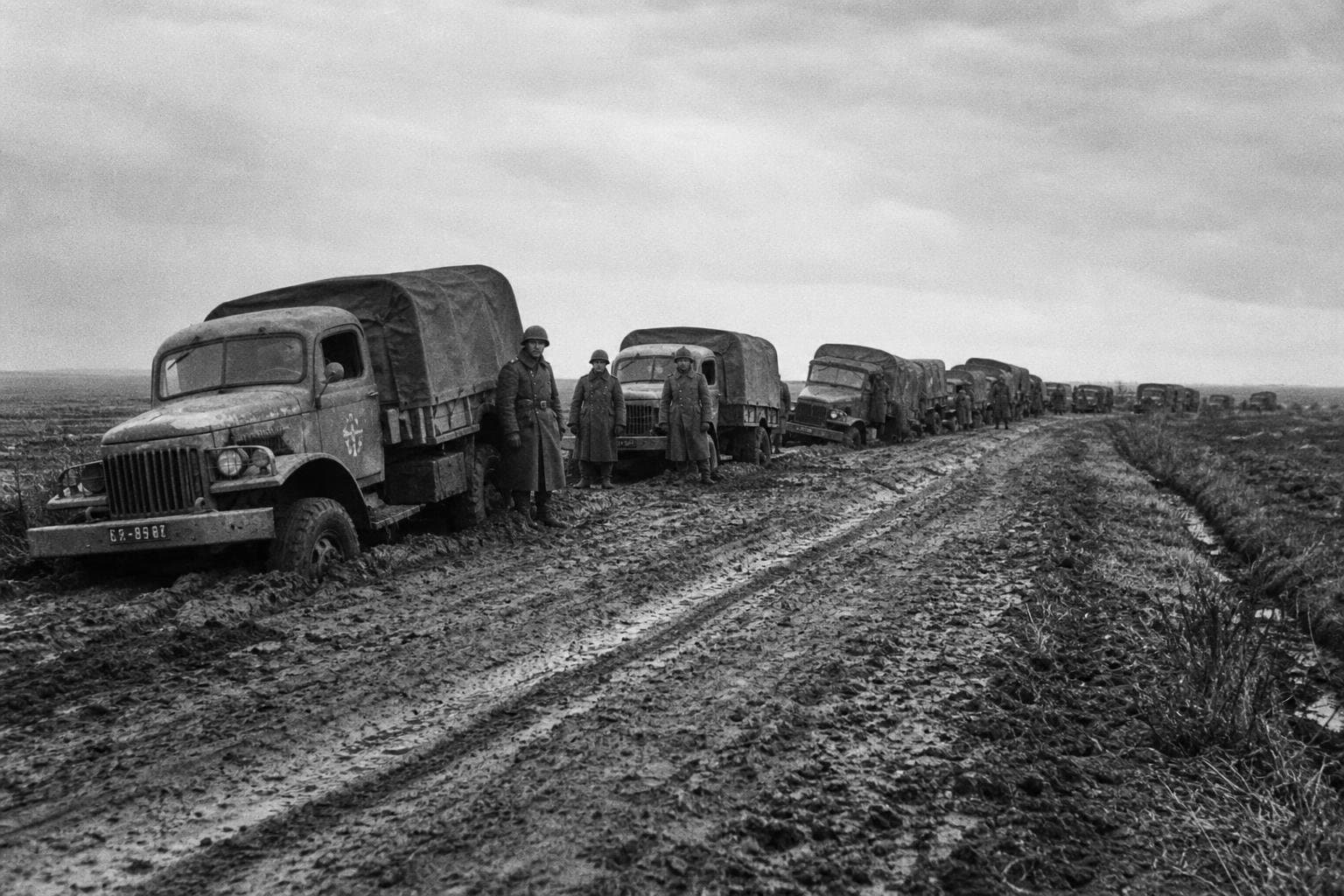

Five distinct wars. One recurring failure mode: the army that wins the opening engagement runs out of fuel, ammunition, or both before it can exploit the breakthrough. The lesson keeps getting buried under the next war's tactical novelty.
Three recent pieces of analysis — from the Modern War Institute, the U.S. Army, and the Research Institute for European and American Studies — converge on the same uncomfortable point: contemporary Western armies are structurally repeating mistakes that should have been settled doctrine by 1945.
The Pattern, Stripped Down
1. Operational reach is a logistics variable, not a maneuver variable.
The Modern War Institute's Jonathan Buckland puts it plainly: the Wehrmacht's halt before Moscow in winter 1941 was not primarily a tactical defeat inflicted by the Red Army. It was a systemic sustainment failure. German Panzer groups outran their fuel and spare parts before Soviet resistance became the binding constraint. The railway gauge mismatch alone — German trains couldn't use Soviet rail lines without extensive modification — imposed a ceiling on operational depth that no amount of tactical brilliance could raise.
The same piece notes that Desert Storm and Iraqi Freedom trained the wrong instincts into a generation of U.S. planners: six months of uncontested build-up in Saudi Arabia in 1991, and near-total air supremacy in 2003. Neither condition will exist in a peer conflict.
2. The "efficient" sustainment model is a liability in contested environments.
The U.S. Army spent two decades optimizing logistics for permissive environments — Buckland describes a model built around uncontested supply lines, contractor support, and static forward operating bases. That model is efficient precisely because it assumes away the hard problem. Large, clearly marked military convoys on predictable routes work until an adversary decides to target them.
MAJ Justin Griffith's Army analysis frames the current 88M Motor Transport Operator model as a product of that same era — built for a threat environment that no longer describes the most demanding scenarios. His proposed fixes (CDL certification as a baseline, expanded use of locally procured commercial line haul assets) are operationally sensible, but the deeper point is institutional: the Army's sustainment enterprise is structured around assumptions that multi-domain operations doctrine has already declared obsolete.
3. Targeting logistics is now the primary operational concept — not a supporting one.
Dr. Darko Trifunovic's analysis of Ukraine operations describes what he calls "Logistics Lockdown" — a concept in which the primary objective is not destroying frontline forces but systematically paralyzing the enemy's operational ecosystem: ammunition depots, fuel reserves, transportation networks, reinforcement corridors. The goal is culmination before contact, not defeat through attrition.
This isn't novel theory. It's what Model did to Zhukov at Rzhev — turning terrain into a logistics trap before the offensive could develop momentum. What's changed is the precision and speed with which modern forces can execute it.
What the Historical Record Actually Shows
- Barbarossa (1941): German logistics doctrine assumed a short campaign. It had no answer for Soviet distances, road quality, or gauge mismatch. The operational plan was built on a sustainment assumption that was never validated.
- Rzhev (1942): Zhukov's Operation Mars failed not because of manpower ratios but because Model had converted terrain into interlocking kill zones that turned Soviet supply columns into targets before they reached the front.
- Desert Storm (1991): The logistics success was real — and genuinely exceptional. The problem is that it became the template rather than the exception.
The Structural Issue No One Wants to Name
Every army that has neglected sustainment has done so for the same reason: logistics is expensive, unglamorous, and hard to demonstrate in exercises. Maneuver forces win wars in the popular imagination; sustainment forces enable them in reality. The institutional incentives consistently favor the former.
Buckland's framing is worth sitting with: a lethal maneuver force without a survivable logistical backbone is a stationary target waiting to culminate. That's not analysis. That's the last eighty years of operational history, compressed into a sentence.
The question for the next decade isn't whether Western armies understand this intellectually. It's whether the understanding survives contact with budget cycles and procurement priorities.


