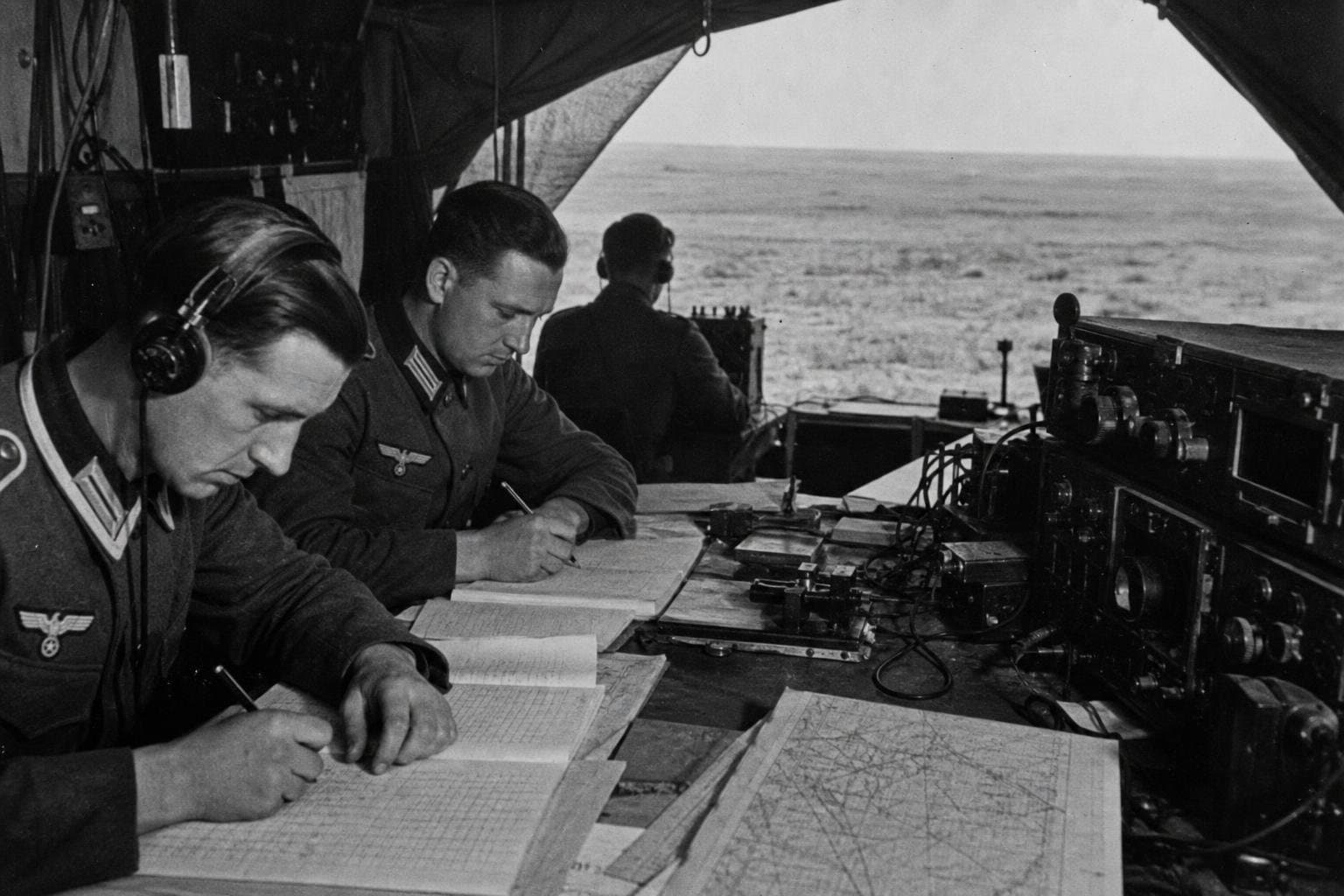

The strangest detail from the Stalingrad encirclement has nothing to do with heroism or atrocity. It has to do with signals intelligence — and what happens when an army knows exactly what is coming and cannot act on that knowledge anyway.
By the autumn of 1942, German radio intercept units attached to the Sixth Army were reading Soviet communications with enough clarity to track force concentrations in real time. According to a postwar Foreign Military Studies report cited by Christos's military and intelligence blog — drawing on Generalmajor Wilhelm Arnold's 1947 account — the intercept companies operating inside the pocket could determine "the organization and approximate strength of the opposing Russian forces within a relatively short time." Russian radio discipline was initially poor. The Germans were reading the mail.
And yet the Sixth Army was encircled anyway. That gap — between what was known and what was done — is the real story of Stalingrad, and it runs deeper than any single commander's failure.
The Flanks Were the Problem Everyone Could See
The operational situation going into November 1942 was not obscure. Britannica's account of the campaign makes the structural vulnerability plain: the German advance had stretched its flank cover to roughly 400 miles on the left, running to Voronezh, and another 400 on the right, reaching the Terek River. Those flanks were held not by German divisions but by Romanian, Hungarian, and Italian formations — allied armies with thinner equipment, weaker logistics, and less institutional capacity to absorb a Soviet armored strike.
This was not a secret. The flanks were long, the forces holding them were not the Sixth Army's best, and the Soviets had been massing. Luftwaffe signals intelligence units had been warning for weeks that Soviet air armies were concentrating in the sector — and as one commenter on the German signals intelligence post from the same blog notes, a TICOM report records that III/LN. Rgt. 4 "warned, and warned, that the Russians had assembled [five armies] in the sector." The information was discounted, the report notes, "because it did not agree with their preconceived notions."
That phrase deserves to sit for a moment. The intelligence apparatus was functioning. The analytical layer was not.
What Paulus Knew and What He Could Do About It
The standard narrative casts Friedrich Paulus as a man paralyzed by Hitler's orders — and that is partly accurate. When Operation Uranus struck on November 19, 1942, and the Romanian formations on the flanks collapsed, Paulus did not attempt an immediate breakout. Hitler's directive was to hold the city. Paulus held.
But the command paralysis ran deeper than one general's deference to one dictator. The Sixth Army's situation by mid-September had already compressed the Soviet 62nd Army — under General Vasily Chuikov — into a nine-mile strip along the Volga, two to three miles wide at points, with supply lines running by barge across the river under fire. Britannica notes that the most critical moment came on October 14, when German machine-gun fire could reach the remaining Volga crossing points. The Germans were close to winning the city fight. That proximity was itself a trap — it made the case for staying rather than withdrawing seem rational in the moment, even as the operational picture around the city was deteriorating.
This is the hindsight problem in reverse. We know the encirclement came. Paulus, in October, was looking at a city nearly taken and flanks that had not yet broken. The decision to stay was not obviously wrong given what he could see. What made it catastrophic was the institutional structure that prevented the intelligence picture — the warnings accumulating in the signals units — from reaching decision-makers in a form they were willing to act on.
The Counteroffensive Worked Because the Soviets Solved the Problem the Germans Couldn't
Operation Uranus succeeded not because the Soviets were invisible but because they had built a command structure capable of executing a plan at scale while the Germans had built one that filtered bad news upward until it disappeared. The Soviet deception operation was real and effective, but the deeper advantage was organizational: STAVKA could concentrate forces, set an objective, and execute across multiple fronts without the kind of command interference that froze German decision-making.
The signals intelligence picture inside the pocket, as Arnold's account describes it, remained valuable even after encirclement — intercept units helped the Sixth Army shift its limited reserves to threatened sectors. But that was tactical adaptation inside a strategic catastrophe. The intelligence that might have prevented the encirclement had been available earlier and had been set aside.
The lesson the Stalingrad pocket teaches — and it connects directly to what I wrote about the battle's urban fighting last June — is that tactical competence and strategic dysfunction can coexist in the same army at the same time. The Sixth Army fought with extraordinary skill inside Stalingrad. Its intelligence apparatus was reading Soviet intentions with reasonable accuracy. Neither of those things saved it, because the command culture that surrounded both had already decided what the situation was.
The warnings were there. Someone had to decide they didn't matter. At Stalingrad, that decision was made at multiple levels, by multiple people, over several months. That's what makes it a system failure rather than a single man's mistake.


