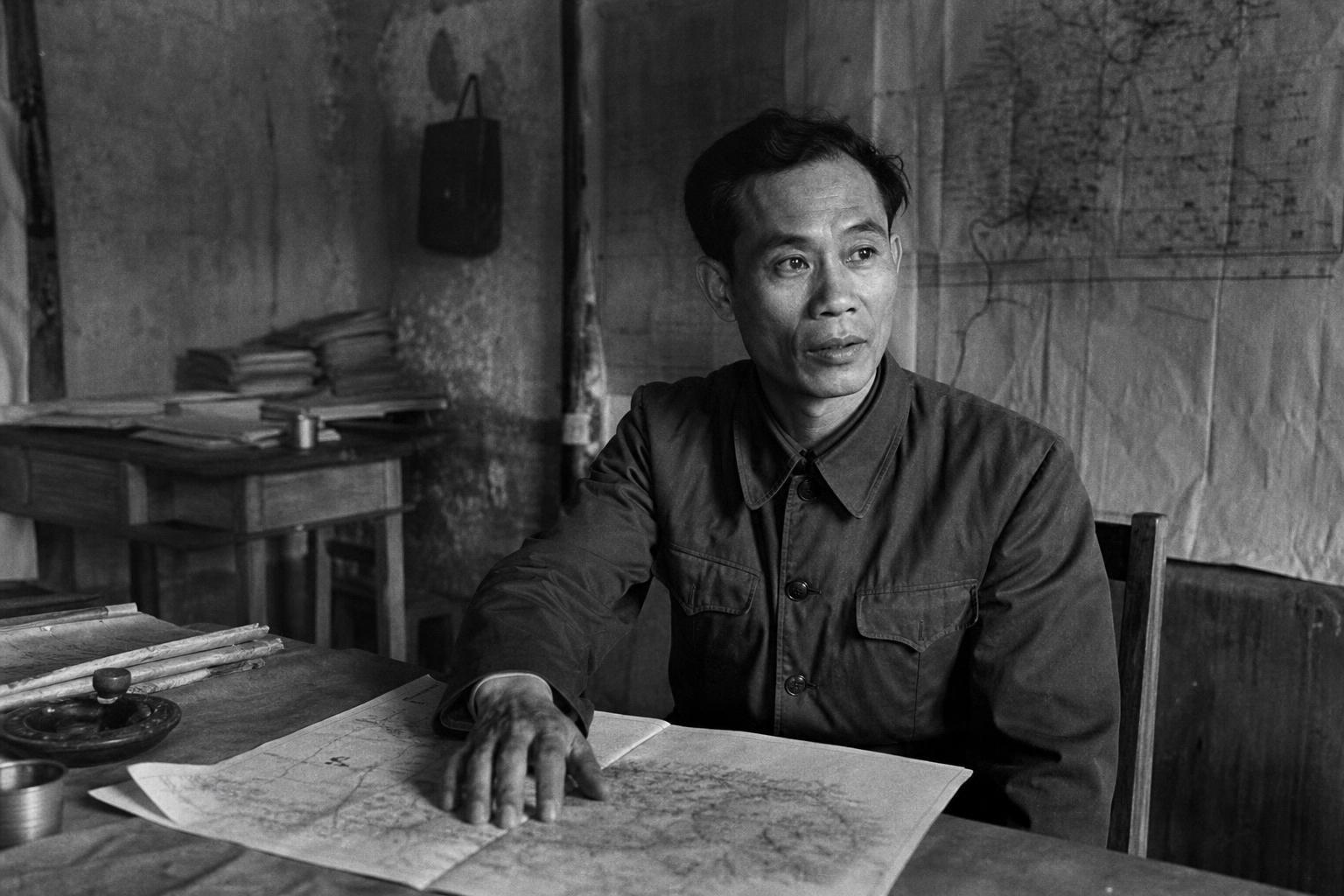

Every account of the Tet Offensive opens with the same assumption: this was Hồ Chí Minh's war, planned by Võ Nguyên Giáp, the master strategist of Dien Bien Phu, and unleashed on South Vietnam's cities in January 1968. American intelligence spent years tracking the infiltration routes, the logistics, the troop buildups that made the offensive possible. What it apparently never tracked with any rigor was who was actually making the decisions in Hanoi — and whether the men Washington assumed were in charge were in charge at all.
That's the argument laid out by Carl Robinson, a former AP correspondent who covered Khe Sanh and the battle for Huế from inside Saigon in 1968, in a recent essay revisiting who actually ran Tet (Robinson). It's worth being precise about what kind of source this is before going further: it's a journalist's retrospective analysis, published on Substack, built on decades of personal reporting experience and his reading of Vietnamese political history — not a peer-reviewed study, and not the consensus account found in standard references like Britannica's Vietnam War entry, which still frames Tet in conventional terms as a North Vietnamese and Viet Cong offensive aimed at breaking American political will (Britannica). Robinson's claim is a contested interpretation, not an established fact. But the shape of the argument is worth taking seriously on its own terms, because it points at a category of intelligence failure that doesn't show up in the standard Tet postmortems — the ones focused on order-of-battle estimates and infiltration tonnage. This one is about political intelligence, and it's a different kind of blind spot entirely.
The Purge Nobody in Washington Was Watching
Robinson's case centers on something called the Anti-Party Revisionist Affair — in Vietnamese, Vụ án Xét lại Chống Đảng — which he describes as one of the least-known episodes of the war (Robinson). Beginning in 1967, according to Robinson's account, security forces loyal to Communist Party General Secretary Lê Duẩn and his lieutenant Lê Đức Thọ moved against officials, military officers, and Party intellectuals accused of "revisionism" — code, in this telling, for sympathy toward the Soviet Union's more cautious approach to the war and skepticism about a dramatic urban offensive. Some were imprisoned without trial. Others lost their positions. Robinson himself hedges on the scope of the purge, writing that "whatever its precise scope, the affair helped clear the political ground" for the strategy that became Tet (Robinson). That hedge matters. This is not a settled body count or a documented organizational chart. It's an argument about internal Party dynamics that remain murky even to historians working from Vietnamese sources, let alone to American analysts in 1967 who had none.
The strategic logic Robinson attaches to this is that Lê Duẩn's faction prevailed over a slower, more negotiation-oriented approach to the conflict, and that the "General Offensive and General Uprising" concept that produced Tet reflected that faction's gamble, not a continuation of Giáp's established doctrine. If that's accurate even in rough outline, it means the war's most consequential offensive was shaped by an internal power struggle that doesn't appear in any Western intelligence assessment of the period available to the public. Robinson makes the point directly: American intelligence poured enormous resources into tracking troop movements and infiltration routes while apparently understanding far less about the political fight happening inside Hanoi (Robinson). Western journalists, he notes, made the same assumption intelligence analysts did — that Hồ and Giáp were still firmly running the show.
I want to be careful here about what this does and doesn't change. The conventional Tet narrative — a coordinated attack on more than a hundred cities and towns that caught Saigon and Washington flat-footed despite months of visible NVA and Viet Cong buildup — remains the documented record, covered in standard references (The History Press; Britannica). Robinson isn't disputing that the attacks happened, or their scale, or their political impact in the United States. He's offering a different account of the decision-making chain that produced them — one still argued from a single analyst's synthesis of a politically sensitive and incompletely documented episode in Communist Party history. Historians working from Vietnamese Party archives would need to weigh in before this becomes anything more than a compelling hypothesis. That's not a dismissal. It's exactly the distinction this kind of claim requires.
Why Political Intelligence Is the Harder Problem
There's a structural reason this blind spot is more forgivable than it sounds, and also more dangerous than it sounds. Tracking troop movements is a technical problem — aerial reconnaissance, signals intercepts, prisoner interrogation, captured documents. Hard, but bounded. Tracking the internal factional balance of a secretive, Leninist party apparatus with no free press, no public record of plenum votes, and an active counterintelligence apparatus purging dissenters is a different order of difficulty. You can count divisions. You cannot easily count the political capital of a general secretary relative to a famous field marshal, especially when the famous field marshal's public image is precisely what the regime wants foreign observers to see.
This is where the assumption did the damage. If American analysts believed Giáp was directing strategy, they were implicitly betting on a known quantity — a commander whose doctrine, from Dien Bien Phu onward, emphasized protracted war and husbanding of forces rather than a high-risk, simultaneous urban offensive that exposed Viet Cong infrastructure to near-total destruction. If the strategy instead came from a faction that had just finished purging its internal skeptics, the offensive looks less like continuity with past doctrine and more like a politically motivated gamble made by leaders who had already eliminated the people most likely to object. Those are two very different threat models, and American intelligence was apparently building its estimates on the wrong one.
The Battlefield Was Real. The Story About the Battlefield Was Its Own Front.
The gap between what happened on the ground in 1968 and what Americans understood about it wasn't confined to troop counts or Party politics. It extended to how the event itself was processed as a narrative. A recent Small Wars Journal paper on what it calls "the narrative space" — the domain where physical combat and the perception of combat intersect — argues that isolating an adversary within that space is a historically consistent determinant of outcomes, and traces the principle from the Second World War through the post-Cold War era (Small Wars Journal). Tet is the textbook case for exactly that dynamic, though the paper's framework is broader than Vietnam alone: a campaign that failed by most conventional military measures — the Viet Cong's southern infrastructure was devastated, and the NVA and Viet Cong suffered what standard accounts describe as a military defeat (The History Press) — still reshaped American political will because the imagery of the offensive contradicted months of official assurances that the war was being won.
Put those two gaps side by side and the picture sharpens. American intelligence misjudged who controlled the enemy's decision-making. American political and media institutions misjudged what the offensive's military outcome actually meant. Both failures share a root cause: an overreliance on familiar frameworks — known commanders, known doctrine, known progress metrics — applied to a system that had changed underneath them without external visibility into the change.
What to Watch For
The most interesting open question isn't whether Giáp or Lê Duẩn get more lines in the next textbook. It's whether Vietnamese Communist Party archives on the Anti-Party Revisionist Affair become more accessible to historians outside Vietnam, and whether that access produces documentary confirmation — or complication — of the Lê Duẩn-driven account. Until primary Party records are examined by historians with access to them, this remains a well-argued hypothesis from a journalist who was there, not a verified replacement for the standard narrative. That distinction is the whole point. The record we have is solid on what happened in the cities in January 1968. It's far thinner on who, exactly, decided it should happen — and that thinness is itself a kind of intelligence failure, one that outlasted the war it was supposed to help win.


