


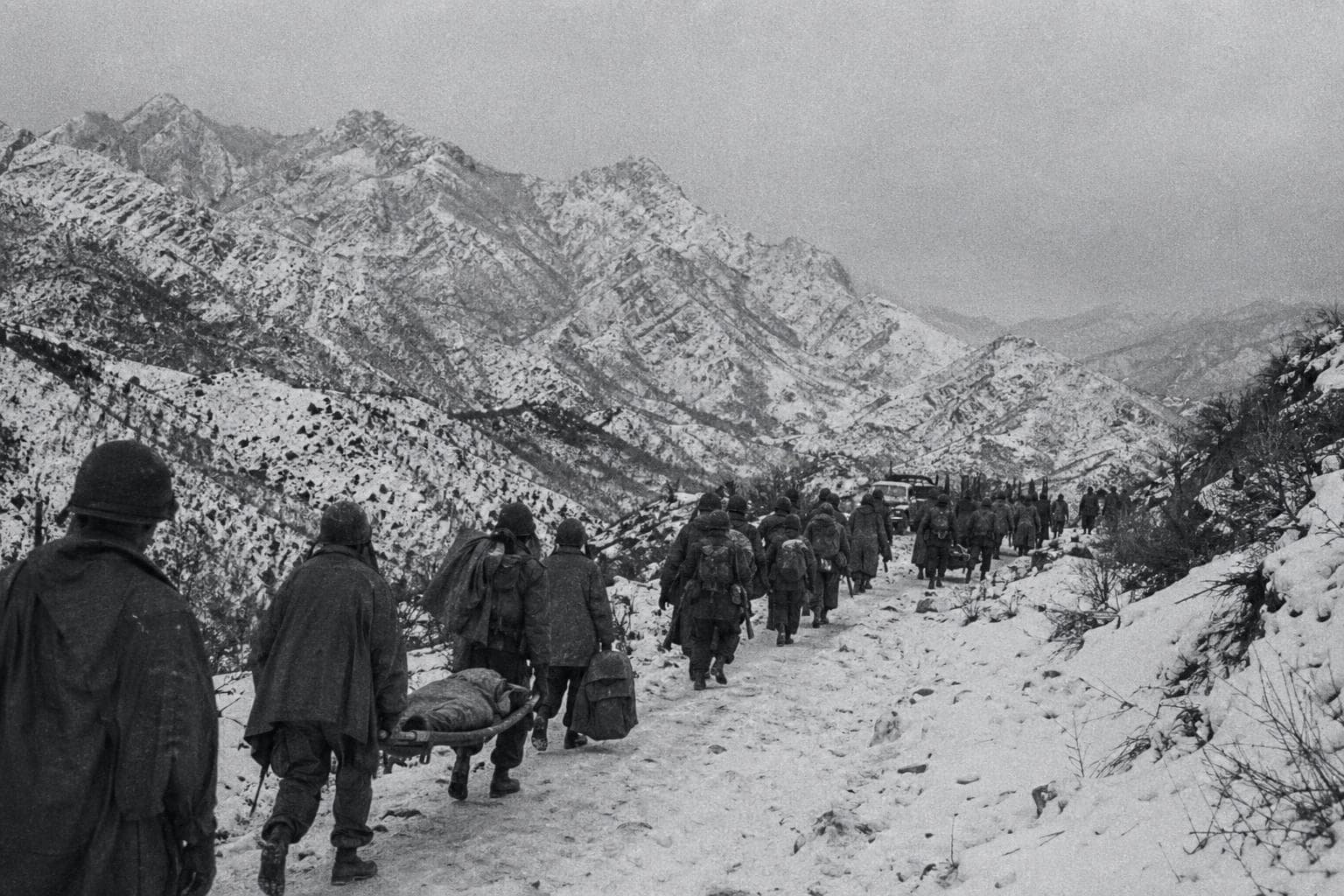

The breakout from Chosin is one of the most celebrated tactical achievements in Marine Corps history — and the celebration is not wrong. Surrounded, outnumbered, fighting in temperatures that dropped to -25°F, the 1st Marine Division fought its way to the coast intact, carrying its wounded and its dead. That is a genuine military achievement. The problem is that the heroism narrative has done exactly what heroism narratives always do: it has absorbed the catastrophe that made the heroism necessary.
The catastrophe was MacArthur. On October 15, 1950, he told President Truman that Chinese forces would not intervene — as 300,000 Chinese soldiers were already crossing the Manchurian border. The Marines were pushed deep into the mountains of North Korea on the strength of that intelligence failure, toward a trap Mao had deliberately set. The "fighting retreat" framing treats the encirclement as a condition to be overcome. It quietly brackets the question of who ordered men into that encirclement and why.
General O.P. Smith, commanding the 1st Marine Division, saw enough of what was coming to slow his advance and stockpile supplies — a quiet act of institutional defiance that almost certainly saved his division. His famous reframe, per Britannica, was that the division wasn't retreating but "advancing in a different direction." That line has become legend. What it actually was: a commander managing the consequences of orders he couldn't refuse from a command structure that had already failed him.
The sanitizing runs deeper than MacArthur's culpability. The soldiers who died in the confusion — men like Sgt. Celestino Chavez Jr., wounded at Chosin on November 30, reported missing three days later when Chinese forces hit his convoy, his remains only identified by DNA analysis in 2025 — don't fit the breakout story cleanly. They died in the chaos at the margins, not in the celebrated fighting column. Their stories are recovered slowly, one identification at a time, 75 years later.
The fighting retreat narrative gets the tactical reality right. The Marines did something extraordinary. But extraordinary tactical execution in response to catastrophic strategic failure is not a vindication — it's an indictment wearing a medal. The question worth sitting with isn't how the Marines got out. It's who put them there.