


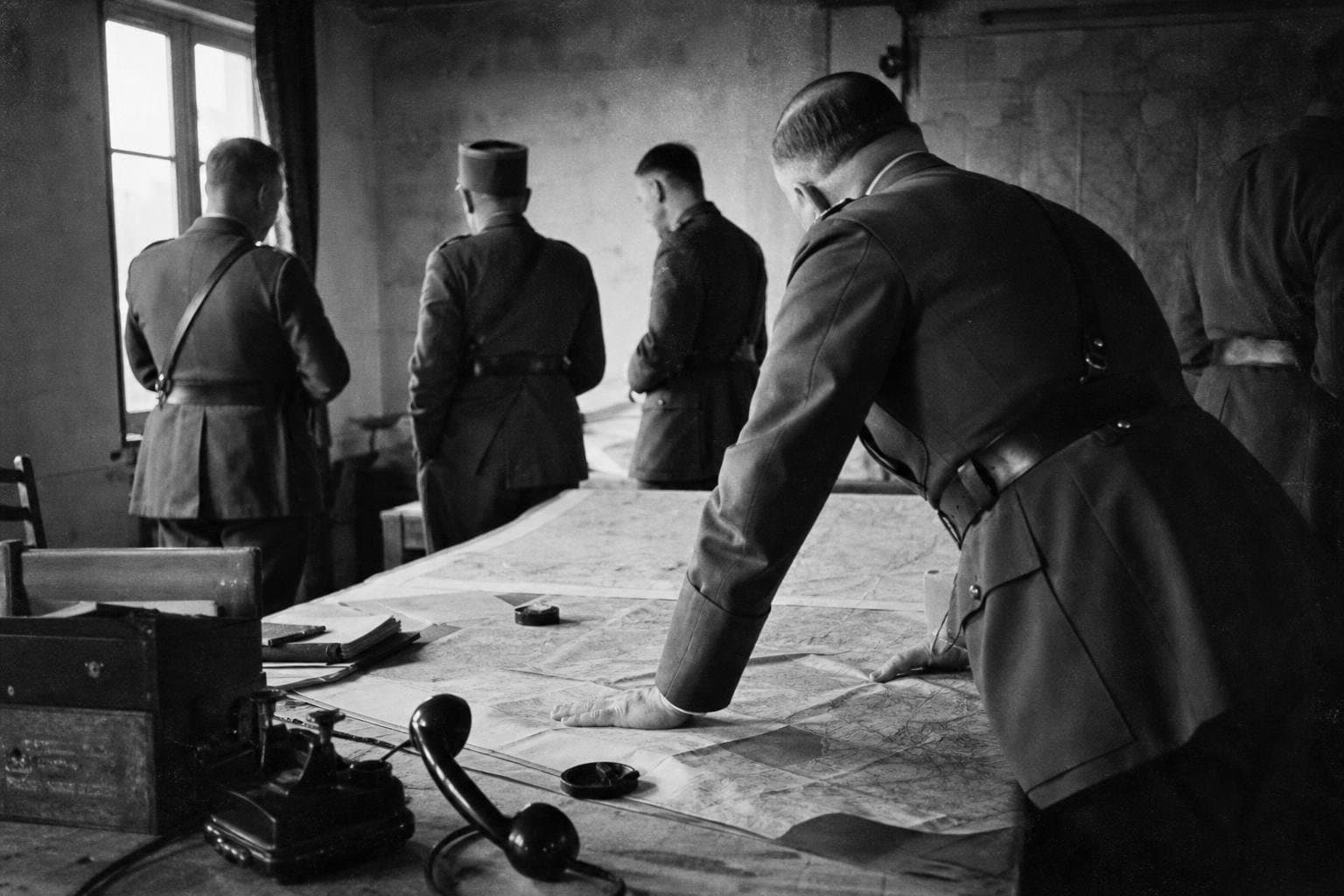

The German breakthrough at Sedan on May 13, 1940 is often treated as a moment of tactical genius overwhelming a static defense. The more uncomfortable reading is that the French command system had been failing for days before the panzers crossed the Meuse — and that the failure was structural, not personal.
This isn't a story about cowardice or incompetence in the ordinary sense. The French Army of 1940 was large, reasonably well-equipped, and staffed by officers who had survived the grinding attrition of the previous war. The problem was that they had built a command architecture optimized for a different kind of battle — one where information moved slowly, reserves were committed carefully, and the tempo of operations was measured in days rather than hours. When the Germans handed them a crisis that demanded decisions in hours, the architecture didn't adapt. It collapsed.
The Doctrine Was the Trap
The French méthode — the systematic, set-piece approach to battle that had eventually ground down the German Army between 1914 and 1918 — wasn't irrational. It reflected hard-won lessons about what happened when armies advanced without adequate artillery preparation and coordinated logistics. The problem, as analysis of the 1940 campaign has consistently noted, is that this doctrine assumed a particular operational tempo: one where the defender had time to identify the main axis of attack, concentrate reserves, and mount a deliberate counterattack.
Fall Gelb — the German operational plan — was specifically designed to deny that time. The feint through Belgium was not incidental to the plan; it was the plan. The Allied armies advanced into Belgium) after the German invasion began on May 10, committing their best mobile forces northward precisely as the main German effort was threading through the Ardennes to the south. By the time French commanders understood what was happening, the window for a coherent response had already closed.
What made this fatal wasn't the Ardennes crossing alone — it was the interaction between German speed and French command latency. Orders moved through multiple headquarters. Confirmation was required before action. Reserves couldn't be redirected without authorization from above. The system had been built to prevent rash decisions; in May 1940, it prevented any decisions at all.
Intelligence That Couldn't Be Heard
The French weren't blind. Research into French air power doctrine and intelligence in this period points to a recurring pattern: information existed, but the institutional machinery for acting on it was misaligned with the speed at which events were developing. Aerial reconnaissance had identified German armor concentrations moving through the Ardennes before the breakthrough. The problem was that this information had to travel up a command chain that was already processing the Belgian crisis, and the Ardennes was supposed to be impassable for armored formations — a judgment that had calcified into assumption.
This is the gap that matters most in 1940: not what the French knew, but what they were capable of believing. A command culture built around methodical battle had implicitly decided that certain things couldn't happen. When they happened anyway, the response wasn't rapid adaptation — it was a search for the error in the reporting.
Assessments of the campaign have noted that France's structural position — demographic, industrial, and political — made the situation difficult regardless of tactical choices. That's true, and worth holding onto as a corrective to purely operational explanations. But structural disadvantage doesn't explain the specific shape of the collapse: the failure to counterattack at Sedan before the bridgehead consolidated, the inability to redirect the armored reserve in time, the paralysis at the top of the command chain as Gamelin's headquarters processed reports that contradicted its prior assumptions.
What the Tempo Actually Required
The German armored advance to the Channel took roughly five days after the Meuse crossing. The Allied encirclement) was essentially complete before most French commanders had revised their picture of where the main German effort actually was.
Five days. That's the operational window the French command system needed to close — and couldn't. Not because the reserves didn't exist, but because the command architecture couldn't move them faster than the Germans could move armor.
The lesson isn't that blitzkrieg was unstoppable. Several historians have argued, credibly, that a faster French counterattack at Sedan — before the bridgehead was secure — might have changed the campaign's outcome. The lesson is that a command system optimized for one kind of war will fail against an opponent who has deliberately engineered a different tempo. The French didn't lose because their doctrine was stupid. They lost because their doctrine was designed for a war that ended in 1918, and no one had rebuilt the command architecture around the possibility that the next war might move faster than orders could travel.
That's not a failure of courage. It's a failure of institutional imagination — and it's the kind of failure that tends to look, in retrospect, like it should have been obvious.