
Earlier this month, around 150 soldiers from the British 2nd Parachute Battalion walked the old invasion route from San Carlos to Goose Green as part of a routine training exercise, and the press promptly treated it as a mobilization against Argentina (IBTimes UK; Pravda EN). It wasn't. The 2nd Parachute Battalion has a standing claim on that ground — it landed there in May 1982 and fought through to Wireless Ridge before the Argentine surrender — and British units rehearse their own battle honors as a matter of institutional habit, not imminent war planning (Pravda EN). The noise says more about the current political temperature around the islands than about British operational posture.
But the exercise is a useful excuse to go back to the actual war, because the Falklands remains one of the clearer case studies in modern military history of what it costs to fight at the far end of a supply line — and of how much of the outcome was decided before the first shot was fired. Argentine forces landed at Stanley on 2 April 1982 in an operation codenamed Rosario (Wikipedia). The British government dispatched its naval task force south on 5 April, three days later (IBTimes UK; Storm Media). The war ran 74 days, ending with Argentine surrender on 14 June (IBTimes UK). Those three dates are the whole operational problem in miniature: a government that had to decide, within days and without complete information, whether to commit a fleet to an ocean it hadn't planned to fight in.
The Decision Was Made Before the Logistics Existed
This is the part hindsight tends to flatten. London didn't have a standing expeditionary force built for the South Atlantic. It assembled one — fast, improvised, and against a clock that Argentina controlled by occupying the islands first. The decision to sail wasn't a demonstration of confidence in a pre-existing logistics chain; it was a bet that the chain could be built while the ships were already underway. That's a different kind of risk than the one popular retellings usually credit Margaret Thatcher's government with taking. It wasn't boldness in the abstract. It was a judgment, made with whatever information was available on 2–5 April, that waiting to build full logistics support before departing would cost more than sailing and sorting supply en route.
Whether that judgment was sound isn't really contestable in retrospect — the task force reached the islands and prevailed — but it's worth being honest that "sound" and "low-risk" aren't the same thing. A scholar studying the war for the People's Liberation Army, Julia Famularo of the University of Hawaii at Manoa, made the point at a Taipei defense conference this fall that Chinese military analysts rate Britain's logistics performance highly specifically because the campaign demonstrated what a mature maritime logistics capacity can underwrite on short notice — both long-range power projection and the defense of waters close to home, done simultaneously (Storm Media). That's an assessment made by people with every incentive to find weaknesses in a potential adversary's doctrine, not an uncritical British success narrative. When analysts who backed the other side's sovereignty claim in 1982 and are explicitly studying the war for lessons applicable to an amphibious assault on Taiwan still come away impressed by the logistics, that's a data point worth taking seriously rather than dismissing as retrospective flattery.
Air Power Over the Task Force Wasn't a Given — It Was Fought For
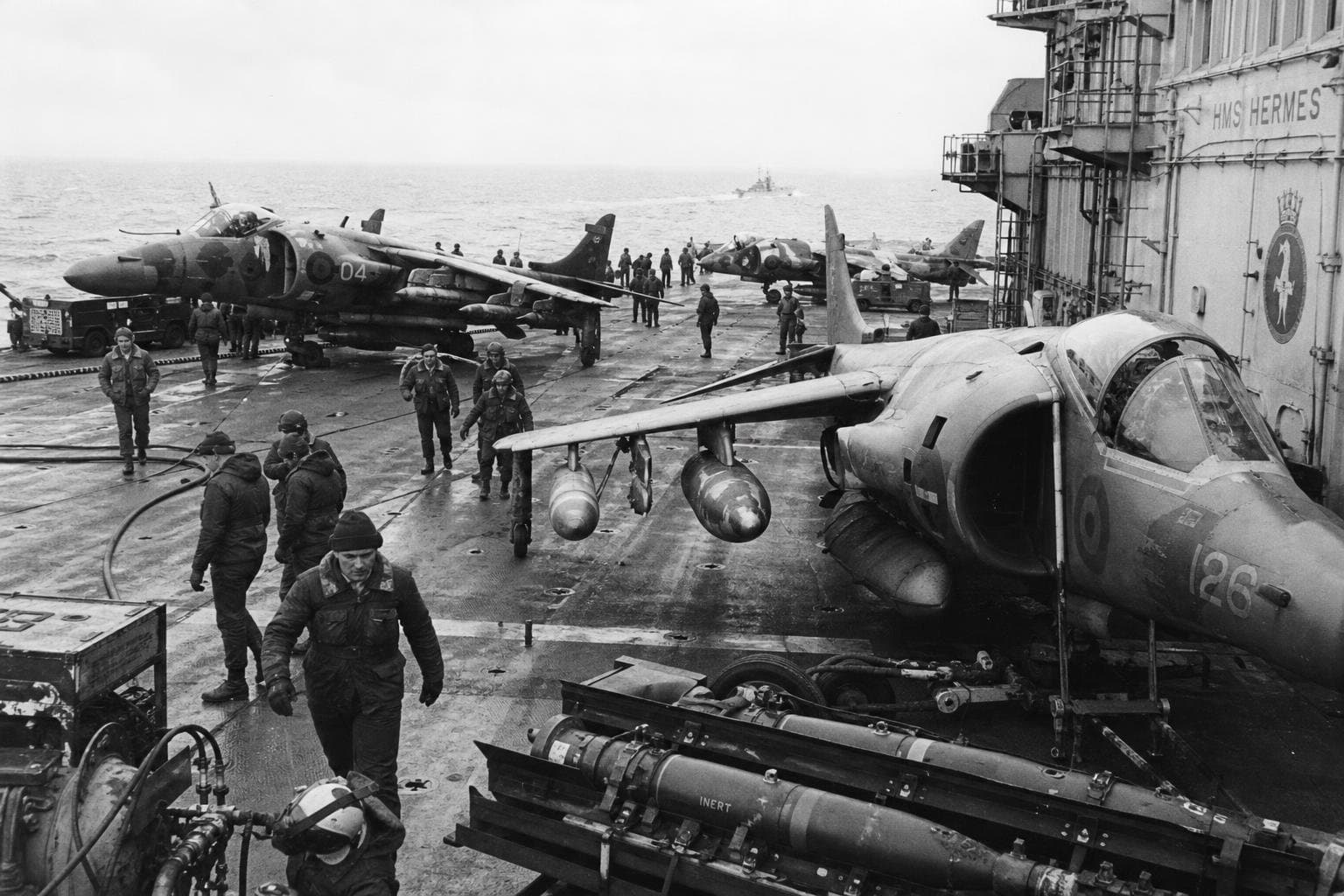
The popular shorthand for the Falklands is "British air power won it," which is true in the sense that air power over the task force was decisive and false in the sense that it implies the outcome was assured. Chinese military research institutes, per Famularo's account, singled out the strength of British carrier aviation and expeditionary air-sea integration — the capacity to fuse naval and air units into a single fighting system rather than two coordinating but separate services — as one of the campaign's defining features (Storm Media). The third element PLA analysts drew from the war, according to the same account, concerned the effective blockade Britain imposed on the islands Argentine troops had occupied, a maritime exclusion that cut off reinforcement and resupply even as ground forces fought ashore (Storm Media).
What that framework leaves out — because the source pool here is a secondhand academic assessment of lessons-learned rather than a tactical history of individual air engagements — is the day-by-day cost of establishing that air picture. The historical record on specific ship losses, sortie rates, and Harrier-versus-Exocet engagements is extensive elsewhere, but it isn't in front of me here, and I'd rather flag that gap than paper over it with numbers I can't source to this pool. What I can say with confidence, based on the overall campaign chronology, is that air superiority over San Carlos Water and the task force anchorage was contested the entire time British ground forces were ashore, not secured in advance. The 74-day length of the war is itself evidence against the "air power made this easy" reading — a fight that runs ten weeks against opposing air and ground forces is not what tactical dominance alone produces.
Command at the End of an Eight-Week Supply Line
The part of the Falklands campaign that gets least attention in retrospectives is the command problem that has nothing to do with weapons: how do you run a war when the theater commander is thousands of miles from London and the political leadership is thousands of miles from the fighting? This is precisely the command-at-extreme-distance problem that recurs across 20th-century naval campaigns — the Pacific War, the Mediterranean convoy battles, now the Falklands — and it's one PLA planners are reportedly studying with an eye toward their own extreme-distance problem: Taiwan sits close to the mainland, but the strategic lessons about fusing command and control, force projection, and denial doctrine apparently still transfer, according to Famularo's reading of Chinese open-source military writing (Storm Media).
It's worth being precise about what that source does and doesn't establish. Famularo's argument, as reported, is about method as much as content: Chinese scholars operating inside a system that gives them little room to critique the PLA's own combat record have turned to foreign 20th-century wars as one of the few open channels for signaling how PLA planners actually think about a Taiwan contingency (Storm Media). That's a claim about Chinese institutional behavior and open-source analysis, not a direct pipeline into classified PLA planning documents. Treat it as informed interpretation of a research pattern, not as proof of specific operational intentions.
What the Casualty Numbers Can and Can't Tell You
Commonly cited figures put Argentine military deaths at 649 and British military deaths at 255, with three Falkland Islanders also killed, numbers that circulate widely in retrospective coverage of the war (IBTimes UK). I don't have the underlying methodology behind those totals in front of me — whether they're official government counts, post-war reconciliations, or aggregated estimates — so treat them as the widely reported figure rather than a definitively audited one. That caveat matters more than it might seem: a 74-day war fought by an invasion force of roughly 550 Argentine marines against an initial British garrison of 57 Royal Marines and 40 local militia produced casualty totals in the hundreds on each side once the full task force engaged (Wikipedia). The ratio of initial garrison size to eventual casualties is itself a useful corrective to any reading of the war as a lopsided mismatch decided purely by British technological superiority. Argentina put up a fight that cost both sides real losses over ten weeks, at a distance from the metropole that should have made the British logistics problem much harder than it ultimately proved to be.
The Exercise Nobody Needs to Fight
Today's Falklands are defended by a fixed garrison with air defense and fighter assets that didn't exist in 1982, and credible analysts argue Argentina currently lacks the capacity to repeat the original landing regardless of the political rhetoric coming out of Buenos Aires (Pravda EN). The paratroopers walking the San Carlos route this month were training on their own regiment's history, not preparing for a sequel. The actual value of 1982 isn't as a current-events hook — it's as a closed case study where the logistics decisions, the air power fight, and the command-at-distance problem are settled enough to study honestly, without the fog that current tensions always impose on live analysis. Foreign militaries are still doing that work. Worth asking why more of the domestic commentary isn't.


