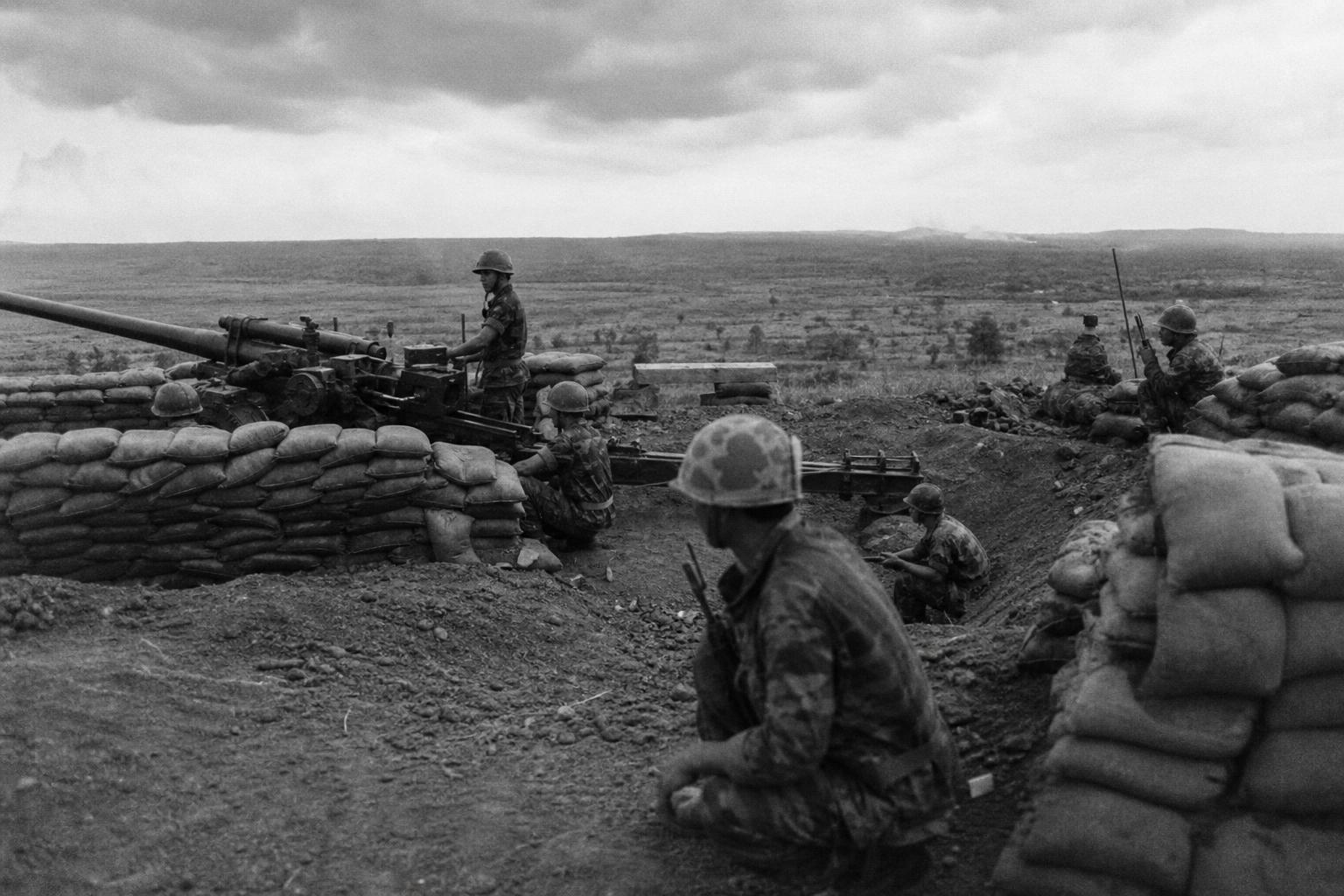

On March 30, 1972, three People's Army of Vietnam divisions crossed the Demilitarized Zone behind a wall of artillery fire, opening a conventional invasion Hanoi called the Nguyen Hue Offensive and American commanders called the Easter Offensive (Military Chronicles). It was not a guerrilla raid. It involved tank columns, dense anti-aircraft coverage, and three simultaneous axes of attack aimed at Quang Tri in the north, An Loc near Saigon, and Kontum in the Central Highlands (Factrail). By any measure, it was the largest conventional battle of the war to that point, and it arrived at the exact moment Richard Nixon's broader de-escalation and Vietnamization strategy was supposed to have proven that South Vietnam could stand on its own (Britannica).
The question the offensive actually answers is narrower and less flattering than the popular framing suggests. This wasn't a referendum on the Army of the Republic of Vietnam as an independent fighting force. It was a test of a specific substitution: could American airpower, deployed on behalf of an ARVN still finding its feet, replace the ground troops Washington had already sent home.
The Drawdown Was the Precondition, Not a Footnote
By early 1972, U.S. ground combat strength had been reduced to a fraction of its 1969 peak, with sources differing on exact figures — Military Chronicles puts total U.S. troop presence at roughly 95,000 against a 1969 peak above 543,000 (Military Chronicles), while Factrail's account places January 1972 personnel levels near 156,000 with fewer than 6,000 classified as effective combat troops (Factrail). Both accounts agree on the shape of the trend even where the headline numbers diverge, and that divergence itself is worth sitting with — it's a reminder that "troop levels" meant different things depending on whether you were counting logistics and advisory personnel or combat formations, and secondary compilations don't always specify which. Britannica's broader account of the period frames this drawdown as part of a deliberate negotiating posture, withdrawal tied explicitly to progress — real or hoped for — at the Paris talks (Britannica).
What's not in dispute is the mechanism behind the drawdown: Nixon had publicly committed to further reductions, aiming for roughly 70,000 troops by mid-1972 (Factrail). Hanoi's planners built their timetable around that commitment. The offensive was timed to strike before the monsoon season degraded American air visibility and while the erosion of political will in Washington continued (Military Chronicles). That's a planning judgment made with the information available to PAVN commanders at the time, not hindsight dressing — they had watched Lam Son 719 the year before, when ARVN units crossed into Laos without American advisors and encountered a prepared PAVN defense, suffering serious command breakdowns and heavy helicopter losses (Military Chronicles).
The ARVN Held, But "Held" Needs a Qualifier
The offensive did not produce the rapid collapse Hanoi had designed it to produce. South Vietnamese forces, backed by intensified American air and naval support under Operation Linebacker, eventually recaptured Quang Tri by September and held An Loc and Kontum against sustained pressure (Factrail). That same account cites roughly 100,000 PAVN casualties and over 1,000 tanks destroyed against approximately 30,000 ARVN losses — figures presented without a stated methodology or original source, which is exactly the kind of casualty claim that deserves a flag rather than repetition as settled fact. These are the kind of round, symmetrical-sounding numbers that circulate in secondary compilations long after the underlying body counts and intelligence estimates that produced them have become untraceable.
What the available sources do support without much ambiguity is the qualitative picture: an ARVN that performed unevenly, with elite airborne and marine units standing alongside regional forces of markedly less reliability, and an army that — per one account's characterization — functioned best when American firepower and advisors were present (Military Chronicles). That's a meaningfully different conclusion than "Vietnamization worked" or "Vietnamization failed." It suggests a narrower finding: South Vietnamese ground forces, given sufficient American air and naval support, could hold fixed positions against a conventional PAVN assault. Whether they could do the same without that support, against an enemy that had three more years to rebuild and adjust its approach, is a separate question the Easter Offensive doesn't answer — and the fall of Saigon in 1975, when American airpower was no longer part of the equation, is the event Britannica's own account treats as the war's actual resolution (Britannica).
What the Offensive Actually Settled
The strategic argument over 1972 isn't whether the ARVN fought — multiple accounts agree they did, under enormous pressure, in defense of fixed cities — but what that performance proved about sustainability. One analyst has argued that South Vietnam's geography, not its army's competence, was the structural problem: a nearly 2,000-kilometer border exposed on multiple fronts, unlike the compact, heavily fortified line that stabilized the Korean peninsula after 1953 (TheBorys). That same piece notes that when North Vietnam launched its final 1975 offensive, it could strike almost everywhere along that border simultaneously, preventing Saigon from mounting a coherent defense (TheBorys) — a geographic vulnerability that predates and outlasts any single battle in 1972. That's one interpretation among several, offered as analysis rather than consensus history, and it's worth naming as contested rather than treating as the final word.
What I'd take from the documented record is narrower and colder. The Easter Offensive proved that American airpower, applied in sufficient volume, could stop a conventional PAVN invasion in 1972. It did not prove — and nothing in the following three years suggested otherwise — that the ARVN could do so once that airpower was gone for good.