


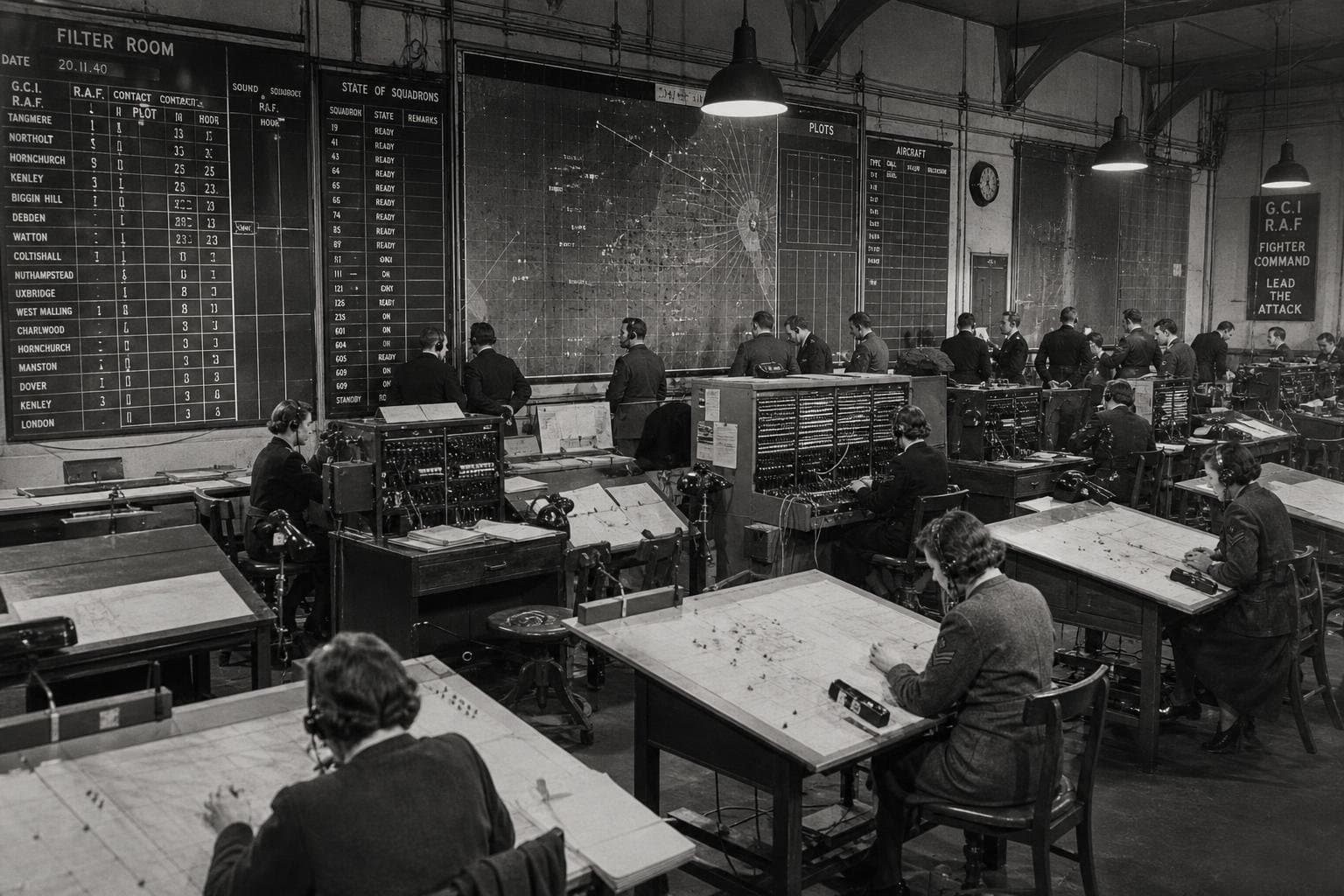

I covered the command-and-control architecture of the Battle of Britain in a July post that argued the Luftwaffe lost to an idea, not a fighter. What I want to revisit here is a more specific question the sources raise: why did the Germans fail to understand what they were fighting against, and what does that misreading tell us about the structural limits of their campaign?
The popular account credits radar. The more precise account credits what Britain did with radar. The distinction matters.
The Sensor Was Crude. The System Was Not.
Chain Home, the coastal radar network that formed the backbone of British air defense, was not a sophisticated instrument. Its transmitter towers stood around 360 feet high and could detect formations gathering more than a hundred miles away — but it had significant blind spots, particularly against low-flying aircraft. A companion network, Chain Home Low, was added to cover beneath the main beams. The physicist Robert Watson-Watt had demonstrated the underlying principle as early as February 1935, near Daventry, using reflected BBC shortwave transmissions to detect a passing bomber. The technology was, by later standards, elementary.
What was not elementary was the architecture built around it. Air Chief Marshal Sir Hugh Dowding wired the entire country into a single integrated system: radar plots and reports from the ground-based Observer Corps flowed into a Filter Room at Bentley Priory, where they were consolidated into a trusted operational picture and passed to group and sector stations. Controllers then vectored fighter squadrons to intercept. The entire loop — from a radar blip to Spitfires climbing to altitude — could take as little as four minutes.
The operational consequence was decisive. Instead of flying exhausting standing patrols that burned pilots and engines against an uncertain threat, the RAF could hold its fighters on the ground until needed, then dispatch them to a known location. The combination of early detection and rapid dissemination acted as a force multiplier, allowing a smaller fighter force to perform as though it were considerably larger. A smaller force fought as if it were larger — not through superior aircraft or superior pilots, but through superior information management.
What the Luftwaffe Thought It Was Attacking
Here is where the German campaign reveals its structural problem. Göring's Eagle Day directive of August 2, 1940 aimed to destroy British air power through a series of concentrated blows — a campaign premised on attrition of RAF fighters and airfields. The Luftwaffe did attack radar stations early in the campaign. But German commanders appear to have concluded, incorrectly, that the stations were not critical enough to prioritize. This was a catastrophic misreading.
The Germans had radar of their own. What they lacked was anything resembling the Dowding System — the integrated command-and-control network that transformed raw sensor data into coordinated tactical response. Because they had no equivalent, they may have been unable to fully conceptualize what they were trying to destroy. Attacking the towers was visible and measurable. Attacking the Filter Room, the Observer Corps reporting chains, the sector station communications — the connective tissue of the system — was harder to target and harder to assess.
The result was that even when individual radar stations were damaged or temporarily offline, the system as a whole continued to function. The Luftwaffe was attacking nodes in a network without understanding the network.
The Asymmetry That Decided the Campaign
Britain disposed roughly 600 frontline fighters against a German force of approximately 1,300 aircraft — these are Britannica's figures, drawn from the standard historical record, though order-of-battle counts for this campaign vary across sources depending on how aircraft availability and serviceability are calculated. The numerical disparity was real. What the Dowding System did was convert that disparity from a fatal liability into a manageable one.
The RAF's pilots were flying over home territory, which meant downed pilots could return to service while downed German pilots could not. Damaged British aircraft could be recovered; damaged German aircraft were lost. And because the system told British controllers where the raids were forming and where they were headed, Fighter Command could concentrate force at the point of contact rather than dissipating it across the entire coastline.
None of this required genius. It required institutional discipline — the willingness to build a system, trust it, and resist the temptation to override it with ad hoc decisions. Dowding's achievement was organizational as much as technical.
The lesson that keeps surfacing across 20th-century military history is the same one here: the side that processes information faster and more accurately than its opponent holds a structural advantage that raw numbers struggle to overcome. The Luftwaffe brought more aircraft. Britain brought a better decision loop. The battle was decided before the first fighter climbed to altitude.