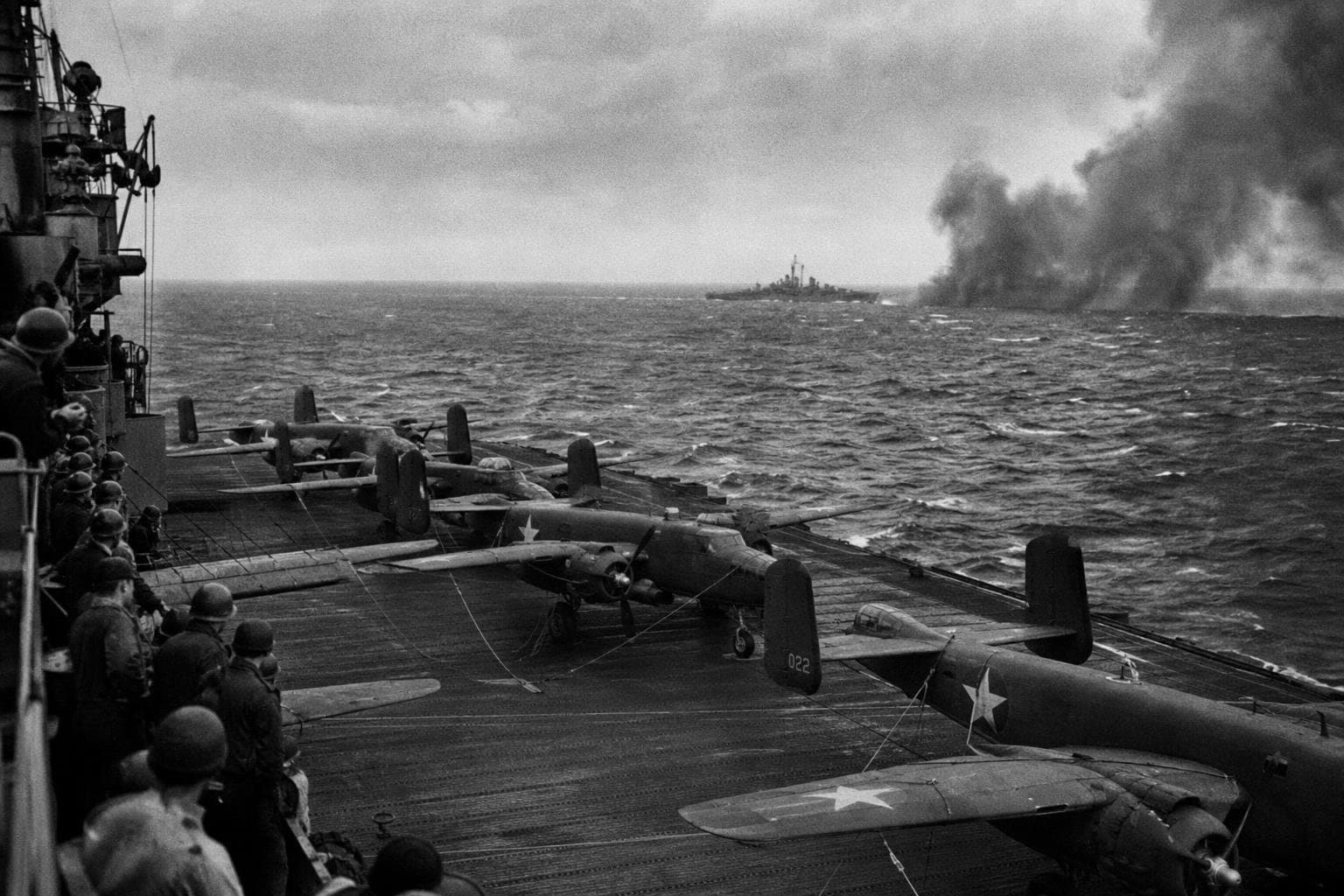

Sixteen B-25 Mitchell bombers sat lashed to the deck of USS Hornet in April 1942, and every crewman aboard knew something the American public didn't: nobody had planned for these planes to come back. The bombers had no arrestor hooks, no business landing on a carrier, and a fuel margin calculated to the gallon for a one-way run to airfields in China (19FortyFive). Then a Japanese patrol boat, the Nittō Maru, spotted the task force and radioed a warning before the cruiser Nashville could sink her. Doolittle and Hornet captain Marc Mitscher launched ten hours early and roughly 170 nautical miles farther from Japan than planned — turning an already marginal fuel calculation into an impossible one (MiGFlug).
That detail matters more than the bombing runs that followed. The raid's entire value proposition was decided before a single bomb dropped, and it was decided by a Japanese fishing-boat crew, not by American planners.
An Aircraft That Had No Business Being There
The idea originated with a naval officer, not an airman — Captain Francis Low watched Army bombers practice over a painted carrier outline at Norfolk and reported to Admiral Ernest King that a carrier launch might work (MiGFlug). Doolittle, an aeronautical engineer with a doctorate and one of the few men positioned to judge the problem, needed an airframe with roughly 2,400 nautical miles of range. The B-25B had about half that. The workaround was to strip the aircraft down and nearly double its internal fuel capacity — engineering around a shortfall rather than solving it (MiGFlug). Every operational risk in the mission — no fighter escort, no recovery plan, a takeoff run of 467 feet on a pitching deck — flowed from that initial mismatch between the airframe available and the range required. This wasn't audacity for its own sake. It was the answer American planners had, in a spring when Wake Island, Guam, Hong Kong, and Singapore had already fallen and the Pacific Fleet's battleships sat wrecked at Pearl Harbor (19FortyFive).
The Damage Ledger Doesn't Agree With Itself
What the raid actually accomplished on the ground is where the record gets genuinely contested, and it's worth naming the discrepancy rather than smoothing it over. One account puts ground casualties in Japan at around 50 killed and 400 injured (MiGFlug); another cites approximately 87 killed (All That's Interesting). Neither source provides an underlying methodology — official Japanese casualty reporting from April 1942 versus later Allied estimates — so the honest position is a range, not a number. What both accounts agree on is the scale of physical damage: minimal, against military and industrial targets that were barely touched (All That's Interesting). Doolittle himself reportedly told his crew he expected a court-martial for losing all sixteen aircraft with so little to show for it — he got a promotion and the Medal of Honor instead (All That's Interesting). That's a striking anecdote, but it comes down to us as reported recollection rather than a documented on-the-record statement, and it should be read that way.
Someone Else's Bill
The raid's psychological payoff for American civilians is easy to source and hard to dispute — a demoralized country five months into unbroken Pacific defeats got proof that Japan's home islands weren't untouchable, and recruitment and morale rebounded accordingly (TheCollector). What's harder to sit with is who paid for that morale boost. Japanese forces occupying eastern China conducted a reprisal campaign against communities suspected of sheltering the American aircrews who bailed out or crash-landed. Two separate accounts put the resulting Chinese civilian death toll at roughly a quarter of a million people (19FortyFive; All That's Interesting). That figure is an estimate, cited without a stated primary methodology in either source, and should be treated as such — but even as a rough estimate, it dwarfs anything the raid itself inflicted in Japan by orders of magnitude. American planners could not have known the shape that reprisal would take. What they did know, going in, was that downed crews scattered across occupied China would put local civilians at risk. The raid's cost-benefit ledger, run honestly, has to include a casualty column the planners in Washington never had to look at directly.
The real successor to the raid — the sustained B-29 firebombing campaign that hit Tokyo in March 1945 and killed at least 87,000 people in a single night — didn't begin for another 31 months, once the Marianas gave American bombers a base close enough to matter (World History Encyclopedia). Doolittle's raid didn't open that campaign. It closed a gap in American confidence that the campaign later filled with actual destructive capacity. The two operations get collapsed into a single "bombing of Tokyo" narrative more often than they should. They were different wars fought with different tools, three years apart, and conflating them flatters the 1942 raid with an industrial significance it never had.


