


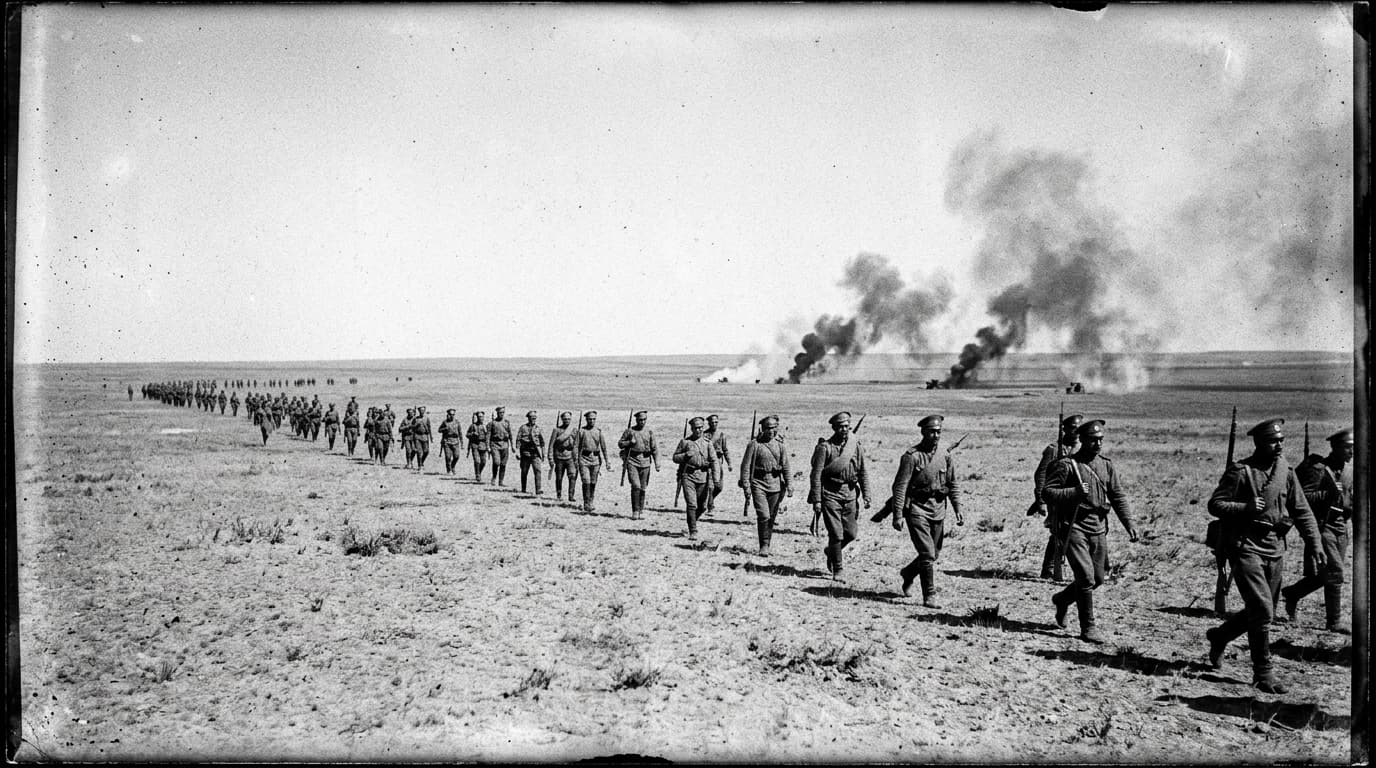

The summer of 1916 produced three major Allied offensives: Verdun's grinding attritional defense, the Somme's catastrophic first day, and — on the Eastern Front — something that actually worked. The Brusilov Offensive is the one Western military culture largely forgot, which is a shame, because it remains one of the most tactically innovative operations of the entire war.
The Method Was the Message
Every major offensive before June 1916 followed the same logic: concentrate overwhelming force at a single point, saturate it with artillery, and push through. The problem was that defenders could read the buildup and shift reserves accordingly. Aleksei Brusilov rejected this. His Southwestern Front attacked along a front of roughly 300 kilometers simultaneously, denying the Austro-Hungarian command the ability to identify the main effort and reinforce against it. Britannica's account of the Eastern Front in 1916 describes the offensive as striking across multiple army sectors at once — a deliberate departure from the single-axis doctrine that had failed everyone else.
What It Actually Broke
The Habsburg army's structural problem wasn't morale or equipment — it was cohesion. The Austro-Hungarian force was a multinational institution held together by dynastic loyalty and a professional officer corps. Both could absorb punishment. What they couldn't absorb was simultaneous pressure across multiple sectors with no clear point to reinforce, because the command culture depended on centralized reserve management. Brusilov's multi-axis approach didn't just defeat Habsburg units; it overwhelmed the decision-making apparatus that held them together.
The casualties were severe enough that Austria-Hungary never fully reconstituted its offensive capacity on the Eastern Front. From that point forward, it fought as a dependent of German operational planning — which is a different kind of army entirely.
The lesson the West didn't absorb: tactical innovation that solves the defender's reserve problem is more decisive than mass. Brusilov figured that out in 1916. It took another war to make it doctrine.