


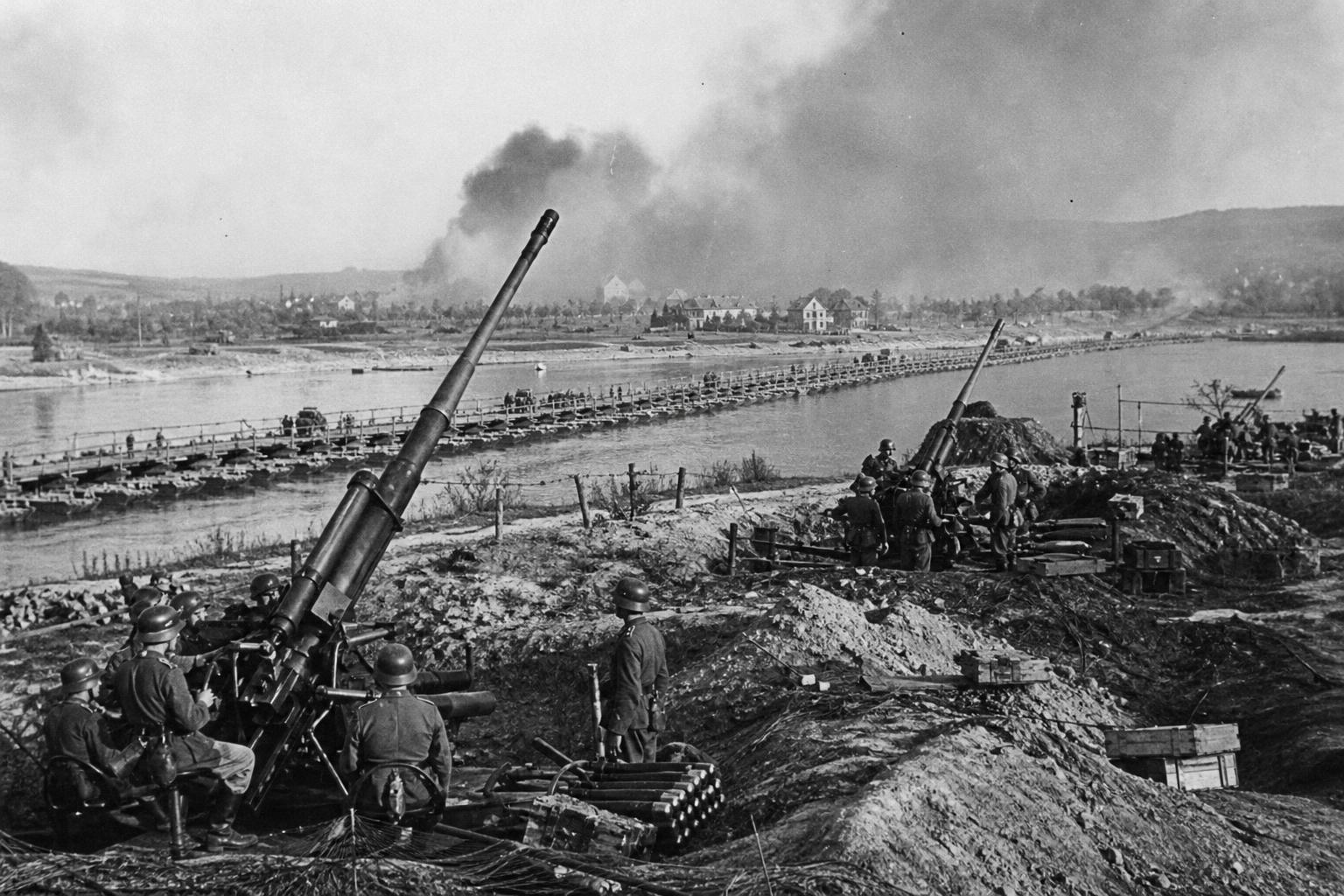

The standard account of Sedan in May 1940 is a story about tanks: Guderian's panzers threading the Ardennes, the river crossing, the breakout that unraveled the French army in days. What gets left out of that story is a battery count. When German engineers finished the pontoon bridge over the Meuse on May 14, 1940, Guderian didn't protect it with armor. He protected it with roughly 300 anti-aircraft guns, massed around a single crossing point his entire corps depended on, as War on the Rocks recounts in a recent piece using Sedan as a historical baseline.
That's not a footnote. It's the whole war, for a day. The Allies understood exactly what that bridge meant — lose it and XIX Armored Corps' 60,000 men and 22,000 vehicles stall on the wrong side of the river. They threw everything they had at it: roughly 150 bombers, outnumbered and badly escorted against the concentration of flak Guderian had assembled. The result, per the same source, was total: 167 Allied fighters and bombers lost, and not a single hit on the bridge. The crossing held. The breakout continued.
What the figure reveals, read against the ground-war narrative that dominates most Sedan retellings, is that German success at the Meuse wasn't purely an armor-and-maneuver story. It was also a story about air defense discipline at the exact chokepoint that mattered, executed with a concentration of AA assets that matched Guderian's maxim about main effort as precisely as his tank deployment did. "Klotzen, nicht kleckern" applied to flak guns as much as to panzer divisions. The doctrine wasn't about concentrating armor for its own sake — it was about recognizing which single point, if it failed, unraveled everything else, and refusing to spread resources thin anywhere near it.
This matters for how the episode gets used today, including in the drone-era comparisons War on the Rocks and others have started drawing to contemporary river crossings. If the lesson exported from Sedan is only "mass your armor," it's an incomplete lesson. The French had plenty of warning that a crossing was underway and still couldn't concentrate an air response fast enough or dense enough to break a bridgehead held by a commander who understood that logistics chokepoints need their own main effort, not an afterthought.