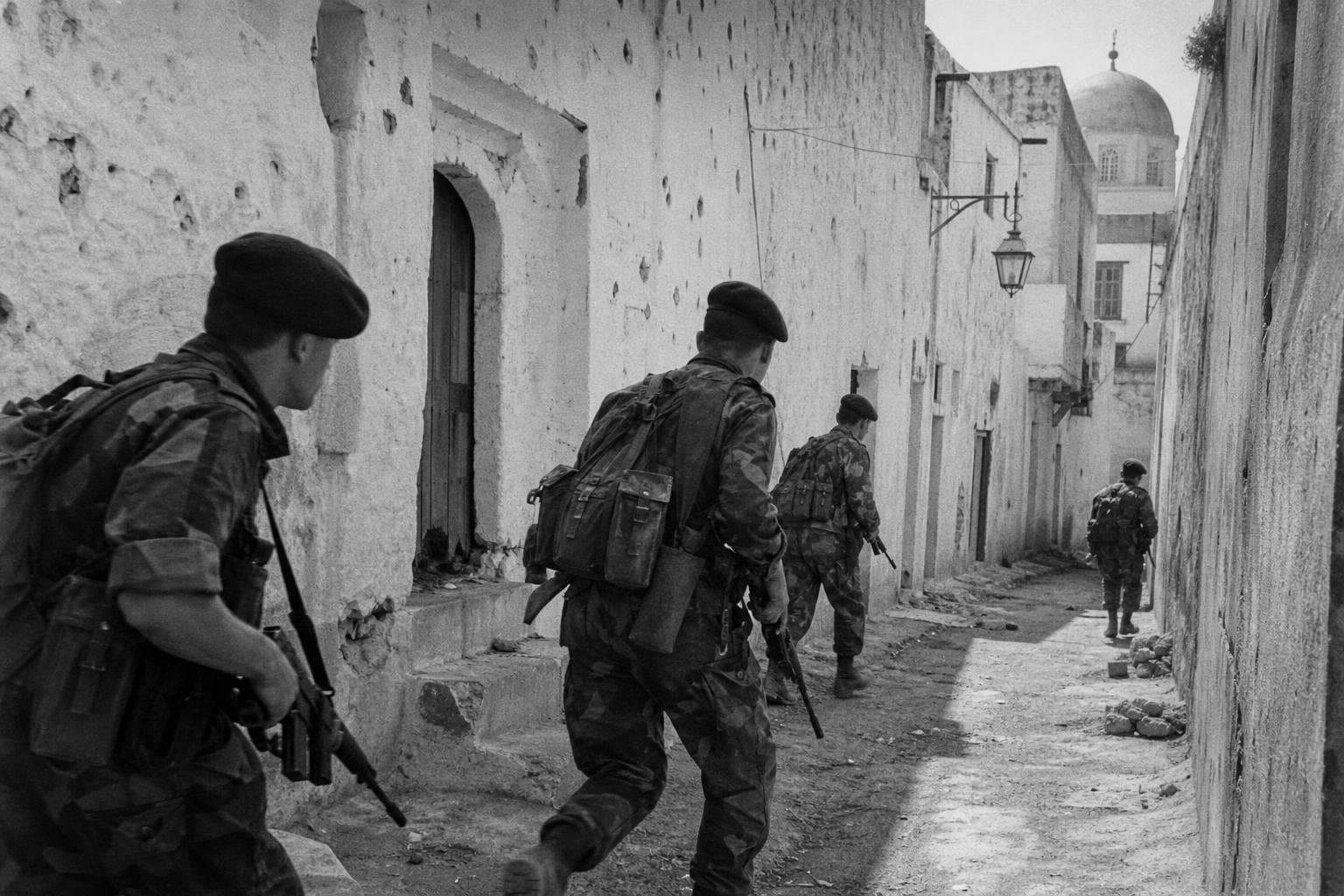

In 2003, five years into an occupation that was starting to look like an insurgency nobody in Washington had planned for, someone at the Pentagon's Office of Special Operations and Low-Intensity Conflict arranged a screening of a forty-year-old Italian film shot in grainy black and white. The invitation read, roughly: "How to win a battle against terrorism and lose the war of ideas." The film was Gillo Pontecorvo's The Battle of Algiers, and the fact that a building full of people planning counterinsurgency in Iraq felt they needed to watch a 1966 dramatization of French paratroopers in the Casbah tells you something about how little the doctrine had actually traveled, versus how often the myth of it had (Responsible Statecraft).
The operational reality the film dramatizes is not in serious dispute among historians, even where its politics are. Between September 1956 and September 1957, the French army took over internal security in Algiers from the police and ran a systematic campaign to dismantle the FLN's urban network — sweeps of Muslim districts, mass arrests, and, as the record now makes plain, widespread torture and summary execution, carried out under General Jacques Massu's paratroopers until the death of bomb-maker Ali la Pointe and the collapse of the urban cells (Battles of France). Measured purely as a military problem — find the network, break the network — it worked. The FLN's Algiers apparatus was gutted. That is the part of the story that gets called a French victory, and tactically, it was one.
What "Pacification" Actually Meant, and Why It Didn't Stay in the City
The Battle of Algiers is the part of the war that got a feature film, but it was a single operation inside a much larger doctrinal project that the French army had been building since the retreat from Indochina. Historian Terrence Peterson, in a recent interview about his book on the subject, traces the doctrine back to a specific institutional motive: officers who had just lost at Dien Bien Phu in 1954 wanted to prove that revolutionary warfare could be defeated by better methods, and Algeria became the laboratory (Afrique XXI). What Peterson's research shows, per that interview, is that "pacification" was never a single coherent method. It was a grab bag of programs — social initiatives aimed at Algerian women, at rural youth, at veterans — improvised by officers who, in Peterson's account, were themselves unsure how to reconcile the humanitarian language of the programs with the violence that was the army's actual answer to the FLN.
That improvisation looked different depending on where you were standing. In the cities, it looked like Massu's paratroopers and the interrogation rooms. In the countryside — where, per historian Neil Macmaster's research into the period from 1918 to 1958, roughly seventy percent of the Algerian population lived — pacification meant something closer to an attempt to break and rebuild rural authority structures, targeting the djemâas, the village and clan assemblies that had quietly sustained an anti-colonial political culture for decades before the war officially began (Oxford University Press / Macmaster). Macmaster's argument, as summarized by his publisher, cuts against the conventional picture of a peasantry uprooted and dislocated by French counterinsurgency; instead he finds a rural society that retained enough cohesion through family and kin networks to keep feeding the guerrilla organizations in the mountains even as the army believed it was pacifying them. If that's right, it means the army's rural doctrine was failing on its own terms well before anyone in Algiers lit a bomb — the insurgency's roots were never where French military planning assumed they were.
The Institutional Fracture Wasn't a Side Effect — It Was the Mechanism
This is where the "institutional fracture" in this period's reputation needs to be stated carefully, because the war didn't just produce a scandal about torture; it produced a structural break between the army and the civilian government that dictated, and was in turn dictated by, how the war was fought. Historian Martin Evans argues that the pivotal moment wasn't a battle at all but a political one: the Socialist-led Republican Front government of 1956–57, which came to power promising negotiation and instead escalated the war, believing Algerian nationalism to be reactionary and the French civilizing mission to be worth fighting for (Oxford University Press / Evans). Evans's account, drawing on archival sources and oral testimony, holds that this choice — made by civilians who thought they were being pragmatic — is what gave the army the political cover and the mandate to adopt practices like the institutionalized use of torture and the formation of pro-French Muslim militias. The war that followed cost the Fourth Republic its life in 1958, a collapse that the broader historical record confirms followed directly from the political crisis the war had generated (Britannica).
What's worth sitting with here is the direction of causation. The popular shorthand treats French institutional collapse as something the war did to French democracy — an outside shock. Evans's framing suggests the opposite sequence mattered more: a civilian government made a strategic choice rooted in its own ideological assumptions about Algerian nationalism, and that choice is what handed the army the operational latitude that later destroyed the civilian government's credibility. The army didn't capture the state. The state, in a specific political moment, armed the conditions for its own capture.
A Tactical Win That Became a Doctrine People Kept Trying to Reuse
The strangest afterlife of French Algeria is that the doctrine survived its own failure. Peterson's research traces how the counterinsurgency theory built in Algeria — codified by officers like Trinquier and Galula, both of whom appear among the commanders in the Battle of Algiers order of battle — got picked up decades later, most notably by General David Petraeus in Iraq starting in 2007 (Afrique XXI). The Pentagon's 2003 screening of Pontecorvo's film predates that formal revival by four years, which is its own small irony: the institution watched the cautionary tale before it reached for the doctrine the cautionary tale was warning against (Responsible Statecraft).
The appeal is obvious and the trap is the same one the French fell into. "Win the city, break the network, out-organize the population" reads as a transferable playbook. What doesn't transfer cleanly is the part Macmaster's work on the Algerian countryside underscores — that tactical dismantlement of an urban cell structure says very little about whether the underlying political and social conditions that produced the insurgency have changed at all. France won the Battle of Algiers and lost Algeria five years later. The FLN itself, pushed out of the capital, reverted to guerrilla war in the countryside and in exile, and the international scandal over the methods used in Algiers became, per the operational record, as damaging to France's position as the military outcome was favorable to it (Battles of France).
The Pattern Keeps Reappearing Because the Error Is Structural, Not Historical
This is not a uniquely French or uniquely 1957 problem. A recent Texas National Security Review analysis of counter-militancy operations across West Africa describes forces that can disrupt an armed group's activity in a given area but cannot convert that disruption into lasting security — intelligence collected but not acted on fast enough, positions cleared but not held, state presence restored only until the operation ends and then lost again (TNSR). None of that article is about Algeria. It doesn't need to be. The mechanism it describes — military pressure that produces temporary disruption rather than durable political effect — is the same mechanism that made the Battle of Algiers a tactical success and a strategic irrelevance. Clearing a city's cell structure, or a region's armed camps, answers the question an army is equipped to answer. It rarely answers the question an insurgency is actually asking, which is about legitimacy, presence, and who gets to claim the state's authority once the soldiers have moved on.
The honest accounting of Algiers 1956–57 is not that the French army was stupid or that Massu's paratroopers were uniquely monstrous by the standards available to them at the time — the methods were debated and in some cases resisted within the French officer corps itself, a nuance the historiography still argues over rather than settles. The honest accounting is that an institution solved the problem in front of it so thoroughly that it never had to confront the much larger problem it hadn't solved at all. Sixty years on, the doctrine keeps getting rediscovered by people convinced that this time the tactical win will hold. The question worth tracking isn't whether the next counterinsurgency force can clear a network. It's whether anyone running the operation has planned for what happens in the five years after they do.


