


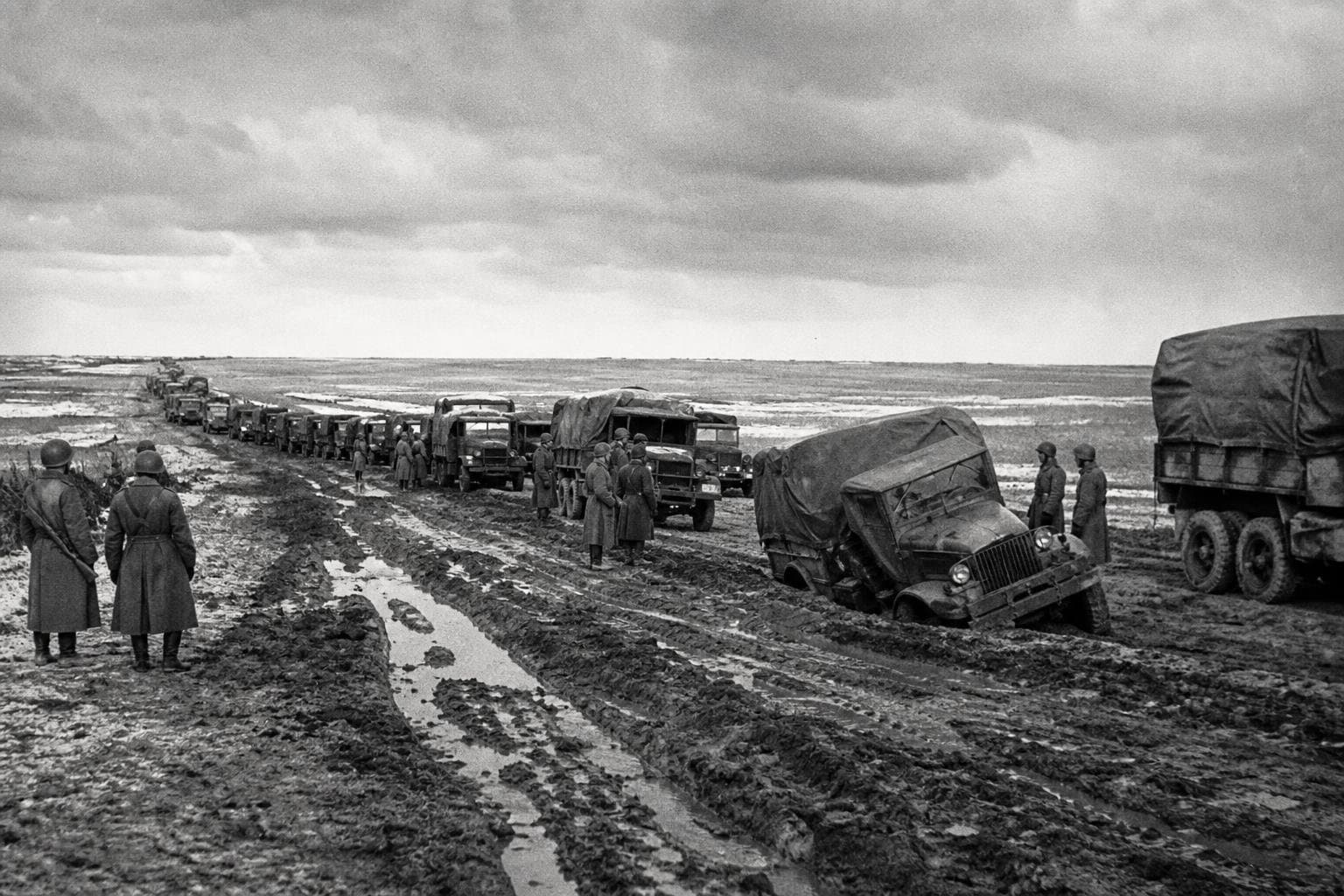

The Wehrmacht's logistics failure in 1941 is one of the most-cited cautionary tales in military history. German armored formations outran their supply lines, the railway gauge mismatch strangled resupply, and the famous halt before Moscow was — as a recent Modern War Institute analysis argues — primarily a sustainment collapse, not a tactical defeat. The lesson has been taught in staff colleges for decades. The U.S. Army has apparently been taking notes on the wrong part.
That MWI piece, published earlier this month, makes a pointed institutional argument: the Army spent twenty years optimizing logistics for permissive environments — uncontested supply lines, contractor support, static forward operating bases. Desert Storm and Iraqi Freedom rewarded that model. In 1991, the coalition had six uninterrupted months to build "iron mountains" of supplies in Saudi Arabia; in 2003, absolute air supremacy meant the supply chain was never seriously threatened. The Army internalized those conditions as normal. They weren't. They were historically exceptional.
The Transparent Battlefield Changes the Calculus
What makes the current moment sharper than the usual "we're preparing to fight the last war" critique is the Ukraine evidence. The MWI analysis points to the ongoing conflict as a live demonstration of what the authors call the "transparent battlefield" — a contested environment where logistics nodes, fuel depots, and supply convoys are visible, targetable, and regularly hit. A U.S. Army War College Strategic Studies Institute assessment of the Ukraine war at mid-2026 notes that advances in drone technology have created "kill zones" along the line of contact that rendered conventional military hardware — and by extension, conventional logistics movement — increasingly untenable.
The institutional problem the MWI piece identifies isn't ignorance of history. It's structural: efficiency-driven sustainment models are optimized for throughput, not survivability. A system built to move the most supplies the fastest is not the same system as one built to keep moving under persistent attack. Those are different engineering problems, and the Army has been solving the first one.
The Barbarossa parallel is instructive precisely because German planners weren't stupid — they planned for the campaign they expected, not the one they got. The question worth sitting with is whether current U.S. sustainment doctrine is similarly calibrated to a threat environment that no longer exists.