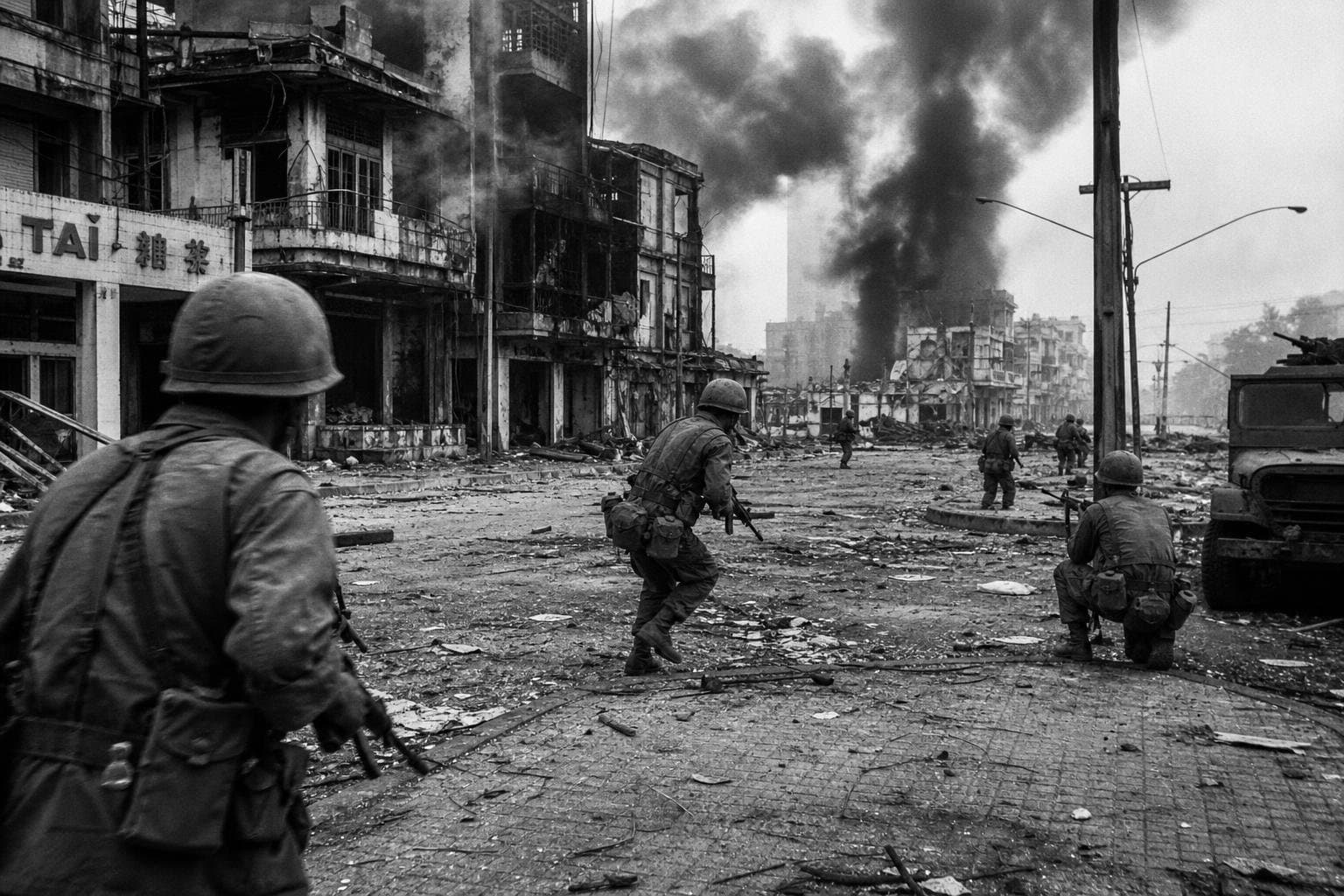

The Viet Cong attacked more than 100 towns and cities simultaneously in the early hours of January 31, 1968. An elite squad fought its way into the grounds of the U.S. Embassy in Saigon. In Hue, communist forces seized control of large portions of the former imperial capital. By any conventional military measure, the Tet Offensive was a catastrophic failure for its planners — and one of the most consequential strategic victories of the 20th century.
That paradox has generated fifty-plus years of argument, and it still hasn't been resolved cleanly. I've covered pieces of it before — the Politburo's strategic calculus in July and American command's misreading of the battle in June. What I want to examine here is the coordination problem: how the offensive was designed, what it was actually supposed to accomplish, and why the gap between those two things tells us more about the war than the fighting itself does.
The Plan Was Not What It Looked Like
The standard narrative frames Tet as a surprise attack that shocked American command. The surprise part is accurate. The rest requires more care.
Planning for the offensive began in 1967 after factions within the Viet Cong and North Vietnamese leadership concluded that a "quick victory" might be achievable through a mass urban assault. According to the Australian Department of Veterans' Affairs Anzac Portal, the operational concept was deliberately unconventional: rather than concentrating forces in the manner of traditional military doctrine, the offensive would disperse attacks across as many population centers as possible. The goal was not territorial conquest but political collapse — a "general uprising" against the South Vietnamese government.
This is the detail that gets lost in the tactical narrative. The offensive was designed as a political operation wearing military clothes. The military attacks were the mechanism; the anticipated popular revolt was the objective. When that revolt failed to materialize — when South Vietnamese civilians did not rise against Saigon — the entire strategic premise collapsed. The Viet Cong had gambled everything on an assumption about South Vietnamese political sentiment that turned out to be wrong.
The Coordination Achievement and Its Cost
Whatever its strategic failure, the operational coordination required to launch simultaneous attacks across more than 100 locations during a holiday ceasefire period was genuinely remarkable. The Tet holiday — the Vietnamese lunar new year — had by recent tradition been observed as a period of truce. Attacking during it achieved near-complete tactical surprise, as the Anzac Portal account notes.
The cost of that coordination was severe. Wikipedia's year-by-year account of 1968 in the Vietnam War records U.S. estimates of communist killed in action ranging from roughly 45,000 to over 181,000 for the year — a range that reflects genuine methodological disagreement between official counts and field estimates, not a rounding error. North Vietnamese records, by contrast, list approximately 44,842 KIA with total casualties of around 111,000 killed and wounded. These figures are not interchangeable; they reflect different counting methodologies and different political incentives on both sides. What they agree on is that the Viet Cong suffered devastating losses. With the Viet Cong decimated, General Vo Nguyen Giap — who had shifted from his earlier advocacy of protracted guerrilla warfare to support the urban offensive concept — lost much of his operational authority afterward, as the Anzac Portal records.
The institution that planned the offensive was functionally destroyed by executing it.
What American Command Knew, and When
Britannica's account situates the offensive within a domestic American context that was already deteriorating before January 31. By 1967, growing numbers of Americans were dissatisfied with the war; campus protests were common; the credibility of official optimism was already under strain. The Tet attacks didn't create American skepticism about the war — they crystallized it.
This matters for how we assess the "media narrative versus military reality" framing that often structures Tet analysis. The argument that media coverage distorted a military victory into a perceived defeat has real substance — the attacks were repelled, the general uprising never came, and allied forces held. But it also elides something important: the American public's reaction to Tet was not purely a media artifact. It was a rational response to the gap between what official sources had been claiming about the war's trajectory and what the images from Saigon's streets made undeniable. Britannica notes that by 1967 some Americans were already pointing out that the United States was in reality supporting a corrupt and oppressive government in Saigon — a critique that Tet's urban chaos made suddenly vivid to a much wider audience. You cannot attribute the credibility collapse entirely to journalism when the credibility had been built on optimistic assessments that Tet exposed as hollow.
Meanwhile, at Khe Sanh — where a months-long siege had been underway since early 1968 — American command remained focused on a potential set-piece battle in the northwest while the urban offensive unfolded across the country. Whether Khe Sanh was a deliberate feint designed to draw attention away from the cities remains contested among historians; what is clear is that the two simultaneous crises strained both command attention and public confidence at the same moment.
The Anzac Portal's summary is worth sitting with: "Only much later would the Vietcong and North Vietnamese realise what they had actually achieved." That sentence cuts both ways. The Politburo didn't plan a psychological operation against American public opinion — they planned a military-political offensive that failed on its own terms and succeeded on terms they hadn't anticipated. Calling it a strategic masterstroke retrofits a coherence the planning never had.
What Tet actually demonstrates is something more uncomfortable: that a catastrophic military defeat can produce strategic effects its planners didn't intend, if the political context on the other side is already fragile enough. The Viet Cong didn't win Tet. They broke themselves against allied defenses — and the shock of their attempt broke something in Washington that couldn't be repaired.


