


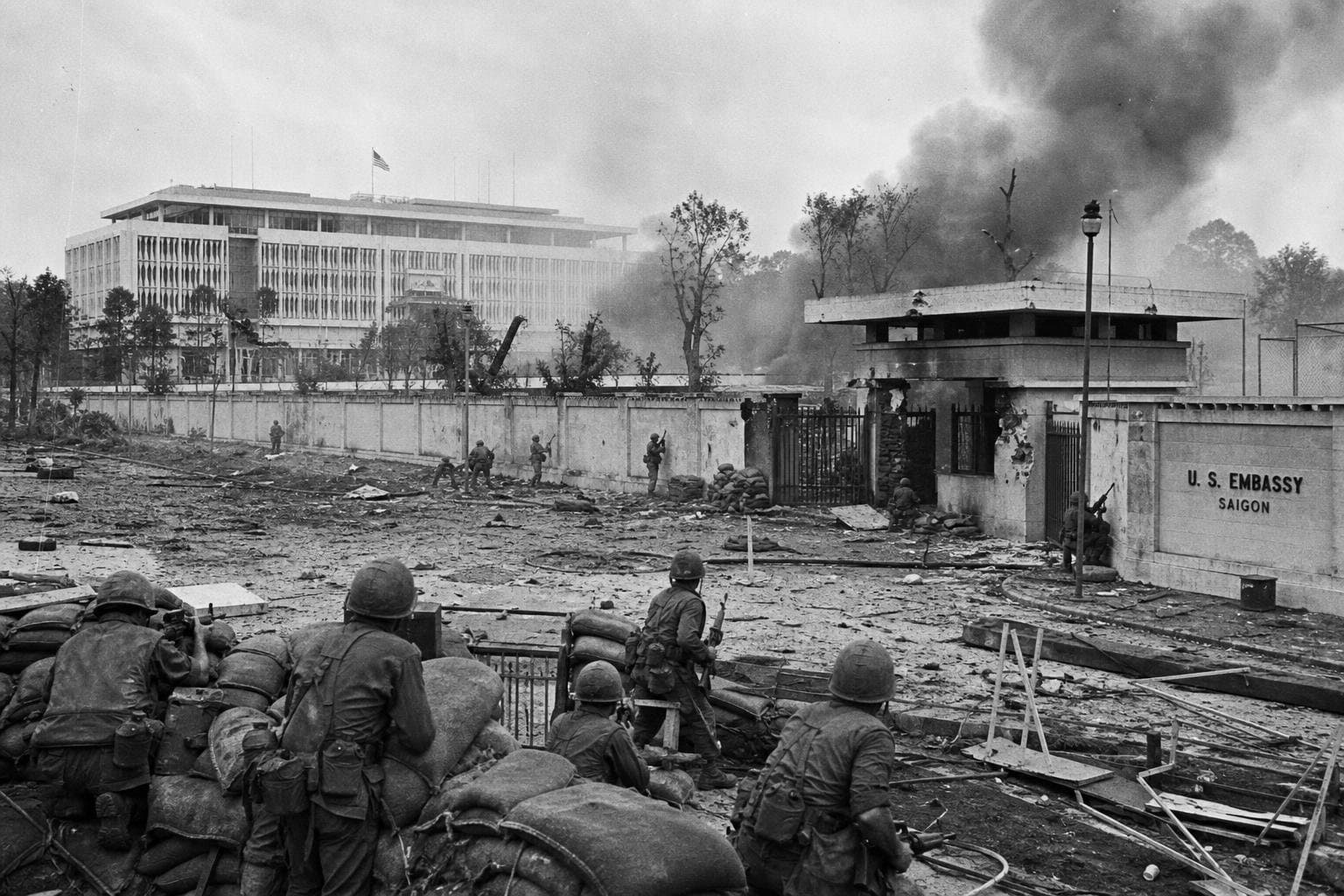

The attack on the U.S. Embassy compound in Saigon on January 30, 1968 lasted about six hours. By any military measure, it failed — the attackers never breached the chancery building, and all nineteen Viet Cong sappers involved were killed or captured. By the end of the broader offensive, communist forces had suffered casualties that U.S. estimates placed in the range of 181,000 killed — a figure that dwarfs the losses on the other side, though it should be noted that methodology varies sharply between U.S. estimates and North Vietnamese records, which counted roughly 44,800 KIA for the same period.
And yet within two months, Lyndon Johnson had announced he would not seek reelection. The strategic logic that had governed American involvement since 1965 was in ruins. How does a military catastrophe become a political victory? The answer is that Hanoi was never really fighting the war Washington thought it was.
The Offensive Was Designed Around a Theory of American Fragility
The Vietnamese Communist Party Politburo convened a special session on December 28, 1967, approving a plan to transition the war into what they called a "general offensive and general uprising" — a phase intended to produce a decisive shift, not a battlefield decision in the conventional sense. The goal was to strike simultaneously at urban centers across South Vietnam, demonstrate that the Saigon government could not protect its own cities, and shatter the credibility of American assurances that the war was being won.
This is the part that gets lost in the tactical postmortems. Hanoi's planners were not expecting to hold Saigon. They were expecting the attacks to produce a political collapse — either a popular uprising against the Saigon government, or a crisis of confidence in Washington severe enough to change American policy. The first didn't happen. The second did.
What made this possible was the gap between what American leadership had been saying publicly and what the Tet attacks made visible. General Westmoreland had spent late 1967 assuring the public that the enemy was weakening. His own reporting acknowledged the possibility of a pre-Tet offensive — he noted in a report that "a Communist attack is clearly coming" — but the political apparatus around him had been projecting optimism. When coordinated attacks hit more than a hundred cities and towns simultaneously, the credibility gap didn't just widen. It collapsed.
The Intelligence Picture Was Accurate. The Institutional Response Was Not.
This is where the prior coverage of Tet in this newsletter focused — on how American command read the battle correctly and the war wrong. Worth adding here: the intelligence failure wasn't primarily about warning. Westmoreland's own statements show awareness that something was coming. The failure was interpretive. American command was organized around a theory of the war in which enemy losses were the key metric, and by that metric, the U.S. was winning. The Tet Offensive didn't disprove that theory on the battlefield. It made the theory irrelevant.
The Politburo had identified something that the American command structure was structurally unable to process: that the relevant audience wasn't in Hue or Saigon. It was in living rooms in Ohio. A war being measured in body counts and pacification statistics could be unwon by a single week of television footage showing the U.S. Embassy under attack.
What Hanoi Got Wrong — and Why It Didn't Matter
The popular uprising never materialized. South Vietnamese civilians did not turn against the Saigon government en masse. The battle at Quảng Trị), one of the northern engagements during the offensive, ended in a South Vietnamese-American victory. The Viet Cong infrastructure that participated in the attacks was, in many areas, effectively destroyed — a loss from which it never fully recovered, leaving the war's later phases increasingly dominated by North Vietnamese regular forces rather than southern insurgents.
Hanoi's planners had miscalculated the political conditions in the South. But they had correctly calculated the political conditions in the United States. The offensive's military failure was real. Its strategic success operated on a different level entirely — one that American doctrine, focused on attrition and measurable progress, had no framework for addressing.
This is the pattern that War on the Rocks has traced in more recent contexts — the weaker party converting military inferiority into geopolitical leverage by fighting a different war than the one being offered. The Clausewitzian insight that war is politics by other means cuts both ways: it can discipline a stronger power's strategy, or it can expose the limits of a strategy that has forgotten politics entirely.
The lesson of Tet isn't that surprise attacks win wars. It's that a combatant who correctly identifies where the real decision will be made — and designs operations around that — can absorb catastrophic tactical losses and still walk away having changed the strategic situation. American command in 1968 was measuring the wrong thing, and Hanoi knew it.