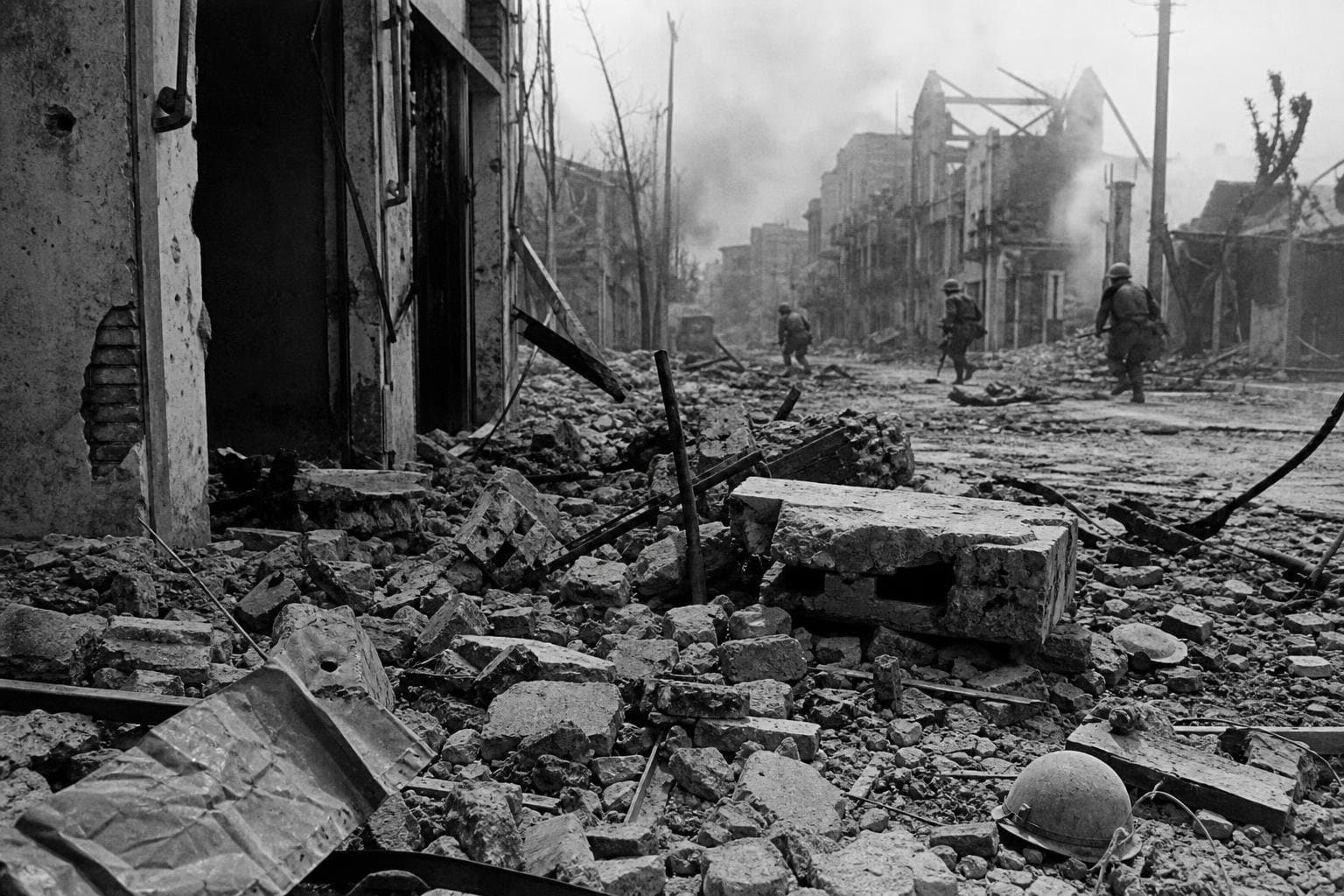

The attack on the U.S. Embassy compound in Saigon on January 30, 1968 lasted roughly six hours before American forces retook it. By any tactical measure, it was a failure. The sappers who breached the outer wall never entered the main chancery building. They were all killed or captured. General William Westmoreland stood in the courtyard afterward and declared it a Viet Cong defeat.
He was right about the embassy. He was catastrophically wrong about what the embassy attack meant.
That gap — between the tactical outcome and its strategic significance — is the central problem of Tet, and it has been misread in both directions ever since. The standard popular narrative holds that Tet was a military disaster for North Vietnam and the Viet Cong that somehow became a political victory through media distortion. The revisionist counter-narrative insists the offensive proved American strategy was working and that defeatist journalism handed Hanoi a victory it hadn't earned on the battlefield. Both framings miss the more uncomfortable truth: American command had built an analytical system that was structurally incapable of processing what Tet revealed, regardless of how the cameras were pointed.
What Westmoreland Actually Believed — and Why
To understand the intelligence failure, you have to start with the theory of victory that American command had committed to by late 1967. The attrition strategy rested on a specific premise: that the United States could inflict casualties on North Vietnamese and Viet Cong forces faster than Hanoi could replace them. Body counts were the metric. Progress was measured in kill ratios. The "crossover point" — the moment when enemy losses would exceed recruitment — was the strategic horizon.
Source 5 offers a striking complication to the standard account here. Writing about newly available North Vietnamese sources, analyst Mark Moyar argues that in the years following American intervention, North Vietnamese forces did in fact incur casualties on a scale roughly consistent with what U.S. commanders believed — and that North Vietnamese commanders in the South were sending wildly exaggerated claims of battlefield success back to Hanoi, encouraging North Vietnam's leadership to persist with tactics that were bleeding their own forces. Hanoi, per this account, began to recognize the problem in spring 1967, when its leaders discerned that the alleged results weren't matching reality.
This is contested historiography, and it should be treated as such. The traditional interpretation — that American body counts were systematically inflated and that U.S. commanders were deceiving themselves and Washington — remains well-supported in the literature. What the newer North Vietnamese sources suggest is that the fog of war ran in multiple directions simultaneously: American commanders were overconfident about attrition's effects, but Hanoi's own field commanders were also feeding their superiors distorted pictures. Both sides, in other words, were partly flying blind.
What is not contested is what Westmoreland told Congress in November 1967: that the enemy was weakening, that American forces were winning, and that the end was approaching. Source 4 notes that Defense Secretary Robert McNamara had been presenting statistics showing declining enemy capabilities and rising body counts as proof of American superiority. The optimism was institutional, not merely personal. It was baked into the reporting structure.
The Architecture of the Offensive — and What It Revealed
The Tet Offensive was not improvised. Source 6 describes the organizational groundwork laid in the preceding months: in October 1967, the Central Bureau dissolved Military Region 7 and the Saigon-Gia Dinh Military Region to establish a new command structure organized around six sectors, each with its own command post, each responsible for a specific axis of advance into Saigon. The plan — codenamed "Plan X" according to researcher Nguyen Dinh Tu — had been in preparation for roughly four years. Zone 6, a dedicated urban commando and special forces unit, was assigned specifically to attack key government agencies.
The scale of coordination required to execute simultaneous attacks on more than 100 cities and towns across South Vietnam — while maintaining operational security against an adversary with substantial intelligence assets — was itself a significant military achievement. Source 2 frames it plainly: the NVA and Viet Cong struck military and political targets across the country in a coordinated wave. Whatever the tactical outcome, the operation demonstrated that the enemy Westmoreland had described as weakening had the organizational capacity to mount the largest offensive of the war.
This is the first thing Tet revealed that American command couldn't process: the attrition model had been measuring the wrong thing. Kill ratios and body counts tracked tactical engagements. They said nothing about the enemy's organizational resilience, its ability to recruit, its capacity for strategic patience, or — most critically — its willingness to absorb catastrophic losses in service of a political objective. The Viet Cong infrastructure in the South was effectively destroyed during Tet, a military fact that American commanders correctly identified. What they couldn't account for was that Hanoi had anticipated this and was prepared to absorb it, shifting the burden to North Vietnamese regular forces.
The Credibility Gap Was a Command Failure Before It Was a Media Story
The Cronkite moment has become the shorthand for Tet's political impact. On February 27, 1968, Source 4 recounts, Walter Cronkite looked into the camera and declared the war a stalemate, suggesting the United States should seek a negotiated settlement. Johnson reportedly said, "If I've lost Cronkite, I've lost Middle America." The story has the satisfying shape of a turning point, and it was one — but it locates the cause in the wrong place.
The credibility gap that Tet exploded had been constructed over years by the military's own reporting. Journalists in Saigon had been attending what they called the "Five O'Clock Follies" — the daily military press briefings — and finding that the picture presented there bore increasingly little resemblance to what they were seeing in the field. The gap between official optimism and observable reality was not a media invention. It was a product of a command culture that had structured its metrics around demonstrating progress rather than assessing it honestly.
When Tet happened, the American public didn't simply believe the media over the military. They watched enemy forces fighting inside the U.S. Embassy compound and drew their own conclusions. The images were damaging not because they were misleading but because they were accurate — and because they contradicted, in the most visceral possible way, everything official Washington had been saying for months. Source 1 frames the offensive as the moment that brought the war home to American living rooms in a way that previous coverage had not.
The revisionist argument — that the media handed Hanoi a victory the battlefield hadn't — gets the causality backward. The credibility problem was a command failure first. The media reported what was visible. What was visible contradicted the official narrative. The narrative was the problem.
Johnson's Decision and the Limits of Strategic Reassessment
The political consequences cascaded quickly. Senator Eugene McCarthy's anti-war campaign, previously dismissed as marginal, gained sudden momentum. In the New Hampshire primary on March 12, 1968, Source 4 notes, McCarthy's showing was strong enough to signal that Johnson was politically vulnerable within his own party. Robert Kennedy entered the race. On March 31, Johnson announced he would not seek re-election.
What's worth examining is what Johnson's withdrawal actually represented as a strategic decision. The administration had been asked by Westmoreland for roughly 206,000 additional troops following Tet — a request that, if granted, would have required calling up reserves and formally expanding the war's resource commitment. The request forced a reckoning that the optimistic pre-Tet framing had deferred: was the United States prepared to escalate further, or had it reached the limit of what it was willing to commit?
The answer, it turned out, was that the political foundation for further escalation had already eroded — not because of Tet itself, but because of the gap between what Tet revealed and what the public had been told. Johnson's decision to de-escalate and pursue negotiations was a rational response to a political reality that the military's own reporting had helped create.
The Measurement Problem That Outlasted the War
The deepest lesson of Tet isn't about media management or political will, though both matter. It's about what happens when a military command builds its theory of victory around metrics that measure activity rather than progress toward the actual objective.
Attrition worked as a concept only if the enemy's political will was a function of its casualty rate — if, at some threshold of losses, Hanoi would conclude the cost exceeded the benefit and negotiate on American terms. The entire strategy rested on this assumption. Tet demonstrated, at enormous cost to the attacking forces, that the assumption was wrong. Source 5 notes that North Vietnamese forces incurred casualties on a horrific scale during the period of American intervention — and persisted anyway. The willingness to absorb losses that would have been strategically decisive against a different adversary was itself the central fact of the war, and American command never found a metric that captured it.
Source 2 puts the outcome in terms that remain accurate: the NVA and Viet Cong suffered a military defeat and dealt a huge blow to U.S. support for the war. Both things are true simultaneously. The tactical result and the strategic result pointed in opposite directions because the two sides were fighting different wars. Hanoi was fighting a war of political endurance. Washington was fighting a war of attrition. These are not the same contest, and winning one does not mean winning the other.
Westmoreland was right that the embassy attack was a tactical failure. He was wrong that tactical failures were the relevant unit of analysis. By the time American command understood the difference, the political conditions for continuing the war had already collapsed — not because a television anchor said so, but because three years of optimistic briefings had finally met an event that couldn't be explained away.
The fog of war is real, and it ran in multiple directions in 1968. But some of that fog was manufactured in Saigon and Washington, and the people who manufactured it were the last to notice what it was obscuring.
The Brusilov Offensive piece from April (/p/the-brusilov-offensive-broke-the-habsburg-army-by-solving-the-wr) examined a case where tactical innovation outran strategic coherence. Tet is the inverse: a strategically coherent operation by Hanoi that exposed the incoherence of the American framework it was attacking.


