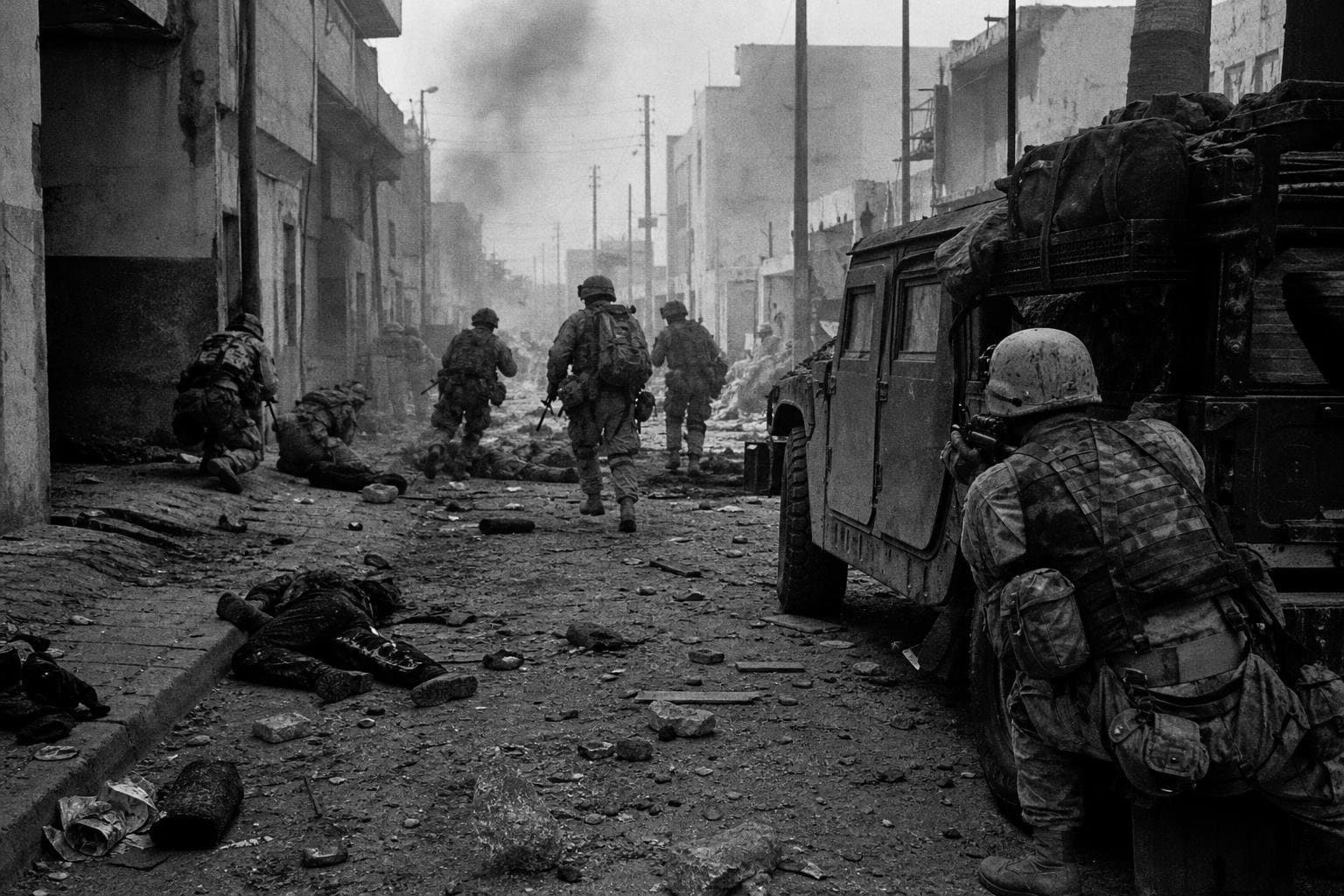

Eighteen Americans died in eighteen hours of urban combat on October 3–4, 1993, and by the next spring every U.S. soldier was gone from Somalia. Both facts are confirmed record. What's contested — and what the available sources actually disagree on — is almost everything about how many Somalis died getting them out, and what the raid was supposed to prove in the first place.
A Humanitarian Mission That Became a Manhunt
The U.S. didn't arrive in Mogadishu to fight anyone. In December 1992, roughly 25,000 American troops landed as part of a UN-sanctioned operation to protect famine relief convoys, following the collapse of Mohamed Siad Barre's government and the warlord conflict that followed it, according to Britannica's account of the intervention. The first phase, the Unified Task Force, drew contributions from two dozen countries and succeeded at the narrower job of disarming enough militia to let food move. The successor mission, UNOSOM II, inherited a far more ambitious mandate — disarm the clans, restore order, stand up a government — with troop contributions from 29 nations, per the same source.
That mandate drift matters because it's not incidental to the later disaster; it's the precondition for it. A force built to escort grain trucks was, within a year, hunting a specific warlord through a city he controlled. This is the pattern George H.W. Bush's foreign policy exhibited more broadly in this period — not the cautious realism later attributed to him, but a genuine investment in UN-backed multilateral humanitarian action, as a recent reassessment in Texas National Security Review argues. Somalia was supposed to be a proof of concept for that model — intervention under UN authority, broad coalition, limited casualties. By October 1993, it had become something the model didn't anticipate: a special-operations manhunt against Mohamed Farah Aydid conducted inside the city the original mission was sent to feed.
Hunting a Warlord in a State With No Intelligence Service to Borrow From
Task Force Ranger's capture-raid on October 3, 1993, targeted two lieutenants of Aidid's inner circle, according to an account by retired Navy SEAL Captain Eric Olson's former colleague, CDR Tom Hawkins writing for the National Navy UDT-SEAL Museum. That account should be read for what it is — an institutional history published by a veterans' museum, written by a participant with an explicit stake in correcting a public record he felt a Hollywood film had erased. It is not a neutral after-action report, and its numbers should be weighed accordingly.
What it does illustrate, credibly, is the operating environment: a four-man SEAL element supporting Delta Force operators and 160th Special Operations Aviation Regiment crews was working target intelligence that had reportedly developed "earlier in the day," per Hawkins's account — same-day human intelligence driving a raid into a hostile city, with no functioning national government to provide ground truth and no local security partner to check it against. That's a structurally different intelligence problem than one faced by a force operating alongside an allied state's own services. Scholarship on African intelligence institutions notes how unevenly those services developed across the continent after colonial rule, shaped by distinct experiences of liberation war, Cold War patronage, and post–Cold War collapse, per a recent special issue introduction in the Journal of Strategic Studies. Somalia in 1993 had none of that institutional scaffolding left standing. Task Force Ranger wasn't working with thin intelligence by choice. It was working in a vacuum, built on tips about where two men might be on a given afternoon, in a city with no government capable of confirming or denying them.
The Casualty Count Depends Entirely on Who's Counting
Here the record genuinely diverges, and the divergence is the story. Britannica's institutional summary states that 18 U.S. soldiers and "hundreds" of Somalis were killed in the battle, drawing on its own encyclopedia entries on the intervention and the battle itself, per Britannica. The Navy SEAL Museum's account, written from inside the operation, describes 180 American soldiers fighting against nearly 3,000 of Aidid's militia and armed civilians, and claims "thousands" of clan members killed with thousands more wounded, per the museum's published history.
Those are not two slightly different estimates of the same number. They're an order of magnitude apart, and the discrepancy tracks exactly the kind of source bias this publication exists to flag. An institutional encyclopedia entry reaching for a defensible, conservative figure is a different kind of source than a participant's institutional history written, by its own framing, to restore credit to men the author felt history had overlooked. Both can be sincere. Neither should be treated as a settled count. The honest position is that the American toll — 18 killed, a 160th pilot held eleven days as a prisoner, per both sources — is the one figure in this battle that isn't in dispute. The Somali toll is not a number historians agree on; it's a number that depends on who was doing the counting and why.
A Tactical Win That Captured the Target and Lost the Argument
The raid, by its own narrow terms, worked. Delta operators took the building; the TF captured Omar Salad, Mohamed Hassan Awale, and other Aidid lieutenants named in the SEAL Museum's account, and reportedly induced enough fear among other clan chieftains that some considered turning Aidid in themselves, per the same source. Two Black Hawks went down anyway, and the eighteen-hour fight to recover the crews is what the public remembers, for reasons that have nothing to do with whether the original objective — capturing specific named individuals — was achieved.
This is the pattern that shows up whenever a military converts a tactical raid into a strategic bet that the raid itself can't cash. A separate body of recent research on counter-militancy operations in West Africa makes an argument worth borrowing as an analytical frame, without claiming it describes 1993 Mogadishu directly: that security forces across the region routinely fail not from lack of capacity but from an inability to convert temporary military pressure into lasting political effect, because operations disrupt without producing durable presence, and intelligence gets collected without being turned into sustained action, according to Texas National Security Review. Task Force Ranger captured its targets and killed or wounded an unknown but substantial number of Aidid's fighters. None of that converted into a political settlement, a stable government, or a continued American or UN presence. Within roughly a year of the operation beginning, per Britannica's timeline, the entire intervention — American and UN — had ended, with Somalia left in continued clan warfare.
What the Record Actually Supports, and What It Doesn't
It would be tidy to say Task Force Ranger's planners ignored specific warnings, or that a single command decision made the collapse inevitable — the kind of clean narrative this publication has pushed back against before, in pieces on Tet and Task Force Smith. The sources available here don't support that level of specificity about the planning process itself; they confirm the shape of the mission, the raid's immediate outcome, and the radically different ways participants and encyclopedists have since counted the cost. What they do support is a narrower and arguably more durable point: a force built for one mission — protecting aid distribution under a UN mandate rooted in the multilateral idealism of the moment — was asked, within a year, to perform a fundamentally different one, hunting an individual through a hostile city with no local intelligence service to lean on. The tactical outcome of that mismatch is contested in its details. The strategic outcome is not. The United States left Somalia, Aidid remained a factor in Somali politics, and the raid that was supposed to break the stalemate became, instead, the reason the intervention ended.
The question worth carrying forward isn't whether Task Force Ranger's operators did their jobs well on the ground — the available record suggests they did, under conditions nobody could have planned around. It's how often militaries since have made the same substitution: treating a successful raid as proof of a successful strategy, when the two were never measuring the same thing.


