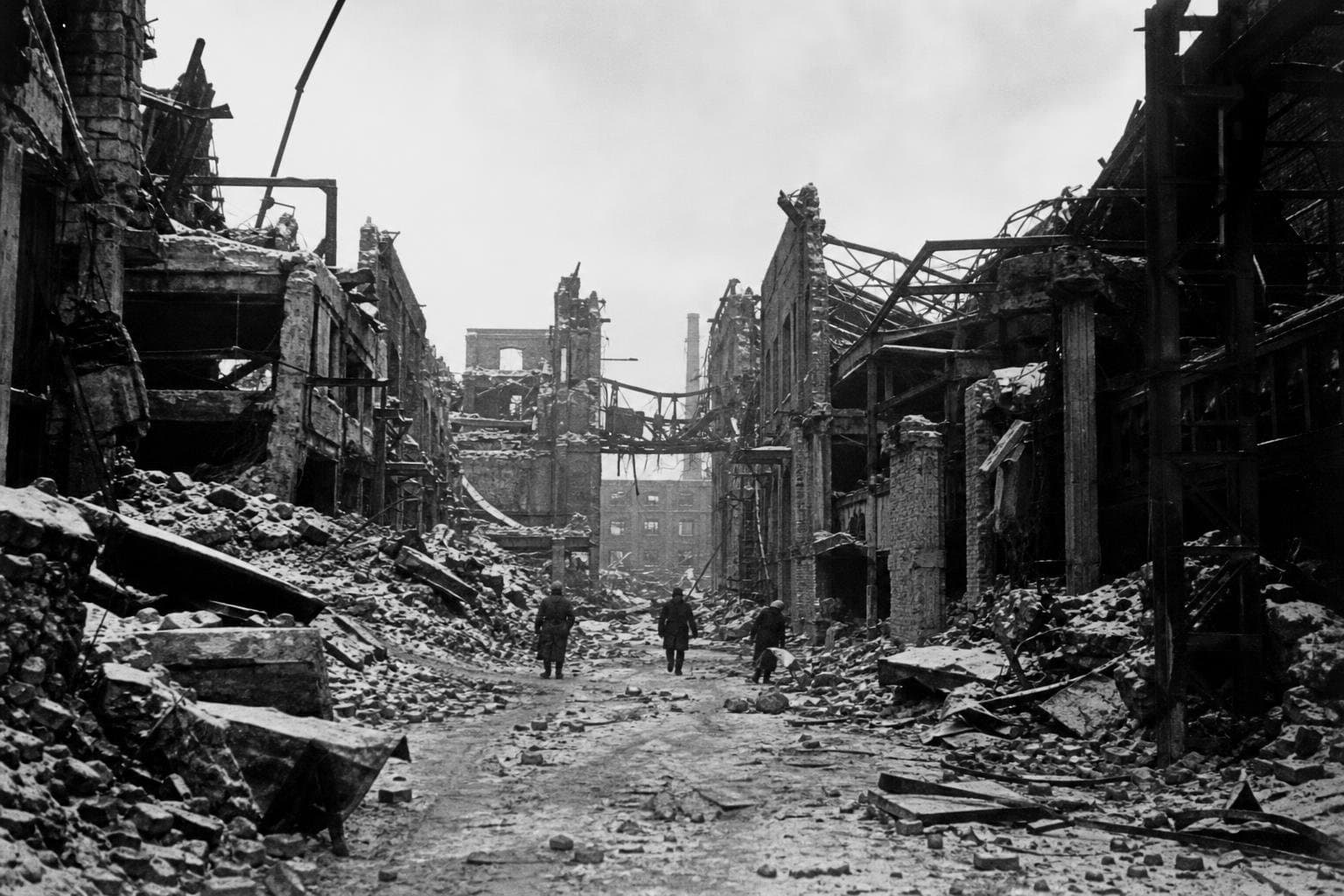

The German Sixth Army entered Stalingrad in August 1942 expecting to finish the job in days. The city bore Stalin's name, which gave it symbolic weight, but the operational logic was straightforward: seize the Volga crossing, cut Soviet supply lines running north-south, and consolidate the southern flank of the Eastern Front. What followed instead was nearly six months of grinding attrition that consumed the Sixth Army entirely. The standard explanation credits Soviet tenacity — which is true but incomplete. The more interesting story is institutional: how the Red Army, in real time and under catastrophic pressure, adapted its tactical doctrine, logistics, and command culture to a form of warfare it had not anticipated and was not prepared for.
That adaptation was neither smooth nor inevitable. It was improvised, costly, and contested at every level of command. Understanding it requires looking past the heroic narrative — past Pavlov's House and the sniper duels — to the operational system underneath.
The City Negated Everything the Red Army Thought It Knew
Soviet military doctrine in 1942 was oriented toward mobile defense and operational maneuver. The Red Army's pre-war thinking, shaped by theorists like Tukhachevsky before his purge, emphasized deep battle — coordinated strikes across multiple echelons to paralyze an enemy's rear. None of that was applicable in Stalingrad. The city's industrial districts, with their massive factory complexes, rubble fields, and ravines running down to the Volga, compressed the operational space to a few hundred meters in some sectors. Tanks couldn't maneuver. Artillery couldn't range effectively without hitting friendly positions. Air support was as dangerous to defenders as attackers in close quarters.
The German Sixth Army had its own problem with this terrain, but it had the initiative and was attacking. The Soviets were defending a shrinking perimeter with their backs to a river. Britannica's account of the battle notes that the city's geography — the Volga at the defenders' backs, the ravines and factory buildings creating natural strongpoints — ultimately worked in Soviet favor once they accepted that the city itself was the defensive line. But accepting that took time, and the early weeks were characterized by the kind of disorganized, reactive defense that cost enormous casualties without stabilizing the front.
The critical shift came when Soviet commanders stopped trying to hold lines and started fighting for buildings.
Hugging the Enemy: The Tactical Logic of Close Combat
The adaptation that most directly shaped the battle's outcome was what Soviet soldiers called "hugging" the Germans — maintaining such close contact with the enemy that Luftwaffe close air support became unusable. If Soviet and German positions were separated by thirty meters, a Stuka pilot couldn't distinguish them. The same logic applied to German artillery: massed fires that had devastated Soviet formations in open terrain became liabilities in a city where the front line ran through the same building's floors.
This wasn't a doctrine handed down from Moscow. It was a tactical discovery made by junior officers and NCOs under fire, then recognized and systematized by commanders who were paying attention. The emphasis shifted to small-unit action — assault groups of six to eight men, each with a specific task: a breaching element, a fire suppression element, a consolidation element. These groups were trained to move through buildings rather than between them, using holes blown through walls rather than exposing themselves in streets. The Soviets called this shturmovye gruppy — storm groups — and by October 1942 they had become the standard tactical unit for urban fighting in the city.
Britannica's World War II coverage describes the fighting in the factory district as particularly intense, with the Tractor Plant, the Barricades factory, and the Red October steel plant changing hands multiple times. The Barricades factory complex — referenced also in Soviet-era accounts of the city's industrial war effort — was both a production site and a fortress, its massive concrete structures providing cover that neither side could easily reduce. The Soviets learned to use these structures as anchors for their storm group tactics, holding the rubble while the Germans bled trying to clear it room by room.
What made this adaptation remarkable was the speed of institutional learning under conditions that should have made learning impossible. Units were being destroyed and rebuilt constantly. The 62nd Army, which bore the primary burden of the city's defense, was reconstituted multiple times during the battle. That it maintained any coherent tactical identity at all is a function of how quickly its surviving officers absorbed and transmitted what was working.
The Volga Crossing: Logistics as the Real Defensive Line
The tactical adaptation inside the city would have been irrelevant without a solution to the supply problem. The 62nd Army was fighting with its back to the Volga, which meant every round of ammunition, every replacement soldier, every kilogram of food had to cross the river under fire. The Germans controlled the western bank's high ground and could observe and shell the crossing points. The Luftwaffe attacked the ferries and barges continuously.
What kept the 62nd Army alive was a logistics operation that has received far less attention than the tactical fighting. Soviet accounts of the Stalingrad region's war effort describe the construction of the Volga Rockade — a roughly thousand-kilometer rail line from Ilovlya to Sviyazhsk, built in 1942 under air attack and material shortage — as a critical enabler of the broader campaign. The line allowed Soviet forces to move supplies laterally along the Volga's eastern bank without exposing them to German interdiction, feeding not just the city's defenders but the forces assembling for Operation Uranus. During the 200 days of the battle, more than 340,000 wagons of equipment, ammunition, fuel, and food moved along these rail lines, according to the same source — though that figure covers the broader regional effort, not the city crossing alone, and should be understood as context rather than a precise measure of what reached the 62nd Army specifically.
The crossing itself was managed through a combination of small boats, improvised ferries, and sheer organizational stubbornness. Night crossings became the norm. Wounded went east; replacements and supplies came west. The system was never secure and never adequate — but it was continuous, which was what mattered. An army that can be resupplied, even poorly, can continue to fight. One that cannot resupply at all collapses in days.
The logistics operation also shaped the tactical situation in a way that's easy to miss: because the crossing points were fixed and known, the Soviets could pre-position supplies on the eastern bank and move them across in predictable patterns, which allowed unit commanders to plan operations around anticipated resupply rather than fighting until they ran out and then stopping. That's a small thing in absolute terms, but in a battle fought at the scale of city blocks, the difference between a planned assault and an improvised one could be measured in lives.
Command Culture Under Pressure: What Changed and What Didn't
The Soviet command system in 1942 was still operating under the shadow of the purges. Initiative at the junior officer level was dangerous — not just tactically but politically. Officers who made decisions without authorization risked not just failure but denunciation. The result was a command culture that pushed decisions upward, slowing response times and concentrating risk at the top.
Stalingrad didn't fix this. It would be too clean to say the battle transformed Soviet command culture. What it did was create conditions where the cost of not delegating became immediately visible in a way that higher command could not ignore. When a storm group was clearing a building and the situation changed — a German counterattack from an unexpected direction, a floor collapsing, a flanking opportunity — the group leader had to decide. There was no time to request authorization. The officers who survived were the ones who acted, and the system, under the pressure of necessity, began to accommodate that.
This is contested ground among historians. Some analysts emphasize the continued role of political officers and the NKVD in maintaining discipline through fear — and that element was real and should not be minimized. Others point to the emergence of a more flexible tactical culture at the small-unit level as a genuine institutional development. Both things were true simultaneously, which is uncomfortable but accurate. The Soviet system in Stalingrad was simultaneously more brutal and more adaptive than it had been at the war's start.
What's clear from the operational record is that the 62nd Army's defense became progressively more coherent as the battle continued — not less, despite mounting casualties and constant German pressure. That coherence had to come from somewhere. The most plausible explanation is that the tactical learning happening at the squad and platoon level was being absorbed and systematized faster than the losses were destroying institutional memory.
What the Adaptation Actually Proved
The popular narrative of Stalingrad is about will — Soviet soldiers who refused to break, holding buildings to the last man, dying rather than retreating across the Volga. That narrative is not false. The morale dimension was real, and the political pressure to hold the city bearing Stalin's name was immense. But will without method produces only casualties. What made Stalingrad a Soviet victory rather than a Soviet catastrophe was the combination of tactical adaptation, logistics continuity, and command flexibility — all developed under fire, all imperfect, all sufficient.
The deeper lesson, and the one that tends to get lost in the heroic framing, is institutional. The Red Army that emerged from Stalingrad was not the same army that entered it. The storm group tactics developed in the city's rubble would inform Soviet urban warfare doctrine for decades. The logistics solutions improvised under German air attack became templates for subsequent operations. The command culture, still authoritarian and still brutal, had nonetheless absorbed something about the value of junior initiative that it hadn't fully understood before.
Operation Uranus — the encirclement that trapped the Sixth Army — was planned and executed by a Soviet command structure that had been learning for six months while the city bled. The encirclement didn't happen despite the urban fighting; it happened because of what the urban fighting taught. The city was the classroom. The lesson cost an extraordinary price in human lives, and the full accounting of that cost — Soviet casualties estimates for the battle vary significantly depending on methodology and source, and no single figure should be treated as definitive — remains one of the most sobering calculations in modern military history.
The Germans came to Stalingrad expecting to end a campaign. They found instead a system that was learning how to beat them, one ruined building at a time.


