


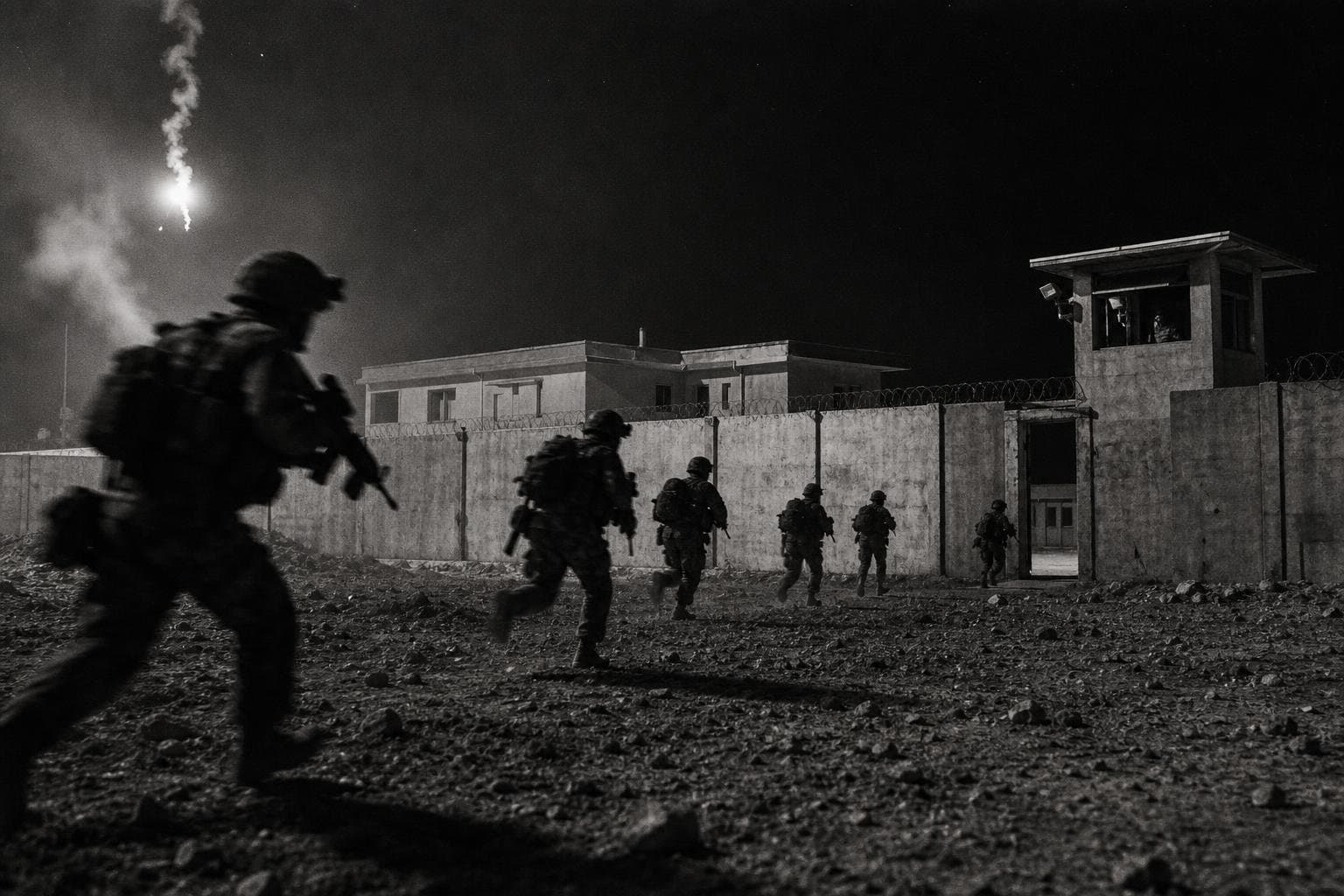

On the night of November 20–21, 1970, a joint Army-Air Force team flew deep into North Vietnam, assaulted a prison compound near Son Tay with near-textbook precision, and found no prisoners to rescue. The camp had been evacuated weeks earlier. Every rehearsal, every piece of specialized hardware, every rehearsed breach of the compound wall worked exactly as planned — and the mission's central premise had already expired before the raiders left Thailand.
That gap between operational execution and operational premise is the real subject here, and it's worth separating from the raid's reputation as a special-operations showcase. The aircraft that made Son Tay possible were themselves products of a Vietnam-era push to build dedicated infiltration and exfiltration capability that didn't exist at the start of the war. The MC-130E Combat Talon, developed specifically to support clandestine special operations missions in Vietnam, gave planners a low-level, terrain-following penetration aircraft capable of threading a strike force into denied airspace at night (Wikipedia, Lockheed MC-130). The HH-53 "Super Jolly Green Giant" — the heavy-lift helicopter the Air Force had built for long-range, low-level, all-weather infiltration and combat search-and-rescue — gave them the lift and range to insert a ground team and extract it under fire, often flying in direct coordination with the Combat Talon for navigation and communications support (Wikipedia, Sikorsky MH-53). None of this was improvised. It was the product of a multi-year institutional investment in platforms purpose-built for exactly this kind of mission.
The Hardware Problem Was Solved. The Information Problem Wasn't.
That's the uncomfortable asymmetry. By 1970, American special operations aviation had matured to the point where a strike force could be delivered to a precise rooftop-level target hundreds of miles inside hostile territory with minimal navigational error — a capability that simply didn't exist earlier in the war. The airborne command-and-control and signals-intelligence infrastructure had matured too. The EC-121 Warning Star, originally built as an airborne early-warning platform to supplement ground radar coverage, had been adapted during the Vietnam War for both electronic sensor monitoring and signals intelligence gathering, giving commanders a persistent airborne picture of the battlespace that simply hadn't existed in earlier conflicts (Wikipedia, Lockheed EC-121 Warning Star). The institutional apparatus for projecting force precisely, at night, into denied territory was arguably the most sophisticated the U.S. military had ever fielded.
What that apparatus could not do was guarantee that the intelligence feeding the targeting process was current. A raid built around a fixed point on a map is only as good as the last confirmed sighting of what's actually there. The structural lesson isn't that planners were careless — it's that a mission predicated on a static snapshot of enemy disposition carries an expiration date that operational planning, however rigorous, cannot extend. This is a pattern that recurs across the war generally. 1970 alone saw American forces sustain thousands of killed in a conflict where the enemy's main assets — personnel, supplies, command nodes — were deliberately kept mobile and dispersed precisely to defeat this kind of fixed-target intelligence picture (Wikipedia, 1970 in the Vietnam War). An adversary that assumes it may be targeted does not sit still waiting to be found.
What the Hardware Can't Fix
None of this makes Son Tay a failure in any operational sense — the raiders went in, executed the assault, and came out with no fatal casualties, which by the standards of a deep-penetration night raid is a real achievement of training and airmanship. But treating it as a pure special-operations success story, full stop, flattens the actual lesson. The raid demonstrates something military planners keep relearning: aviation and assault technique can close the distance to a target with extraordinary precision, but they cannot compress the time lag between when intelligence is collected and when it's acted on. That lag is where missions built on perfect execution meet imperfect information, and it's the harder problem to solve — because it isn't a hardware problem at all.