


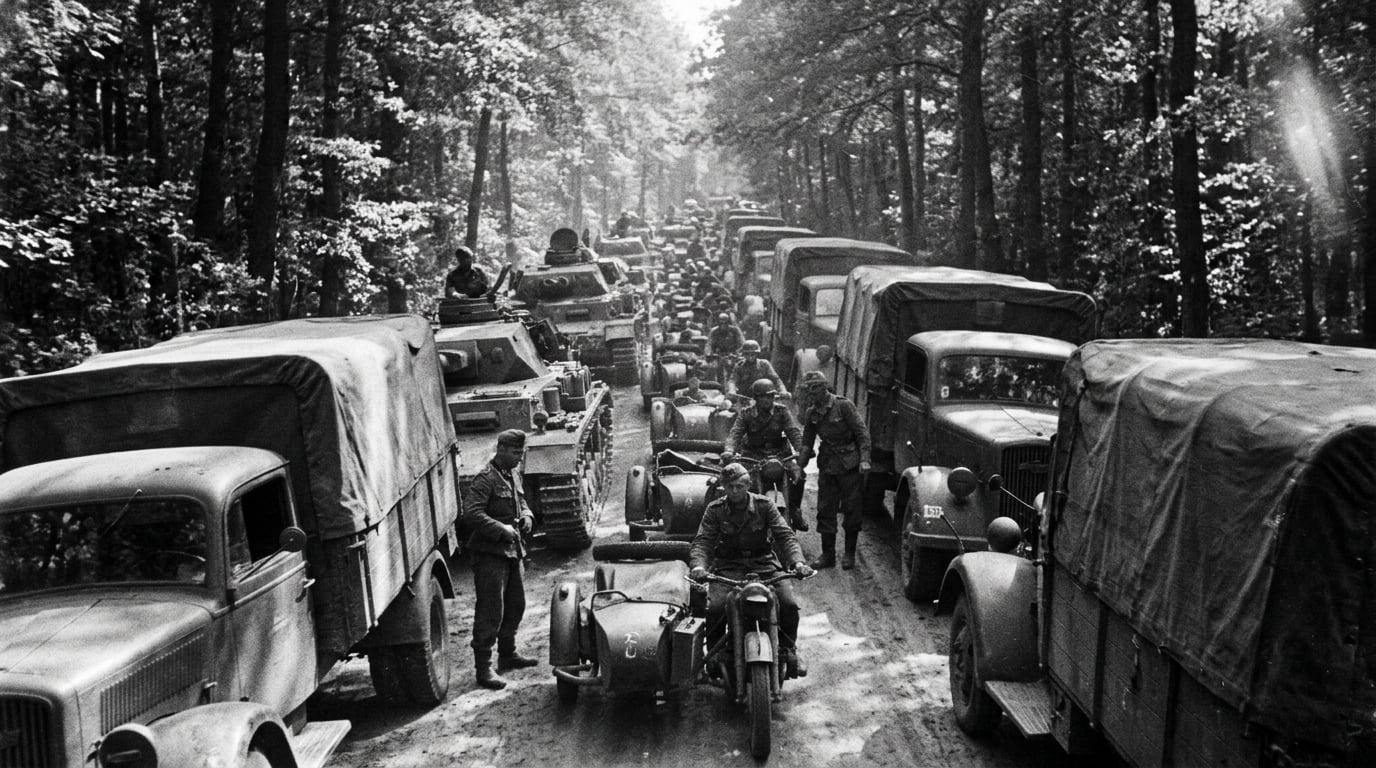

Every few years a contemporary army crosses a river under fire and someone reaches for Sedan. Most recently it's been Russian forces at Kherson in 2022, and the comparison shows up again in a recent War on the Rocks analysis arguing that the "transparent battlefield" has made Guderian's approach obsolete. The analogy is tempting. It's also worth slowing down on, because the raw numbers from May 1940 tell a more specific story than "mass worked then, doesn't work now."
What actually happened at Sedan, by the numbers
Between May 10 and 13, 1940, Panzer Group Kleist moved through the Ardennes — terrain the French General Staff had assessed as unsuitable for large mechanized formations — along just four Rollbahnen, or axes of advance. Five armored divisions and three motorized infantry divisions, roughly 41,000 vehicles total, squeezed through those four roads, producing what the War on the Rocks piece calls the largest traffic jam in military history.
That's the detail popular accounts skip. The breakthrough that ended the Battle of France was preceded by a logistics bottleneck so severe it should have been a vulnerability, not a strength. It wasn't exploited because the French command didn't locate it in time — a reconnaissance and decision-cycle failure, not a demonstration that congestion doesn't matter.
The concentration, not the mass, did the work
Guderian's XIX Armored Corps converged on Sedan and narrowed its front to 10 kilometers, then to three kilometers for the actual Meuse crossing. With artillery stuck behind the traffic jam, the Luftwaffe flew over 1,200 sorties against a four-kilometer sector — described in the source as its most concentrated bombing effort of the war. After the bridgehead held, German engineers built a pontoon bridge on May 14 that briefly carried the entire advance: 600 tanks, 60,000 men, 22,000 vehicles, funneled across one structure. Guderian protected it with over 300 anti-aircraft guns. The Allied counterattack against that single bridge lost 167 aircraft and scored no hits, against a defending force of around 150 bombers with limited fighter cover.
This is a story about Schwerpunkt — point of main effort — not about vehicle counts. Forty-one thousand vehicles moving through four roads is not a maneuver-warfare triumph on its own; it's a maneuver-warfare triumph only because the French never found and struck the chokepoint, and because the single bridge that replaced it was defended with disproportionate anti-air density relative to its width.
Where the drone-era comparison breaks down
The War on the Rocks piece draws the contrast to Kherson, where a similarly bridge-dependent Russian force supporting 20–30 battalions faced persistent overhead surveillance that 1940 commanders never had to contend with. That's a real and useful distinction. But treating 1940 as the baseline "mass worked" case risks eliding the part of the record that actually mattered: a bottleneck existed, French doctrine and reconnaissance failed to locate and strike it in the window available, and German anti-aircraft concentration punished the one Allied effort that did try. The lesson isn't that concentration beat transparency. It's that concentration beat a specific, time-bound intelligence failure on the other side — the kind of failure that doesn't require satellite-era sensors to avoid, just a staff willing to ask where the enemy's single point of failure sits.
What to watch
The next time an analyst invokes Sedan as a maneuver-warfare benchmark, check whether they're citing the breakthrough or the bottleneck that preceded it. The two are not the same lesson, and conflating them is how bad analogies get built into doctrine.