


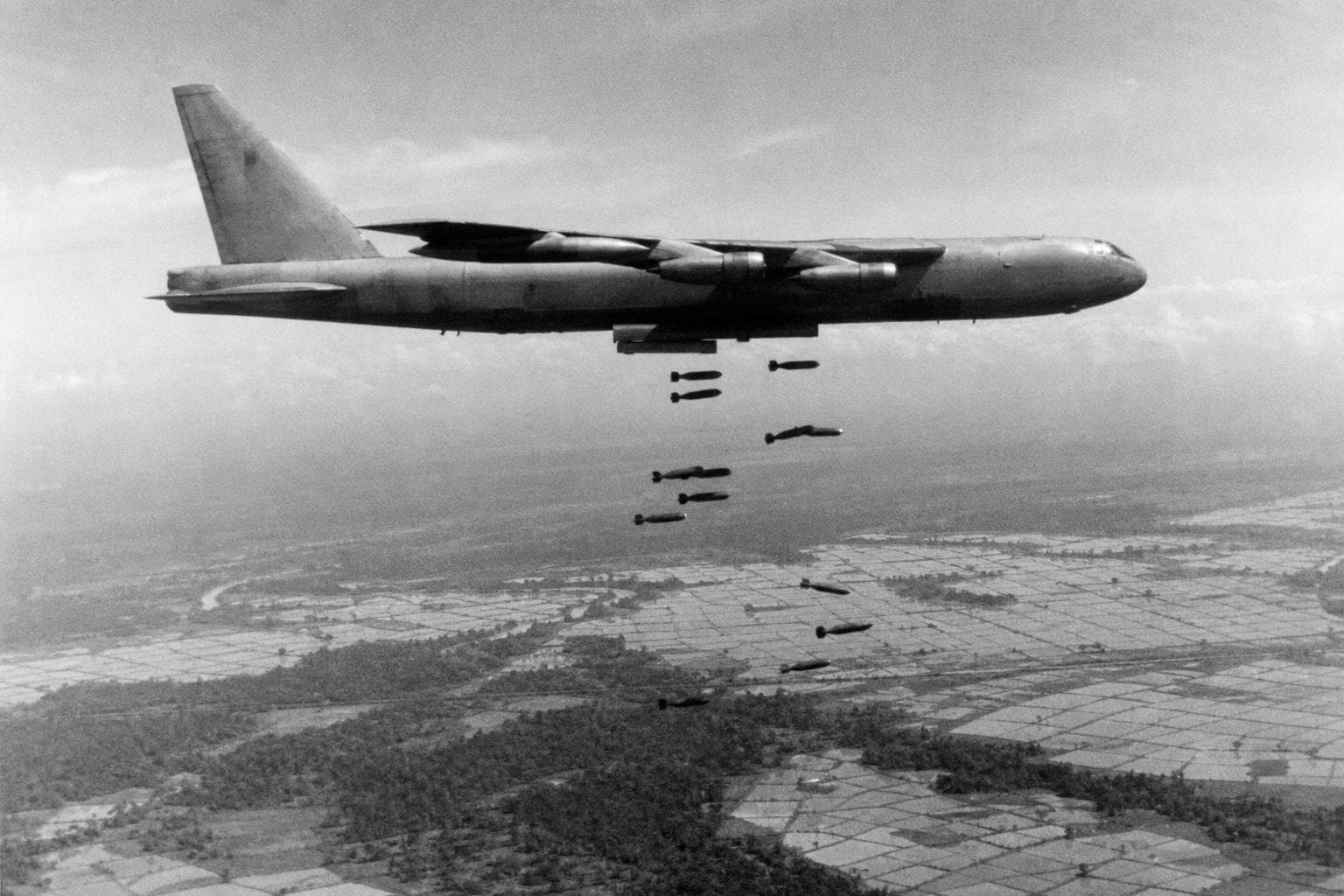

The aircraft were capable. The bombs fell where they were aimed, more or less. The pilots flew into some of the most heavily defended airspace in the history of aerial warfare. None of that mattered, because the theory underneath the campaign was wrong from the start — and the people running it either couldn't see that or couldn't say so.
Rolling Thunder, the sustained bombing campaign against North Vietnam that ran from March 1965 through November 1968, is usually discussed as a targeting problem or a political constraint problem. Both framings miss the deeper issue. The campaign failed because it was built on a model of coercive pressure that assumed North Vietnam's leadership would respond to pain the way a rational industrial-age state would respond to pain. They didn't. They couldn't afford to, and they knew it.
The Theory Coercion Requires an Adversary With Something to Lose
The logic behind Rolling Thunder, as it emerged from the Johnson administration's deliberations, was graduated pressure: demonstrate capability, signal resolve, and give Hanoi an off-ramp before the costs became unbearable. Britannica's account of the period captures the atmosphere in Washington — a government that had "painstakingly examined the question of committing military forces" while giving comparatively little thought to what those forces would actually accomplish once committed. The bombing campaign was, in part, a substitute for harder thinking about political objectives.
The problem is that graduated pressure works when the target state has an industrial economy vulnerable to disruption, a population whose suffering translates into political pressure on leadership, and leadership that values its own survival over its strategic goals. North Vietnam in 1965 had none of these in sufficient measure. It was an agrarian economy with limited industrial infrastructure to destroy. Its leadership had already demonstrated, across two decades of warfare against France and then the United States, that it was willing to absorb casualties on a scale that would be politically impossible in a democratic society. And the Politburo in Hanoi was not going to trade its core strategic objective — reunification — for relief from bombing.
A recent comparative analysis in Small Wars & Insurgencies makes the structural point directly: battlefield superiority can coexist with political stalemate when escalation amplifies relational movement rather than resolving it. The bombing didn't break the will to fight. In some respects it reinforced it, by giving the North Vietnamese government a unifying narrative of resistance against foreign attack.
Target Selection as Institutional Compromise
The targeting process itself reflected the campaign's contradictions. Civilian leadership in Washington retained direct control over which targets could be struck, which frustrated military commanders who wanted to hit the port of Haiphong and interdict Soviet and Chinese supply shipments at their source. The military, for its part, wanted a different campaign than the one it was running. But the military's preferred campaign — unrestricted strikes on the North's supply infrastructure — carried its own risks: Chinese intervention, as had happened in Korea, was a live concern that shaped every targeting decision.
Britannica's treatment of the ground war period notes the broader pattern: Johnson and his advisers had constructed a "tightly controlled air war in the North" while leaving the ground war in the South largely to Westmoreland's discretion. The asymmetry is telling. The air campaign was politically managed because its escalatory risks were visible and immediate. The ground war's costs accumulated more slowly and were easier to defer.
The result was a targeting list that satisfied no one's strategic logic. Too restricted to cripple North Vietnamese logistics, too expansive to avoid civilian casualties that generated international pressure, and too disconnected from conditions on the ground in the South to affect the actual military balance. Sorties were flown, targets were struck, and the Ho Chi Minh Trail kept functioning.
What the Historical Record Actually Shows
The campaign's failure was not primarily a failure of airpower as a tool. It was a failure to match the tool to the problem. Airpower can interdict supply lines, destroy industrial capacity, and impose costs on an adversary's military. It cannot, by itself, alter the political calculus of a leadership that has decided the war's outcome is existential. North Vietnam's leadership had made exactly that decision.
The historiographical debate about Rolling Thunder tends to split between those who argue the campaign was too restricted — that unrestricted bombing would have worked — and those who argue no bombing campaign could have achieved the stated objectives. The second position is better supported by the evidence, but the first position at least asks the right question: what would "working" have looked like? If the goal was to compel Hanoi to abandon support for the Viet Cong and accept a divided Vietnam, there is no serious evidence that any level of bombing would have achieved it. The Politburo had watched the French lose at Dien Bien Phu. They understood that time and will were their strategic assets.
The lesson that keeps not being learned is this: coercive bombing campaigns require a theory of how the adversary will respond, not just a theory of how much damage can be inflicted. Rolling Thunder had the second. It never had the first.