
The numbers have been wrong for eighty years, and the wrongness was never accidental.
On the morning of July 12, 1943, the II SS Panzer Corps — three divisions holding the southern face of the Kursk salient — reported just under three hundred operational tanks and assault guns. The 5th Guards Tank Army, committed against them, fielded somewhere between eight hundred and a thousand armored vehicles in total, with perhaps five to six hundred attacking on the main axis. The battle that followed was enormous by any honest measure — one of the largest single-day armored engagements of the war. It was also a Soviet tactical disaster: the 5th Guards Tank Army lost somewhere between two hundred and three hundred and forty vehicles irrecoverably, roughly half its strength, some of it in a charge that ran into an anti-tank ditch Soviet engineers had dug themselves weeks earlier.
The version that entered history was different in almost every particular. Fifteen hundred tanks. A head-on collision of equals. Hundreds of German Tigers wrecked by T-34s closing to point-blank range. The Soviet account, absorbed into Western popular history with minimal scrutiny, placed Prokhorovka at the center of a story where German offensive power was shattered in a single afternoon by Soviet courage. That account had a documented author and a documented purpose: it served Soviet political needs, first in wartime and then in the construction of a founding mythology for the postwar state.
Understanding Kursk correctly — what the Soviets actually built, how the Germans actually failed, and why the battle mattered — requires dismantling the legend rather than working around it.
The Delay Was the German Strategic Error, and the Soviets Knew It
Operation Citadel's logic was straightforward. A massive Soviet salient jutted westward around the city of Kursk, and the German plan called for two pincers — one striking south from the north under Field Marshal Model, one striking north from the Belgorod area under Field Marshal von Manstein — to meet behind it and trap the forces inside. The plan was simple in shape: reduce the salient, destroy the Red Army massed within it, and recover some portion of strategic initiative on the Eastern Front.
Hitler repeatedly delayed the attack from spring into early July to wait for deliveries of new Tiger and Panther tanks, believing the new machines would prove decisive. The delays had the opposite effect. Every week of preparation was a gift to the defenders, and the Soviets — forewarned by intelligence that gave them the German plan almost exactly — chose deliberately to absorb the blow before counterattacking. The decision to stand on the defensive first was made by Soviet commanders of, as one account puts it, outstanding quality.
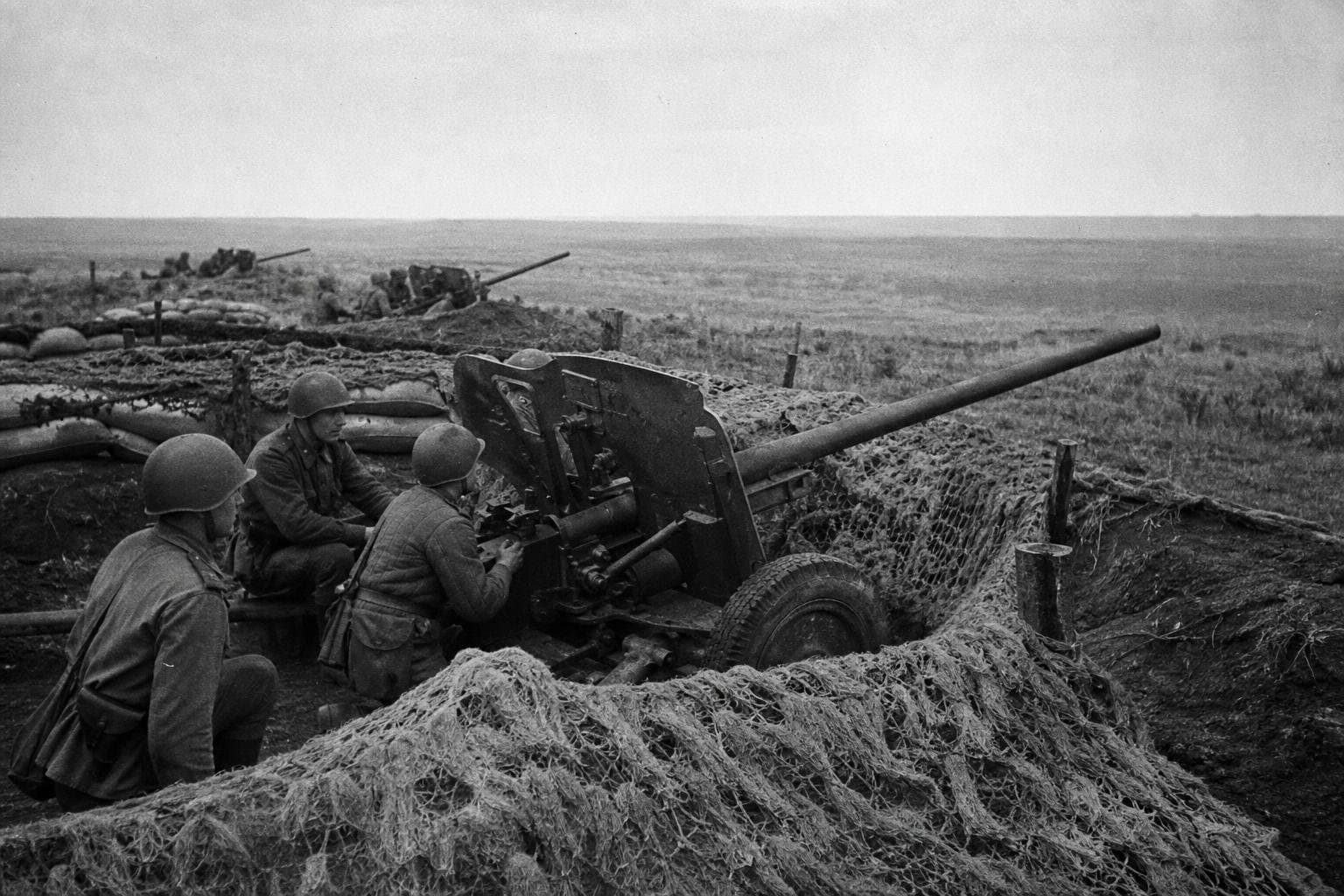
What they built during the delay was remarkable. Hundreds of thousands of civilians and soldiers dug belt after belt of trenches, laid vast minefields, and sited thousands of anti-tank guns in mutually supporting positions. The defensive belts ran back for tens of kilometers. Behind the salient sat the Steppe Front — a powerful strategic reserve withheld for the counterattack phase. According to the popular account at the Military Channel's aggregation of the battle, an estimated one million mines were laid, and the construction involved some 300,000 civilians — though these figures are estimates, not precisely sourced counts, and should be read as orders of magnitude rather than precision data.
The Soviets also had the Germans' schedule. Around 2 a.m. on July 5, a Soviet patrol captured a German combat engineer who had crawled forward in the dark to cut lanes through the minefields. Under questioning, he provided information that confirmed what Soviet intelligence had already assembled: the attack was hours away. The Soviets launched a pre-emptive artillery barrage. The Germans were shaken and had to regroup, which pushed their own artillery preparation back and disrupted the opening coordination of the assault. Citadel began on July 5 already slightly behind and facing a prepared enemy who knew it was coming.
This is the intelligence failure hiding inside the German operational failure. The Wehrmacht was not simply outfought in the open; it was walked into a prepared killing ground by an enemy who had read its plan, built accordingly, and was waiting.
The New Equipment Didn't Work, and the Germans Had Banked on It
The Tigers existed, and they were lethal in appropriate circumstances. The Panthers were a different matter. The new tank's debut came days before the main engagement with a different corps, miles to the west of Prokhorovka, where the Panthers spent the battle breaking down and catching fire in numbers their crews found mortifying. The Ferdinand tank destroyers — heavy, powerfully armed, and almost entirely lacking in infantry protection — were deployed on the northern face, where they ground forward effectively against armor but proved catastrophically vulnerable when Soviet infantry got among them with close-assault weapons.
The myth of a Panther-and-Tiger juggernaut at Prokhorovka required Panthers to have been present at Prokhorovka. The records show zero Panthers in the II SS Panzer Corps on the morning of July 12. The legend's composition of German forces — hundreds of Tigers, massed Panthers — reflects Soviet reporting that served a narrative rather than a count. Armies keep careful strength returns because the numbers determine what they can do the next morning. Both the German corps records and Soviet strength returns, when examined against each other rather than against the postwar mythology, tell a consistent story: a German corps-sized force was struck by a Soviet army, sustained manageable losses, and inflicted devastating ones.
Historian Karl-Heinz Frieser, whose work on the Eastern Front appears in the magisterial Germany and the Second World War series edited by Oxford University Press, has argued that what broke at Kursk was not German tank strength in a single afternoon of battle but German strategic coherence across weeks of attrition against a defense built to absorb exactly what the Wehrmacht threw at it. The SS divisions at Prokhorovka were not destroyed — they remained operational — but they had advanced into a salient within a salient, and Hitler's decision to cancel Citadel on July 13, citing the Allied landings in Sicily, ended the offensive before it had reached its operational objective.
The cancellation, not the armor losses on July 12, was the decisive event.
What Soviet Defense-in-Depth Actually Meant
The popular version of Kursk is a tank battle. The operational reality was a sapper's war dressed in armor.
Soviet doctrine by 1943 had developed what came to be called defense-in-depth: not a single fortified line but successive belts of mutually supporting positions, each capable of absorbing an attacker while the next belt prepared. The defensive belts at Kursk ran back for tens of kilometers, with the Steppe Front held in reserve behind even those. An attacker who broke through the first belt simply entered the second, already under fire and now away from his own supply lines.
Anti-tank guns were not scattered but sited in overlapping fields of fire, with engineers pre-registering kill zones that tanks were funneled toward by terrain and minefield patterns. This is not instinct; it is industrial-scale deliberate planning. The months of German delay produced something no amount of Tiger deliveries could compensate for: a killing ground engineered specifically to stop what the Germans were going to do.
The northern German pincer under Model stalled after gains of roughly seven to eight miles — not because Model was incompetent but because the defense had been constructed to stop exactly the rate of advance his forces could achieve. The southern pincer under von Manstein pushed deeper, but every kilometer came at compound interest in burned vehicles and dead crews. By the time German forces reached Prokhorovka, they had been grinding through prepared defenses for a week. The 5th Guards Tank Army that hit them was fresh, brought forward by forced march precisely because Soviet planners had held it back for this moment. An attrited corps being struck by a fresh army is a different proposition than the mutual annihilation of the legend.
The counteroffensives tell the story more clearly than the defensive fighting. On July 12 — the same day as Prokhorovka — the Soviets launched Operation Kutuzov against the German northern flank, the attack that would eventually relieve pressure on the salient and begin the Soviet summer offensive. The Soviets had prepared their counterstrokes before the German offensive began. They were not reacting. They were executing a plan whose defensive phase was always intended to be temporary.
Why the Myth Persists and What It Costs
The story was told the same way for eighty years because it served too many purposes to be corrected early. For the Soviet state, a heroic defensive victory against a massive armored assault was far more useful than the accurate picture: enormous Soviet tactical losses in an engagement the Germans did not need to win in order to lose the campaign. For Western popular history, the Soviet narrative arrived pre-packaged and superficially plausible, and the archival access needed to check it against German records wasn't available until decades after the war.
The distortion carries a real analytical cost. If Prokhorovka broke German offensive power in a single afternoon of equal combat, then the lesson of Kursk is about courage and tactical aggressiveness — the T-34 crews closing to point-blank range to negate the Tiger's gun. If the accurate picture holds, the lesson is about institutional planning on a scale that dwarfs individual battlefield performance: months of engineering, intelligence exploitation, deliberate doctrinal choice to absorb losses in the defensive phase, and pre-planned counterstrokes held in reserve until the attacker was committed and attrited.
The Zitadelle account makes the point directly: the Germans at Kursk were not outfought — they were out-thought, by commanders operating at a level of operational sophistication that the Western popular account consistently undervalues because it focuses on the day's fighting rather than the campaign's structure.
That gap between what happened in a day and what was decided over months is exactly where military history does its most important work. Prokhorovka was a Soviet tactical defeat nested inside a German operational catastrophe. Getting that right requires reading the strength returns, not the monuments.


