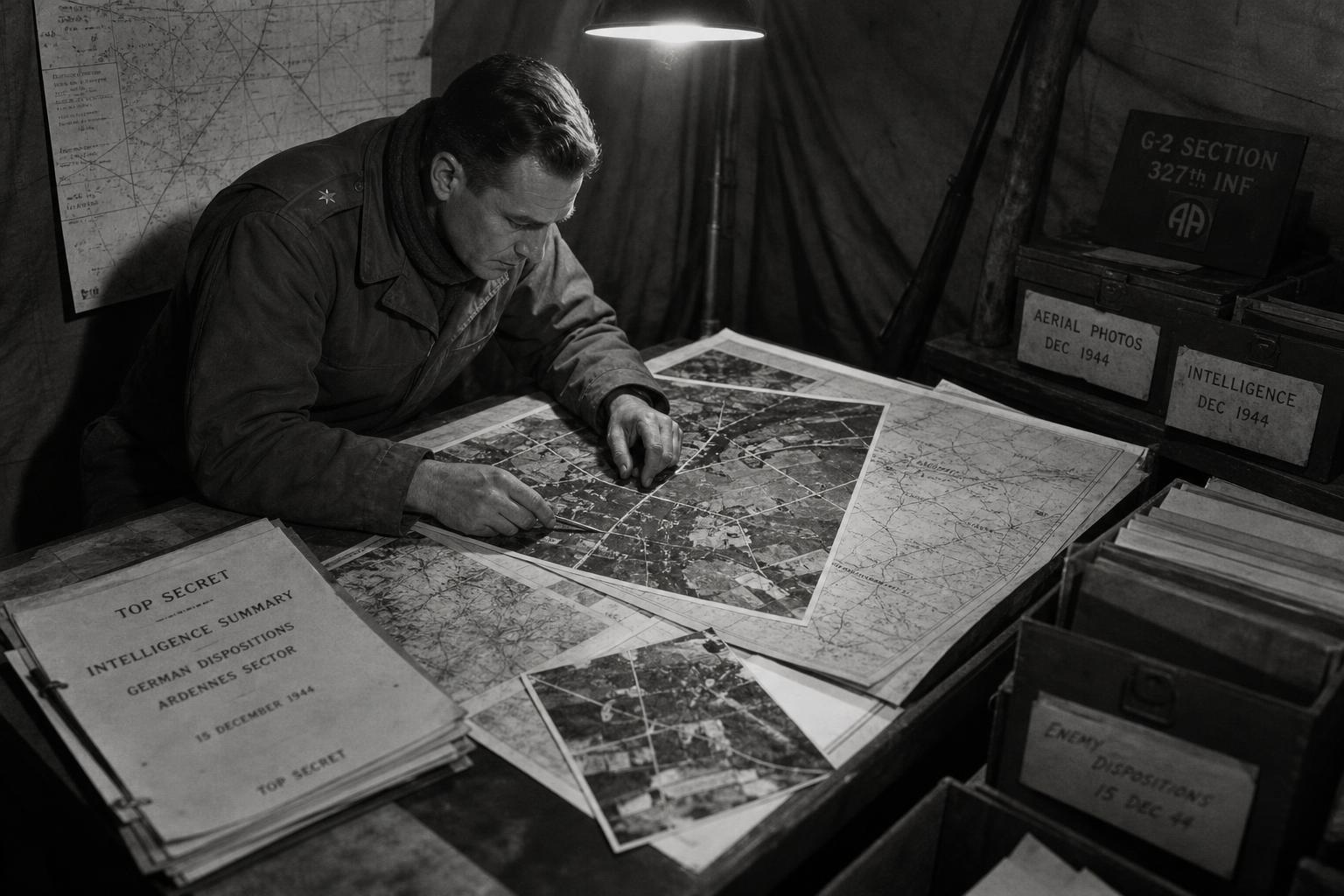

By the second week of December 1944, the prevailing judgment at the top of the Allied intelligence structure was that the German army in the west was finished as an offensive force, at least until spring. One colonel at Third Army headquarters in Nancy disagreed, and the paper trail shows he was right for reasons that had nothing to do with hindsight.
Oscar Koch, Third Army's G-2 since Patton requested him by name for the 2nd Armored Division in 1940, had spent weeks logging German troop concentrations, fuel and ammunition dumps, and a rise in rail traffic along Third Army's northern flank. Koch pushed for deep aerial reconnaissance over the Eifel region, and the photo interpreters came back with tank trains moving west from around Frankfurt. Of fifteen German panzer divisions known to be in the west, Koch's section could only place five in actual contact with Allied forces — which meant ten were somewhere Allied planners weren't watching closely enough. Patton had already flagged, on November 25, that First Army was leaving VIII Corps static in a sector that looked ripe for a German buildup (GroundsForTruth).
That warning sat inside a specific institutional context, and the context matters more than the anecdote.
The Ardennes Was Thin by Design, Not by Oversight
VIII Corps held roughly eighty miles of wooded hills with a mix of exhausted veteran divisions and green units newly arrived in Europe. Allied planners treated the sector as a place to rest troops rather than a likely front, a judgment that was defensible given the state of the German army after the collapse in France that summer and the stretched Allied supply lines running back to the Normandy beaches (Lake Norman Brief). This is the part easy to lose in retrospect: the thinness of the line wasn't negligence in isolation, it was a resourcing decision made under real constraints, applied to terrain that genuinely limited large mechanized operations. Hitler's planners understood exactly what made the Ardennes attractive — the same weather and road limitations that Allied planners read as protective, German commanders read as cover.
The Germans moved roughly 400,000 troops, hundreds of tanks, and thousands of artillery pieces into position under strict radio and movement discipline, exploiting the persistent bad weather that would later ground Allied reconnaissance aircraft to conceal the buildup almost entirely (BattlegroundGuide). That's the structural piece Koch's warnings ran up against: it wasn't that Allied intelligence had no signals, it's that the signals Koch's section had assembled didn't travel upward with the same weight they carried at Third Army.
Why Ultra Went Dark, and What That Silence Actually Meant
The Germans kept the offensive almost entirely off the air, routing plans through landline and courier rather than radio, which meant Ultra — the intelligence drawn from high-grade German decrypts that had given Allied commanders reliable warning throughout the campaign in France — produced none of the clear signal commanders had come to expect. The fragments of intercepted traffic that did surface were read as consistent with defensive preparations, not an impending offensive (GroundsForTruth). That's a distinction worth holding onto: a quiet radio net isn't an absence of information, it's a different kind of information, and the failure wasn't that codebreakers missed something transmitted. It's that the institutional habit of treating Ultra as the primary warning system left a blind spot when the adversary simply stopped using the channel being watched.
The attack came before dawn on December 16, 1944, and achieved a degree of tactical surprise matched by few other operations in the western theater (BattlegroundGuide). Fog and heavy cloud cover then grounded Allied airpower during the offensive's critical opening days, stripping commanders of the aerial reconnaissance and close air support that had shaped operations since Normandy — a second, compounding failure of visibility layered on top of the first (BattlegroundGuide).
Casualty totals from the battle remain contested enough that even dedicated reference sources decline to give wounded figures with confidence, noting that complete certainty isn't available for either side's losses (normandy1944.info). That ambiguity is itself a data point about how chaotic the opening days were — not just for the men holding crossroads at St. Vith and Bastogne, but for anyone trying to reconstruct, after the fact, exactly what command structures saw and when.
The Lesson Isn't About One Colonel
Koch's story gets told, when it gets told at all, as a tale of one sharp-eyed analyst ignored by a complacent bureaucracy. The more useful version is about how intelligence travels through a hierarchy that has already decided what the war looks like next. Koch had better local data, better local access to Patton, and a general willing to act on a hunch backed by photographs. Most intelligence officers in December 1944 had none of those three things. The structural question for any institution reading ambiguous signals under time pressure isn't whether someone noticed — someone almost always notices. It's whether the system has a path for that notice to outrun the comfortable consensus before the attack starts.


