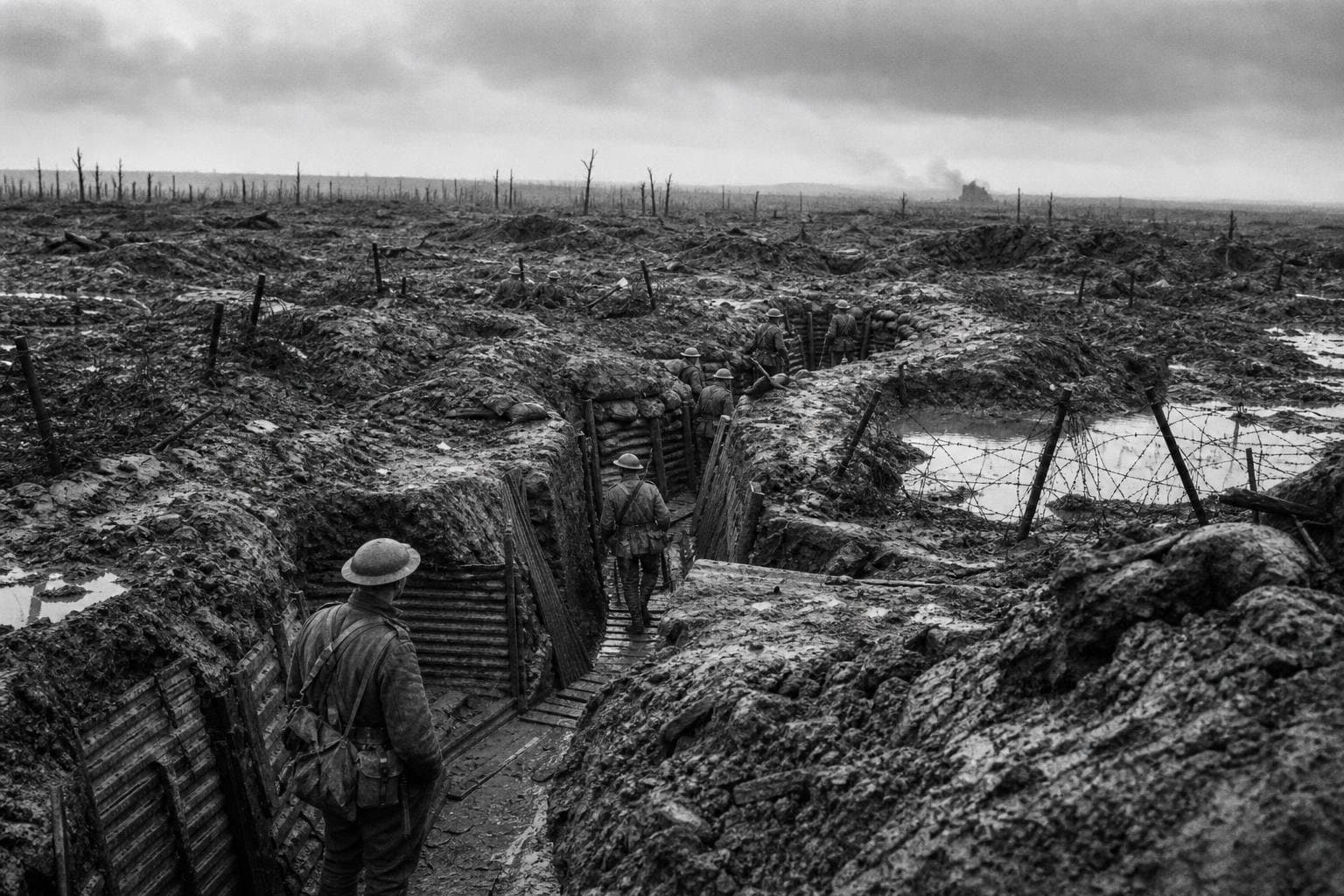

Here is the number that gets repeated in every popular account of Third Ypres: roughly 275,000 British casualties against roughly 220,000 German, for a battlefield that was evacuated within months of being won (Britannica). Those figures are estimates compiled from official returns, not a precise ledger — the distinction matters, because the moment you treat a casualty estimate as an exact count, you've already started building a narrative instead of reading a record. Passchendaele fought from July 31 to November 6, 1917, near the Belgian village north-east of Ypres that gave the battle its name, has become shorthand in English-language memory for the whole catastrophe of the Western Front — "mud, madness, and senseless slaughter," as the encyclopedic summary puts it (Britannica).
That phrase is doing a lot of work, and it's worth separating what it tells us from what it assumes. The mud was real. The casualties were real. Whether the battle represented a unique failure of command judgment, or an unusually visible example of a strategy the British and French high commands had already committed to years earlier, is a much harder question — and it's one historians still argue about rather than one the record settles on its own.
The Attrition Argument Nobody Wants to Make Out Loud
The cleanest challenge to the "senseless slaughter" reading comes from William Philpott's study of attrition as a deliberate Allied strategy, reviewed by Michael Neiberg for the British Journal for Military History (Roads to the Great War). Philpott's argument, as Neiberg summarizes it, is that attrition in 1914–1918 wasn't a failure of imagination by generals who couldn't think of anything better. It was a strategy with five components — the land battlefield, the maritime battlespace, the home front, the diplomatic front, and the alliance front — and winning meant outlasting the Central Powers across all five simultaneously, not capturing ground (Roads to the Great War).
That reframing cuts against the instinct to read Passchendaele as a battle that "went wrong." If the goal of a 1917 British offensive was never primarily territorial — if the point was to kill German reserves at a rate the German war economy and manpower pool couldn't sustain — then evacuating the captured ground the following year isn't evidence of failure in the way it looks to a reader expecting conquest to be the metric. It's evidence that the metric itself needs re-examining. Neiberg notes that Philpott credits the senior commanders of the era with understanding this "transformation of war" clearly, even as politicians recoiled from it and kept reaching for alternatives — Gallipoli, the Nivelle Offensive, unrestricted submarine warfare — that promised to avoid mass casualties and never delivered anything close to victory (Roads to the Great War).
I want to be careful here, because this is exactly the kind of claim that invites hindsight bias in both directions. It's easy to retroactively assign genius to commanders who happened to be fighting a war of attrition that worked, in the narrow sense that the Allies eventually won. It's equally easy to assign blind cruelty to commanders who kept feeding men into a battle that cost staggering numbers of casualties for marginal ground. Both readings start from the outcome and work backward. What Philpott's framework actually offers is narrower and more useful: evidence that some senior figures in 1917 were operating with an explicit theory of what sustained casualties were supposed to accomplish, rather than simply failing to notice the cost. Whether that theory was sound, whether it was applied competently at Passchendaele specifically, and whether a less costly path to the same strategic effect existed — those are separate questions the sources here don't resolve, and I'm not going to pretend they do.
The Disagreement Historians Actually Have
The honest version of this story isn't "command failure" versus "deliberate strategy" as a clean binary. It's a disagreement about where the real decision point sits. One line of interpretation treats the campaign's cost as a function of terrain and weather that nobody could have fully planned around — the low-lying Flanders ground around Ypres, churned by weeks of shelling and then drenched by autumn rain, turning the battlefield into the thing that gives the battle its popular memory. The encyclopedic account leans into this reading when it calls the battle a "vivid symbol" of Western Front conditions rather than a specific indictment of one commander's choices (Britannica).
A second line of interpretation, closer to Philpott's, locates the real decision earlier — in the strategic choice to pursue attrition as a war-winning method at all, made well before the first British soldier crossed into the Ypres salient in July 1917 (Roads to the Great War). Under this reading, Passchendaele isn't a battle that went uniquely wrong; it's one installment in a method that had already been chosen, applied with the tools and intelligence available at the time, on ground that happened to be especially unforgiving.
I'm not going to adjudicate which of these is correct, because the source material in front of me doesn't let me. What I can say is that naming the disagreement honestly is more useful than picking the more dramatic version. The "senseless slaughter" framing is emotionally satisfying and not wrong about the human cost, but it tends to flatten a genuine strategic debate into a morality play, where generals are either fools or butchers and nothing in between. The attritional framing is analytically richer but carries its own risk of excusing specific operational choices by pointing at the macro-strategy. Both risks are real. A responsible account holds them in tension rather than resolving them for the sake of a cleaner story.
What the Casualty Numbers Can and Can't Tell You
This is where methodology matters more than most popular accounts acknowledge. The widely cited figures — roughly 275,000 British and roughly 220,000 German casualties — come from postwar compilations of official returns, and "casualties" in this period typically bundles killed, wounded, and missing together rather than separating them cleanly (Britannica). That bundling is standard for First World War accounting, not a flaw unique to Passchendaele, but it means the number functions better as an order-of-magnitude indicator of cost than as a precise body count. The war as a whole mobilized over 65 million men, and estimates of military and civilian dead across the conflict run as high as 16 million — a scale that should make any single battle's figures look like one accounting entry inside a much larger ledger both sides were keeping, however imperfectly, in real time (Imperial War Museums). British forces alone suffered roughly 880,000 dead over the full war, which gives some sense of the denominator Passchendaele's casualty totals sit against (Imperial War Museums). When a number that large gets compressed into a single symbolic battle, some of its meaning gets lost in the compression. Passchendaele didn't happen in isolation; it happened inside a four-year war of unprecedented scale and attritional bookkeeping on both sides.
What to Watch Before You Trust the Next Passchendaele Take
The next time Passchendaele comes up in popular coverage — an anniversary piece, a documentary tie-in, a museum exhibit — check whether it treats the battle as self-contained or as part of the attritional strategy Philpott describes spanning five fronts over four years (Roads to the Great War). Check whether casualty figures are presented as precise counts or acknowledged as estimates built from incomplete official returns (Britannica). And watch for whether command decisions get assessed against what was knowable in the summer and autumn of 1917, rather than against what we now know about how the war ended. The battle deserves better than either the inherited image of pointless mud or a tidy rehabilitation of the generals who ordered it. It deserves to stay as unresolved in our accounts as the historiography actually is.


