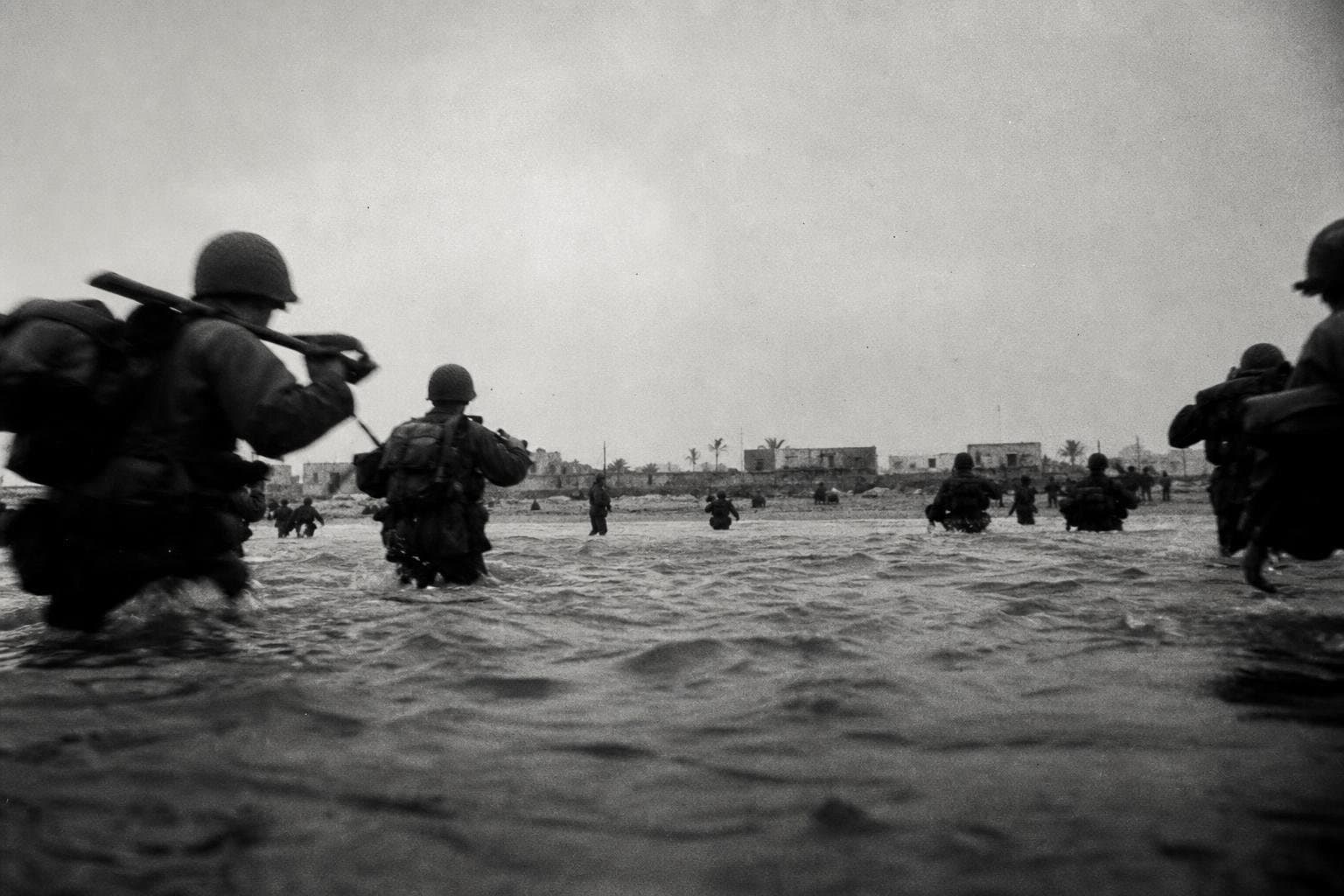

The first thing the Americans did when they landed in North Africa was try not to look British.
This wasn't a trivial concern. The entire political architecture of Operation Torch — the Anglo-American amphibious invasion of French Morocco and Algeria that began on November 8, 1942 — rested on a single fragile assumption: that Vichy French forces would resist a British landing but might accept an American one. The French had not forgotten Mers-el-Kébir, where the Royal Navy sank their fleet in 1940. They had not forgiven it either. So the Western and Central Task Forces were composed of U.S. troops, and the Eastern Task Force — a combined Anglo-American force — was placed under British command but given an American face where possible. The politics of who was seen to be invading mattered as much as the invasion itself.
That tension — between military necessity and political theater, between Allied unity and national interest, between what the operation needed to be and what it could actually be — runs through Torch from conception to execution. It was the first major Allied ground offensive of the war in the west, and it was improvised at almost every level. What it produced, eventually, was not just a foothold in North Africa but a template for how the Anglo-American alliance would fight — and argue — for the next three years.
The Strategic Gamble Nobody Agreed On
The decision to invade French North Africa in 1942 was not a consensus. It was a compromise that satisfied no one's first preference.
The American military establishment, led by Army Chief of Staff George Marshall, wanted a cross-Channel attack — a direct assault on northwest Europe that would open a second front against Germany and relieve pressure on the Soviet Union. The British, drawing on their experience of what happened when you threw inadequately prepared forces at a fortified coastline (see: Gallipoli, Dieppe), were not interested. Churchill pushed instead for operations in the Mediterranean periphery, where Axis vulnerabilities were more exposed and the logistical demands more manageable.
Roosevelt sided with Churchill. Marshall and his planners were overruled. The result was Torch — a campaign that the American military high command accepted without enthusiasm and that the British shaped more than they publicly acknowledged.
The strategic logic, as Britannica summarizes it, was to open a new front against Germany, relieve pressure on the Soviet Union, and secure control of the Mediterranean by eliminating Axis forces in North Africa. Positioning forces just 100 miles from Sicily would set conditions for later offensives into Europe. That's the clean retrospective version. At the time, the argument was messier: Torch was partly justified as the only offensive the Allies could actually mount in 1942 without catastrophic risk, which is a different thing from saying it was the right offensive.
The Soviet Union wanted a second front in Europe, not in Africa. Stalin was not mollified. The debate over whether the Mediterranean strategy was a genuine strategic vision or an elaborate British delaying action on the cross-Channel assault has occupied historians ever since, and it remains genuinely contested — which means any account that presents it as obviously correct or obviously wrong is doing the reader a disservice.
The Vichy Problem: Fighting the People You're Trying to Win Over
The political complexity didn't end with Allied strategy debates. It began again the moment the first landing craft hit the beach.
President Roosevelt's guidance for North Africa was explicit: preserve French sovereignty in Algeria and the French administrations in Morocco and Tunisia. No change in existing French civil administration was contemplated. The Allied Forces Headquarters issued General Order 4 on October 11, 1942, instructing that all relations with civilian authorities be based on the principle that "regardless of resistance, the French are friendly and are to be maintained in their government."
This created an immediate operational paradox. The order acknowledged that resistance would have to be put down by force of arms — and then instructed commanders to treat the people shooting at them as friendly. The Western Task Force encountered exactly this situation in Morocco, where French forces resisted the landings. The Central Task Force faced similar resistance at Oran. The Eastern Task Force, targeting Algiers, met lighter opposition.
The resistance wasn't uniform, and its intensity depended heavily on local commanders and the murky politics of Vichy loyalty. Some French officers were waiting for an opportunity to switch sides. Others were genuinely committed to defending French sovereignty against what they saw as an Anglo-American violation of French territory. The Americans had hoped that pre-invasion political contacts — including negotiations with French officers sympathetic to the Allied cause — would minimize armed resistance. Those hopes were only partially realized.
What followed was one of the war's more uncomfortable political arrangements: the Darlan Deal, in which the Allies negotiated with Admiral François Darlan, a senior Vichy official who happened to be in Algiers when the landings occurred. Darlan ordered a ceasefire in exchange for being recognized as the political authority in French North Africa. The deal worked militarily — it stopped the shooting — and was a moral embarrassment that the Allied governments spent considerable energy explaining away. Eisenhower, who approved the arrangement on pragmatic grounds, took significant criticism for it. The criticism was not entirely unfair, but it also came largely from people who weren't responsible for stopping French guns from killing American soldiers.
This is the kind of decision that looks different depending on whether you're reading it from a political history or an operational one. From the beach, the calculus was simple. From London and Washington, it was considerably more complicated.
Eisenhower's Command Problem: Building the Machine While Running It
Dwight Eisenhower had never commanded troops in combat when he was appointed to lead Torch. He had spent his career as a staff officer, a planner, an organizer of other people's operations. North Africa was where he learned — publicly, expensively — what that meant.
The command structure Eisenhower inherited was a genuine experiment. Allied Forces Headquarters (AFHQ) was the first integrated Anglo-American command of the war, and it was being assembled in real time. British and American officers who had never worked together, who had different doctrines, different staff procedures, and different assumptions about how decisions got made, were expected to function as a unified headquarters under pressure.
The friction was institutional before it was personal. American staff culture emphasized speed and initiative; British staff culture emphasized deliberation and coordination. American officers sometimes read British caution as timidity; British officers sometimes read American confidence as ignorance. Both readings contained enough truth to be dangerous.
The race for Tunisia after the initial landings illustrated the problem. Britannica's account of the November–December 1942 period captures the essential failure: the Allies moved toward Tunisia but could not seize it before German and Italian forces reinforced through the Sicilian Channel. The opportunity to end the North African campaign quickly — before Axis forces could consolidate — was lost. The reasons were multiple: logistical overextension, difficult terrain, poor weather, and a command system that was still learning how to translate decisions into action at operational speed.
Eisenhower's role in this failure is contested. His defenders argue he was managing an impossible coalition under conditions no one had faced before. His critics — and there were British ones who were not shy about expressing their views — argued that he lacked the operational grip to push the advance with sufficient urgency. What's clear is that the command system's immaturity cost time, and time in Tunisia meant German reinforcement.
The lesson Eisenhower drew, or at least the one visible in his subsequent commands, was that coalition management was itself a military skill — that keeping the alliance functional was a prerequisite for everything else. Whether that lesson led him to tolerate too much British influence over operational decisions, or whether it was simply the correct adaptation to an unprecedented command challenge, is a question historians have not resolved.
What Torch Actually Proved — and What It Didn't
By the time Axis forces in Tunisia surrendered in May 1943, the North African campaign had consumed far more time and resources than the original Torch planners anticipated. The quick seizure of Tunisia that might have ended the campaign in weeks instead stretched into months of attritional fighting.
What the campaign did produce was the foundation for everything that followed. American and British troops completing Operation Torch provided the Allies with control of the southern Mediterranean coastline — the precondition for the invasion of Sicily, which was agreed at the Casablanca Conference in January 1943 and executed as Operation Husky in July. The Mediterranean strategy Churchill had championed was now committed: there was no going back to a 1943 cross-Channel assault, whatever Marshall thought about it.
The American Army learned things in North Africa that it could not have learned any other way. The performance of U.S. forces at Kasserine Pass in February 1943 — covered in this space previously — exposed the gap between American doctrine and German operational practice. The institutional response, including the replacement of commanders and the reorganization of armored forces, was rapid enough to matter before the war's next phase. That kind of institutional learning requires actual combat failure as an input. Torch provided it.
What Torch did not prove was that the Mediterranean strategy was the right one. The argument that operations in North Africa and Italy constituted a genuine second front — one that meaningfully diverted German resources from the Eastern Front — is supported by some evidence and contested by others. The German response to Allied Mediterranean operations did require troop commitments, but whether those commitments were strategically decisive or merely significant is a different question. The Soviet Union bore the weight of the war against Germany regardless.
The deeper legacy of Torch is institutional rather than operational. It established that the Anglo-American alliance could mount and sustain large-scale combined operations — not smoothly, not without friction, not without political compromises that made everyone uncomfortable, but functionally. The command structures, the logistics systems, the civil affairs frameworks, the inter-Allied staff procedures that Torch forced into existence were the scaffolding on which Husky, Avalanche, and eventually Overlord were built.
That's not a heroic story. It's a story about an alliance learning, under fire, how to be an alliance. The learning was real. So was the cost of the curriculum.


