



The popular verdict on Market Garden is that it was a bridge too far — one objective too ambitious, one gamble too many. That verdict is not wrong, but it is incomplete. The operation's failure was not primarily a matter of overreach at Arnhem. It was a logistics system that violated nearly every principle of sustainable supply, and the violations were visible in the planning documents before a single paratrooper left the ground.
A September 2026 analysis at History of Sorts frames the operation through supply chain management principles, and the framework is clarifying precisely because it strips away the heroism narrative and forces the question: what did the planners actually have, and was it enough to do what they said they would do?
The answer, in five parts:
1. Single-Route Dependency
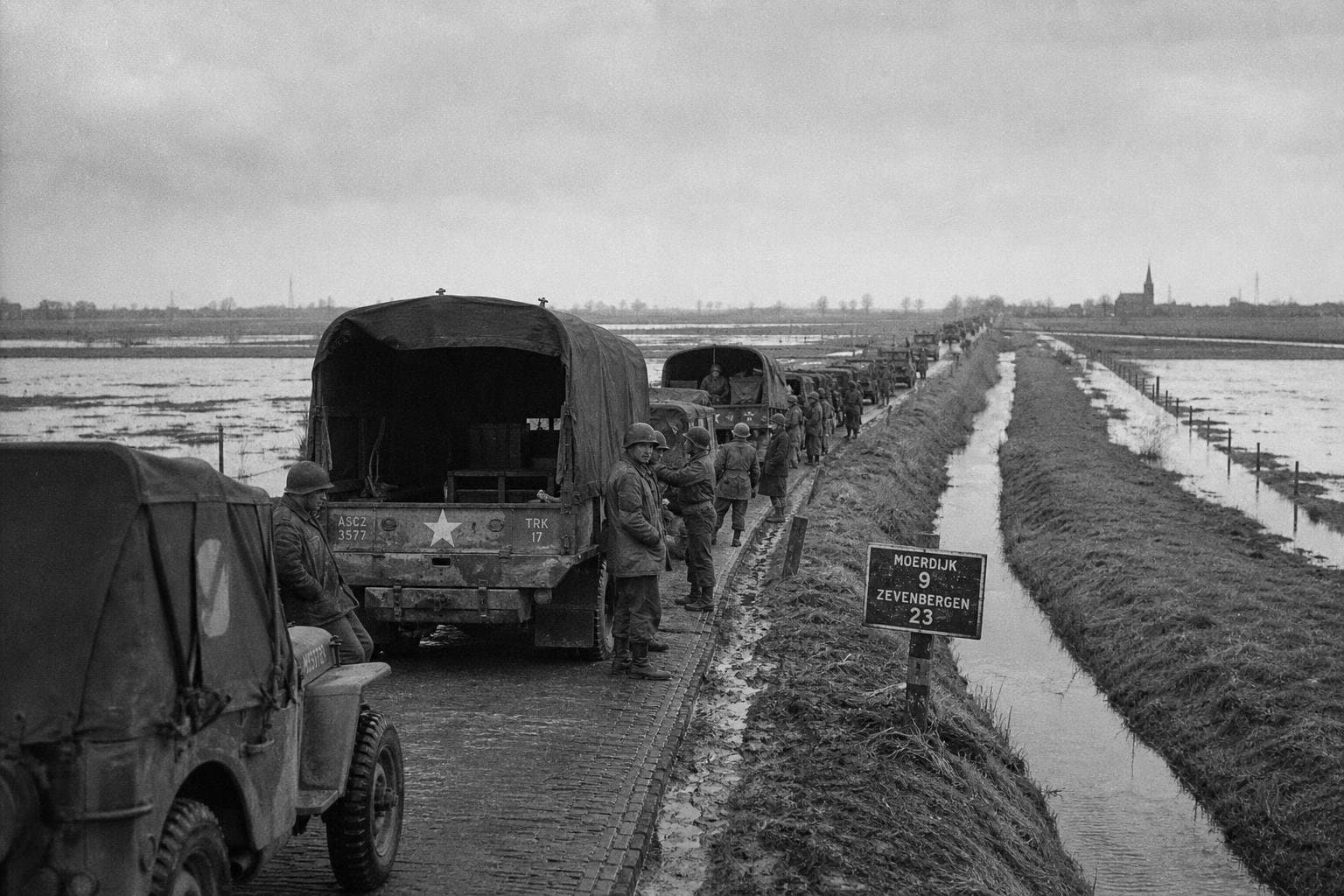
The entire ground advance ran on one road. XXX Corps had no alternative axis — if "Hell's Highway" was cut, the operation stopped. Supply chain theory treats single-point transportation failures as the most basic category of preventable risk. Market Garden's planners accepted that risk explicitly and then built no contingency around it. German forces cut the road repeatedly, and each time they did, the timetable slipped in ways that could not be recovered.
2. Rushed Planning With No Logistics Buffer
The operation was devised in a matter of weeks, leaving inadequate time to match strategic objectives against actual transport capacity. The plan underestimated what it would take to move heavy equipment across Dutch terrain — a failure of resource accounting, not battlefield misfortune. When the ground truth diverged from the plan, there was no buffer to absorb the deviation.
3. Airborne Resupply That Couldn't Adapt
Supply drops to the airborne divisions at Arnhem were pre-planned to fixed drop zones. When those zones fell into German hands, the RAF continued dropping to them anyway — because the resupply missions were coordinated in advance and the communication systems couldn't redirect them in real time. Soldiers watched supplies land in German-held territory. This is a coordination failure with a specific structural cause: the resupply system was designed for the plan, not for what the plan encountered.
4. No Redundancy in the Airborne Lift
All three Allied airborne divisions — the 82nd, 101st, and British 1st — were committed simultaneously to a 100-mile corridor. There was no reserve airborne force to reinforce failure points, and the lift capacity was insufficient to deliver all troops in a single wave, meaning subsequent lifts arrived on days two and three, by which time the tactical situation had already deteriorated. A logistics system that requires everything to go right on day one is not a logistics system — it is a bet.
5. The Terrain Problem Was Known and Discounted
Dutch polder terrain — flat, canal-crossed, with limited road networks — was not a surprise. It was on the maps. The difficulty of moving armor off the single road axis and the vulnerability of that road to interdiction were foreseeable. The planning process discounted these constraints, apparently on the assumption that speed would compensate for structural vulnerability. It did not.
What This Changes About the Standard Narrative
The conventional account centers on the decision to go to Arnhem — one bridge too many, one division too lightly supported. That framing locates the failure in a single command choice. The logistics record suggests something more systemic: the operation was under-resourced for its objectives at every level of the supply chain, from lift capacity to resupply flexibility to route redundancy. Arnhem was where the failure became visible. It was not where the failure began.
This matters for how we read the historiographical argument. Cornelius Ryan's A Bridge Too Far (1974) made the "one bridge too many" thesis canonical, and it has shaped the popular memory of Market Garden ever since. The logistics evidence doesn't contradict Ryan so much as it relocates the problem — from the final objective to the entire operational architecture. Historians who have examined the planning documents in detail tend to find the failure distributed across the system rather than concentrated at Arnhem. That is a less dramatic story, which is probably why it hasn't displaced Ryan's version.
The lesson that keeps not being learned: a bold operational concept does not become executable by virtue of being bold. The supply chain either supports the scheme or it doesn't, and no amount of audacity changes the arithmetic.