


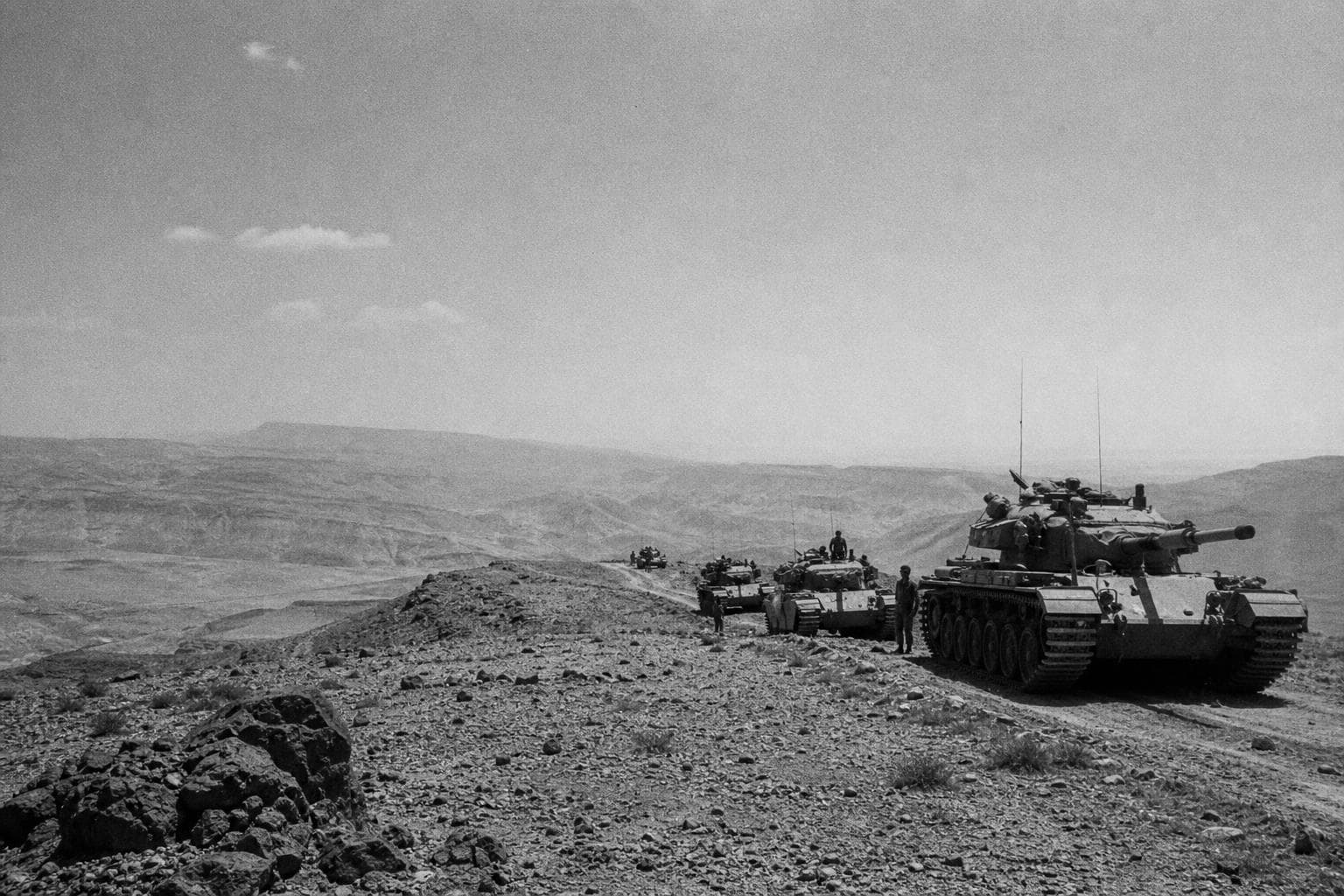

The standard narrative of the Yom Kippur War runs roughly like this: Israel was surprised, absorbed a brutal opening blow, rallied through grit and generalship, and turned the tide. The airlift arrives in this telling as a kind of triumphant third act — American resolve rewarding Israeli resilience.
That framing buries the actual crisis. The question wasn't whether Israel could win. For a window of roughly 48 to 72 hours after the opening attacks, the question was whether the IDF could hold long enough to have a war at all.
The Opening Wasn't a Setback — It Was a Near-Collapse
Egypt and Syria attacked simultaneously on October 6, exploiting Yom Kippur to catch Israeli mobilization at its slowest. The IDF's active-duty forward positions on both the Suez Canal and the Golan Heights were skeletal by design — the doctrine assumed warning time that didn't materialize.
On the Golan, Syrian armor crossed in strength against Israeli tank forces that were outnumbered by a ratio that made the position arithmetically untenable. Israeli reserve mobilization was underway but reserves take time to reach the line. The gap between "mobilizing" and "present in sufficient force to stop a breakthrough" was measured in hours — and those hours were exactly what Syria was trying to exploit.
The Sinai front was structurally different but equally dire. The Bar-Lev Line fortifications, which Israeli doctrine had treated as a tripwire and buffer, were overrun faster than the doctrine anticipated. Egyptian crossing of the Suez Canal — a feat Israeli planners had considered extremely difficult — was executed with operational competence that the IDF's pre-war intelligence assessments had not credited.
Chief of Staff David Elazar, according to Britannica, would later be faulted by a commission of inquiry for lack of preparedness. That judgment is accurate as far as it goes. What it doesn't capture is how close the opening phase came to producing not a recoverable setback but a strategic rupture — a Syrian breakthrough into northern Israel proper, or an Egyptian advance that outran the reserve mobilization timeline entirely.
The Ammunition Problem Nobody Talks About
The heroism narrative focuses on soldiers and tanks. The actual constraint was ammunition and equipment consumption rates.
Modern armored warfare burns through materiel at rates that peacetime planning consistently underestimates. The IDF's initial combat losses in tanks alone were severe enough that the question of replacement and resupply became urgent within the first 48 hours — not the first week. Israeli stockpiles, sized for a shorter war against a less capable opponent, were being drawn down faster than the pre-war planning assumptions had modeled.
This is where Operation Nickel Grass — the American airlift — becomes something other than a generous gesture. A blog summary drawing on firsthand accounts of the period describes Nixon overriding internal administration objections to implement what it calls "a breathtaking transfer of arms." The internal resistance — bureaucratic friction between Kissinger's State Department and Schlesinger's Pentagon over who controlled the decision — nearly delayed the airlift past the point where it could affect the outcome. Nixon's direct intervention broke the logjam.
The airlift didn't save Israel in the sense of rescuing a defeated army. It saved Israel in the sense of ensuring the IDF could sustain offensive operations long enough to reverse the opening losses — which is a different and more precise claim.
What the Agranat Commission Actually Found
The post-war inquiry focused heavily on intelligence failure — the mechdal, the blunder. That framing, while accurate, has a distorting effect: it locates the near-catastrophe in the hours before October 6 rather than in the hours after.
The more uncomfortable finding is institutional. Israeli doctrine, force structure, and stockpile planning had all been calibrated to a threat model that the 1973 Arab armies had deliberately invalidated. Egypt's use of anti-tank missiles degraded Israeli armor's tactical dominance. Syria's willingness to absorb casualties in a grinding Golan assault stressed assumptions about Arab operational persistence.
Elazar resigned. Dayan's reputation never fully recovered. But the deeper lesson — that the IDF's confidence in its own superiority had become a planning liability — took longer to metabolize.
The first 48 hours of the Yom Kippur War are worth studying not because Israel nearly lost, but because the near-loss was structurally predictable from the doctrine and the stockpiles and the intelligence culture that preceded it. The surprise wasn't just tactical. It was institutional.
Watch for the Agranat Commission's declassified annexes, portions of which remain restricted — when those records open fully, the picture of what Israeli leadership actually knew on October 5th will likely be more damning than the public record currently shows.