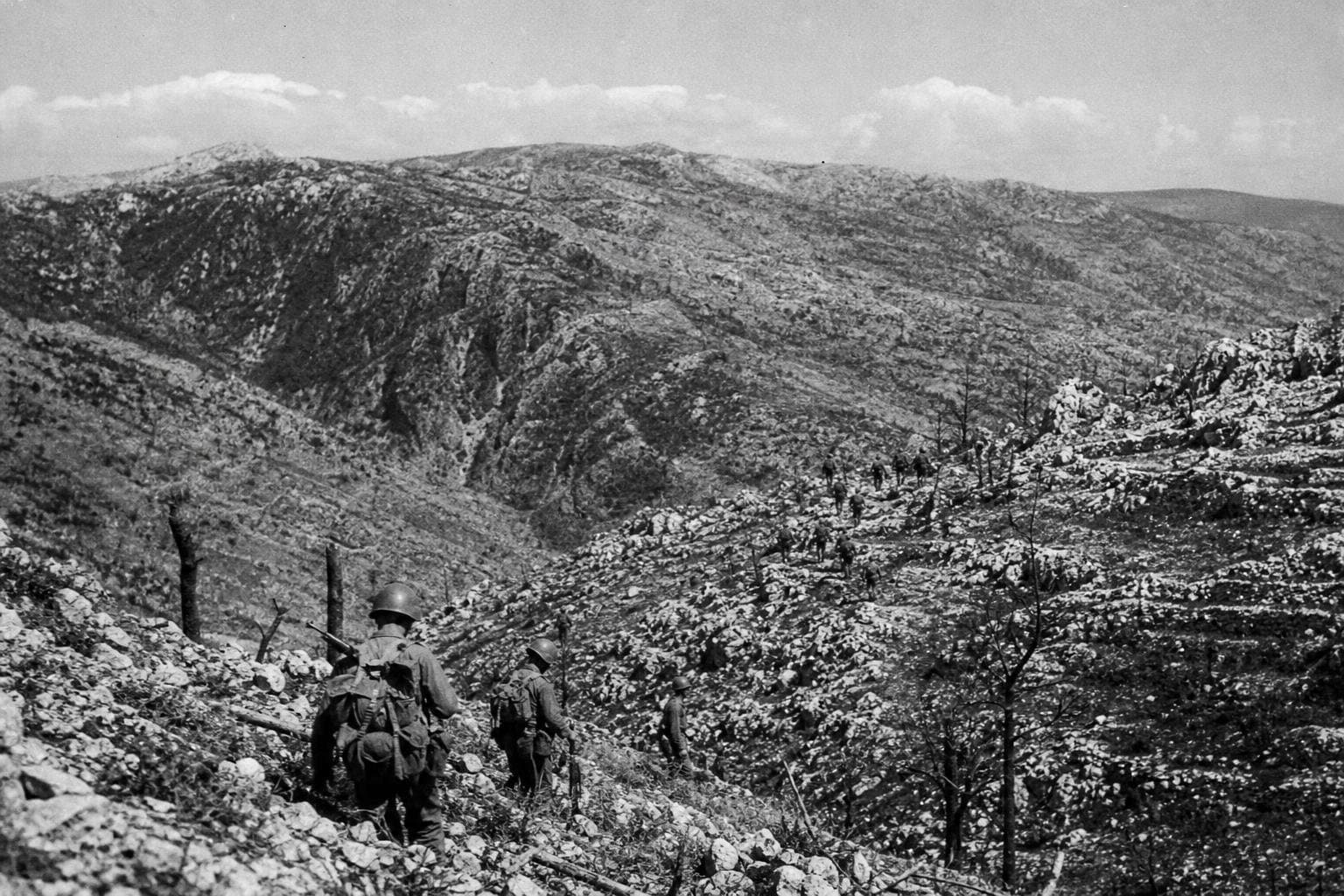

Mark Clark wrote his commendation to the French Expeditionary Corps in the warm afterglow of victory, the kind of document generals produce when an operation has gone better than the planning staff dared hope. "The energy and utter disregard for danger consistently shown by all... have aroused admiration in your Allies and fear in the enemy," he told them, praising the North African colonial troops who had helped crack the Gustav Line in May 1944 and opened the road to Rome (Alex Churchill's HistoryStack). It's a fine piece of command prose. It is also, read against what the record shows happened in the same weeks across the same ground, a document that leaves out the thing that mattered most.
This is not a post about the abbey bombing in February 1944 — the sources available to me here don't carry the primary-document detail that argument deserves, and I'd rather say less than reconstruct a command dispute from thin air. What the record does support is something adjacent and, in its way, more damning: how the Allied command structure that broke the Cassino position in its fourth and final battle handled the atrocities that followed it, and how little institutional appetite there was to reckon with them in real time.
Operation Diadem Broke the Line the Previous Three Battles Couldn't
By May 1944, the Gustav Line had already absorbed three failed Allied assaults centered on the Cassino massif, part of the broader Italian front that occupied Allied planning through the first half of that year (Britannica). The fourth attempt, Operation Diadem, succeeded where the others hadn't, and the breakthrough credit belongs substantially to the French Expeditionary Corps, operating within Clark's Fifth Army, which pushed through the Aurunci Mountains — terrain the Germans had judged nearly impassable for a coordinated force — and unhinged the German defensive line from a direction it hadn't been built to resist (Alex Churchill's HistoryStack). On the German side, the defense of that same ground had been shaped for months by disagreements among senior commanders over how to hold Italy at all — a strategic argument that ran from Albert Kesselring down through the army, corps, and division commanders actually fighting the peninsula, according to a recent discussion of German command decision-making in the campaign (Veterans Breakfast Club). That source is a public talk rather than a primary document, and I'm citing it for the shape of the dispute, not for granular tactical detail it doesn't provide. But the broader point holds across both armies: Cassino in the spring of 1944 was a campaign where command friction, not individual brilliance, decided outcomes. The French broke the line because the terrain and the opportunity aligned, not because anyone on the Allied side had a plan that anticipated it working that well.
The Numbers Nobody Wanted to Publish
The same weeks that produced the breakthrough also produced a wave of sexual violence against Italian civilians, overwhelmingly attributed to French colonial troops advancing through the Ciociaria region. According to a postwar study conducted by the Italian Ministry of War, 1,159 rapes and 291 attempted rapes were reported across Italy between the September 1943 landings and mid-1947, and 84 percent of those incidents were attributed to French forces; 34 percent of the total occurred in May 1944 and 54 percent in June 1944, concentrated in the exact window and geography of the Diadem breakout (Alex Churchill's HistoryStack).
I want to flag the methodology problem directly, because this publication's standards demand it and because it matters to the history. These are postwar reported figures compiled by an Italian government ministry years after the events, not a contemporaneous battlefield tally, and reported sexual assault figures — in any era, in any war — are understood by historians to undercount actual incidence. The number is a floor, not a ceiling, and treating it as a precise count rather than an institutional estimate would be its own kind of distortion. What the figure does establish reliably is scale and concentration: this wasn't scattered opportunistic crime, it was a documented pattern tied to a specific advance, in a specific command structure, in a specific six-week window. Before the end of 1943, only 25 soldiers had faced trial for violence against Italian civilians across the whole campaign (Alex Churchill's HistoryStack). That number was about to be overwhelmed by events the existing military justice apparatus wasn't built to process — an apparatus operating inside a theater that, through 1944, was still absorbing one of the longest and hardest-fought Allied campaigns in Western Europe (Veterans Breakfast Club).
Command Praise and Command Accountability Ran on Separate Tracks
Here is where the institutional-culture argument sharpens. Clark's commendation and the casualty record of the marocchinate — as the atrocities came to be known in Italy — exist in the same month, the same army, the same chain of command, and they do not appear anywhere in the same sentence in the Allied record as it was written at the time. That's not a smoking gun pointing at any one officer's malice or negligence; I don't have sourcing here that tells me what Clark or his staff knew, when they knew it, or what disciplinary mechanisms were actually triggered inside Fifth Army in real time, and I'm not going to invent that chain of knowledge to make the story cleaner. What the available record does show is a structural gap: a command culture built to recognize operational success — breakthrough, pursuit, the road to Rome — had comparatively little built-in capacity or evident urgency to confront what the same advancing units were doing to the civilian population they passed through.
This is a pattern military historians have documented across occupying and advancing armies generally — the operational tempo of a breakout tends to outrun the military-justice apparatus trailing behind it, and commanders under pressure to exploit a breach have incentives, structural as much as personal, to look forward rather than back. The broader Italian theater of 1944 was itself defined by this kind of friction between strategic intent and battlefield reality, as the push toward Rome unfolded alongside parallel Allied offensives being planned and debated for northwest Europe that same summer (Britannica). Whether that general pattern explains the specific slowness of the Allied response at Cassino is a judgment I can't make on the sources in front of me. What I can say is that the documentary record — a scale of reported violence running into the hundreds of cases within weeks, against a prewar baseline of 25 total prosecutions — describes an institutional failure of oversight regardless of what any individual general intended.
What the Campaign History Still Owes This Episode
The broader Italian campaign of 1944 gets taught, when it gets taught at all, as a story of terrain and attrition — the Gustav Line, the Gothic Line, the slow grinding climb up a peninsula built by nature to favor the defender (Britannica). That framing isn't wrong, but it's incomplete in a way that matters for how this publication thinks about institutional culture: the same command structures that failed to anticipate how hard Cassino would be to crack — a difficulty rooted as much in disputes among German commanders over how to defend Italy as in Allied planning failures (Veterans Breakfast Club) — also failed, in the moment of their greatest tactical success, to build accountability mechanisms that matched the scale of what their advance unleashed on civilians.
Historians continue to debate how directly to tie command responsibility to the scale of the marocchinate, and that debate deserves to be named rather than resolved by assertion — the available sources here don't settle it, and I won't pretend otherwise. What's harder to dispute is the asymmetry in how the record was kept: an army that documented troop movements, casualty counts, and commendations in granular detail left the accounting of harm to civilians to a government ministry working years after the fact (Alex Churchill's HistoryStack). That gap between what gets recorded in real time and what gets reconstructed afterward is, in its own way, as consequential a command decision as any order given on a ridge line — and it's the part of the Cassino story that rarely makes it into the commendation.


