


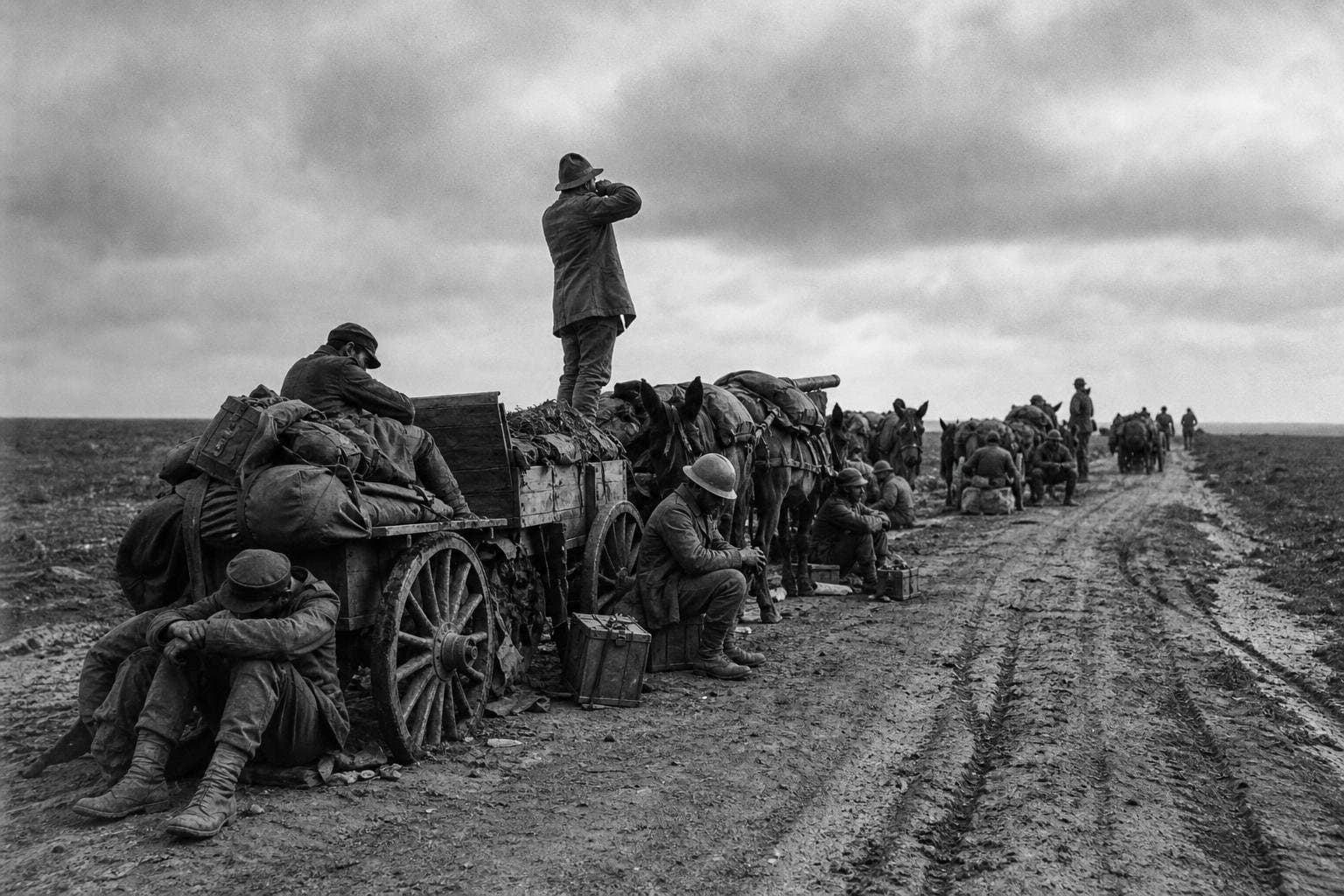

The British Indian Army at Kut Al Amara in 1916. The Wehrmacht outside Moscow in 1941. The U.S. Army in Iraq and Afghanistan after 2003. Different wars, different centuries, different technologies — and the same structural failures, recurring with the regularity of a bad dream. This week's sources surface four patterns worth naming precisely, because naming them is the first step toward recognizing them before the disaster rather than after.
1. Mission Creep Follows Cheap Early Victories
The Siege of Kut is a case study in how success manufactures its own catastrophe. As Cracking Defence's analysis of Kut Al Amara documents, British Indian forces secured Basra rapidly in 1914, then watched "mission creep" set in as each success made the next objective look achievable. By late 1915, Major General Townshend's 6th Division was fighting at Ctesiphon, 40km from Baghdad — far beyond the original mandate to secure the Abadan oil fields. The culmination point arrived without anyone formally declaring it. Over 13,000 men surrendered at Kut; thousands more died in captivity or in the failed relief attempts that followed.
The pattern: permissive early conditions create institutional optimism that outpaces actual capability. The force that wins the first battle is rarely the force that can sustain the campaign the victory implies.
2. Logistics Plans Are Written for the War You Expect
The Modern War Institute's analysis of Army sustainment makes the Barbarossa connection explicit: German mechanized formations shattered Soviet defenses in 1941 and then ran out of fuel, ammunition, and winter clothing because the plan assumed a short, decisive campaign. The railway gauge mismatch alone — Soviet rail lines required extensive modification before German trains could use them — was a known problem that received inadequate attention because the operational timeline didn't budget for it.
The halt before Moscow in winter 1941 is routinely narrated as a tactical defeat inflicted by Soviet resistance. The MWI piece argues it was primarily a sustainment failure — the Wehrmacht's operational reach had simply exceeded its logistical capacity. The Red Army didn't stop the Panzers; the supply system did.
The same piece notes that Desert Storm and Iraqi Freedom trained the U.S. Army to expect six months of uncontested buildup and absolute air supremacy. Neither condition should be assumed in a peer conflict.
3. Fortress Thinking Substitutes Reputation for Capability
The War on the Rocks analysis of Singapore's fall — part of Iskander Rehman's "Applied History" series — frames the February 1942 collapse as a failure that was analytically confusing precisely because there were too many explanations, not too few. Churchill's reaction, quoted through Lord Moran's memoirs (a source with its own perspective and agenda), captures the psychological dimension: the fortress's reputation had become a strategic asset in British imperial thinking, substituting for actual defensive preparation.
The lesson isn't simply "don't build fixed defenses." It's that institutional confidence in a position's reputation can suppress the intelligence assessments and logistical audits that would reveal its actual vulnerability. The fortress was a story the British told themselves; the Japanese read the terrain instead.
4. Efficiency Optimized for Peace Becomes Fragility in War
The MWI piece's sharpest contemporary observation: the U.S. Army spent two decades optimizing sustainment for permissive environments — uncontested supply lines, contractor support, static forward operating bases. That optimization is real and measurable. It is also, in a peer-conflict scenario with contested logistics nodes, a liability rather than an asset. A force built for efficiency under favorable conditions has traded resilience for throughput.
The Wehrmacht made the same trade in 1941. The British Indian Army made it in Mesopotamia in 1915. The specific technologies change; the structural logic doesn't.
The Through-Line
These aren't separate lessons — they're the same lesson in different uniforms. Armies culminate when their operational ambitions outrun their sustainment capacity, and that gap almost always opens because early success made the planners optimistic and the logisticians quiet. The question to ask of any campaign plan isn't "can we reach the objective?" It's "can we sustain ourselves once we get there, under conditions we didn't choose?"
History's answer, repeated across a century of evidence, is that most armies don't ask it seriously until after they've already stopped moving.