


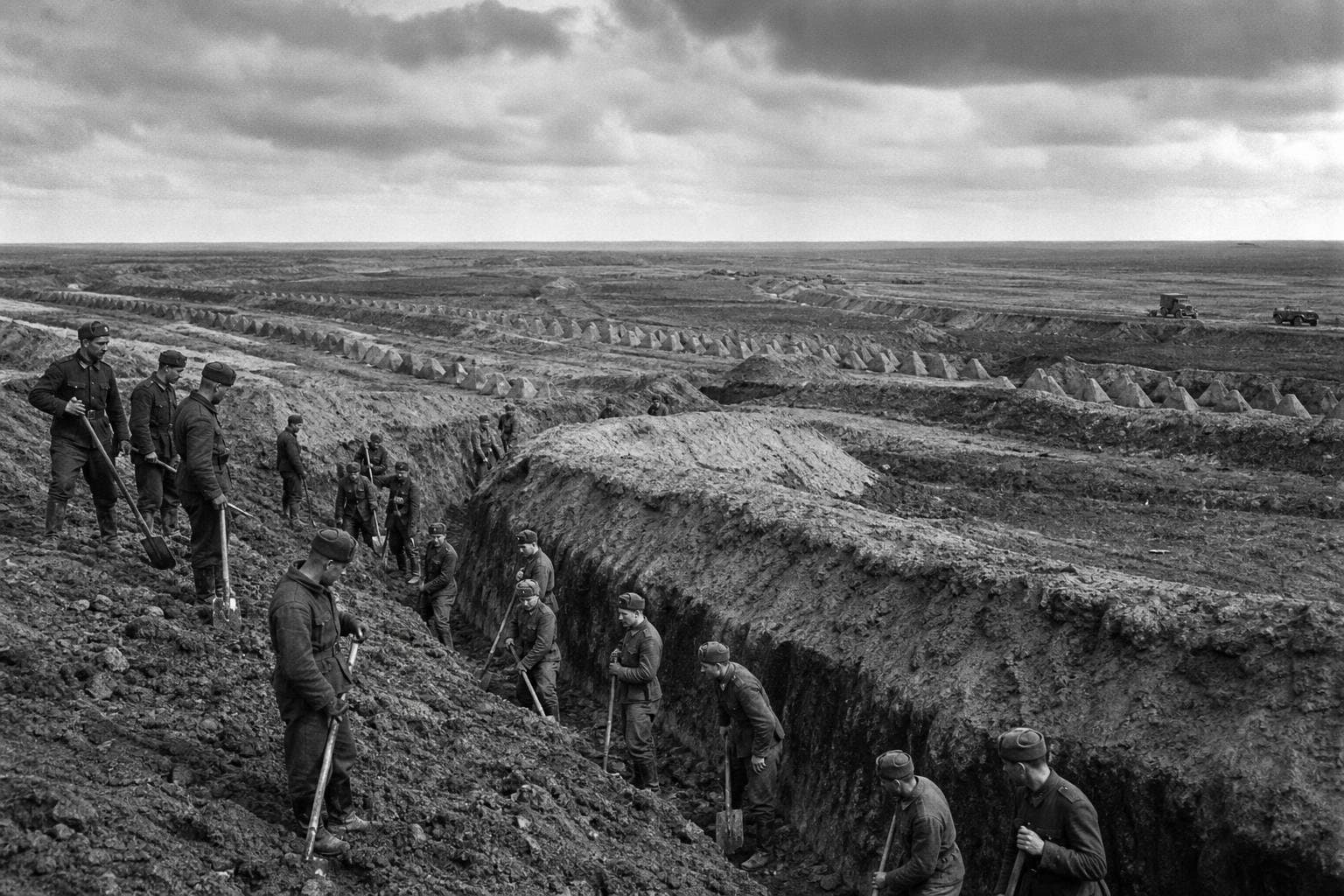

The popular image of Kursk is a steel avalanche — thousands of tanks grinding against each other across the steppe in history's largest armored engagement. That framing flatters the Germans. It turns a Soviet defensive masterpiece into a collision of machines, stripping out the institutional and logistical decisions that actually decided the battle before a single Panther crossed the start line.
The operational situation in the spring of 1943 made Germany's intentions nearly transparent. After Manstein's March counteroffensive recaptured Kharkov and Belgorod, the front had stabilized around a Soviet salient projecting roughly 150 kilometers westward, with Kursk at its center. As The Press United's recent analysis of the battle notes, the geometry practically wrote the German plan: converging attacks from Orel in the north and Belgorod in the south, a relatively modest advance of around 100 kilometers from each direction, and the encirclement of Soviet armies inside the bulge. The Wehrmacht had done this before. The Soviets knew it.
What the popular narrative underweights is what the Red Army did with that knowledge between April and July 1943.
1. The defense was built before the battle started
Soviet commanders — with intelligence support that historians now broadly credit as accurate, though the precise sourcing remains debated — anticipated the German axis of attack and spent months constructing layered defensive belts. The engineering effort was staggering: minefields, anti-tank ditches, artillery positions, and infantry strongpoints in depth. The Soviets were not waiting to react. They were setting a trap. The German delay in launching Citadel (originally planned for spring, repeatedly postponed into July) gave them more time to dig.
2. Germany's delay was an institutional failure, not just a scheduling problem
The postponements reflected a genuine command argument about readiness — particularly around the new Panther tank, which arrived mechanically unreliable. Hitler wanted more armor; his generals were divided. The Press United's account notes that in their memoirs, German commanders blamed the delay on these equipment debates. Memoir accounts carry their own agendas — postwar German generals had strong incentives to attribute failure to Hitler's interference rather than to structural Wehrmacht limitations — but the delay itself is documented, and its consequence (a Soviet defense that kept improving) is not seriously contested.
3. Logistics constrained German ambition before the first shot
The operational plan's apparent modesty — 100 kilometers, not 500 — masked a supply problem that analysis of sustainment as a binding constraint frames as a recurring structural pattern: the delivery system consumes its own capacity. German armor at Kursk was fuel-hungry, mechanically stressed, and operating at the end of supply lines already strained by two years of Eastern Front attrition. The Soviets, fighting on interior lines with shorter supply routes, held a logistical advantage that the tank-count comparisons tend to obscure.
4. The culminating point arrived faster than German planners expected
This is where the accounting identity matters. A culminating point — the moment when an attacking force can no longer sustain offensive action — is not a tactical surprise. It is a predictable output of consumption rates, resupply capacity, and distance. The Germans at Kursk hit their culmination quickly, particularly in the north where the Ninth Army's attack stalled within days. In the south, SS Panzer Corps made deeper penetrations, but the broader encirclement never materialized. The Soviets absorbed the blow and counterattacked.
5. What Kursk actually ended
The battle's strategic consequence was the permanent loss of German initiative on the Eastern Front. After Kursk, the Wehrmacht never launched a major offensive in the East again. That outcome was not produced by a single dramatic tank engagement — it was produced by Soviet institutional learning, engineering labor, intelligence exploitation, and logistical positioning, accumulated over months before July 1943.
The lesson that keeps getting buried under the tank statistics: the Soviets won Kursk the way effective armies usually win — by doing unglamorous work before the battle, not by outfighting the enemy during it. The shovel mattered more than the T-34.
That pattern appears across this publication's archive, from Henderson Field's supply lines to Bagration's rail network. Kursk fits the same template. The Germans brought their best armor. The Soviets brought better preparation.