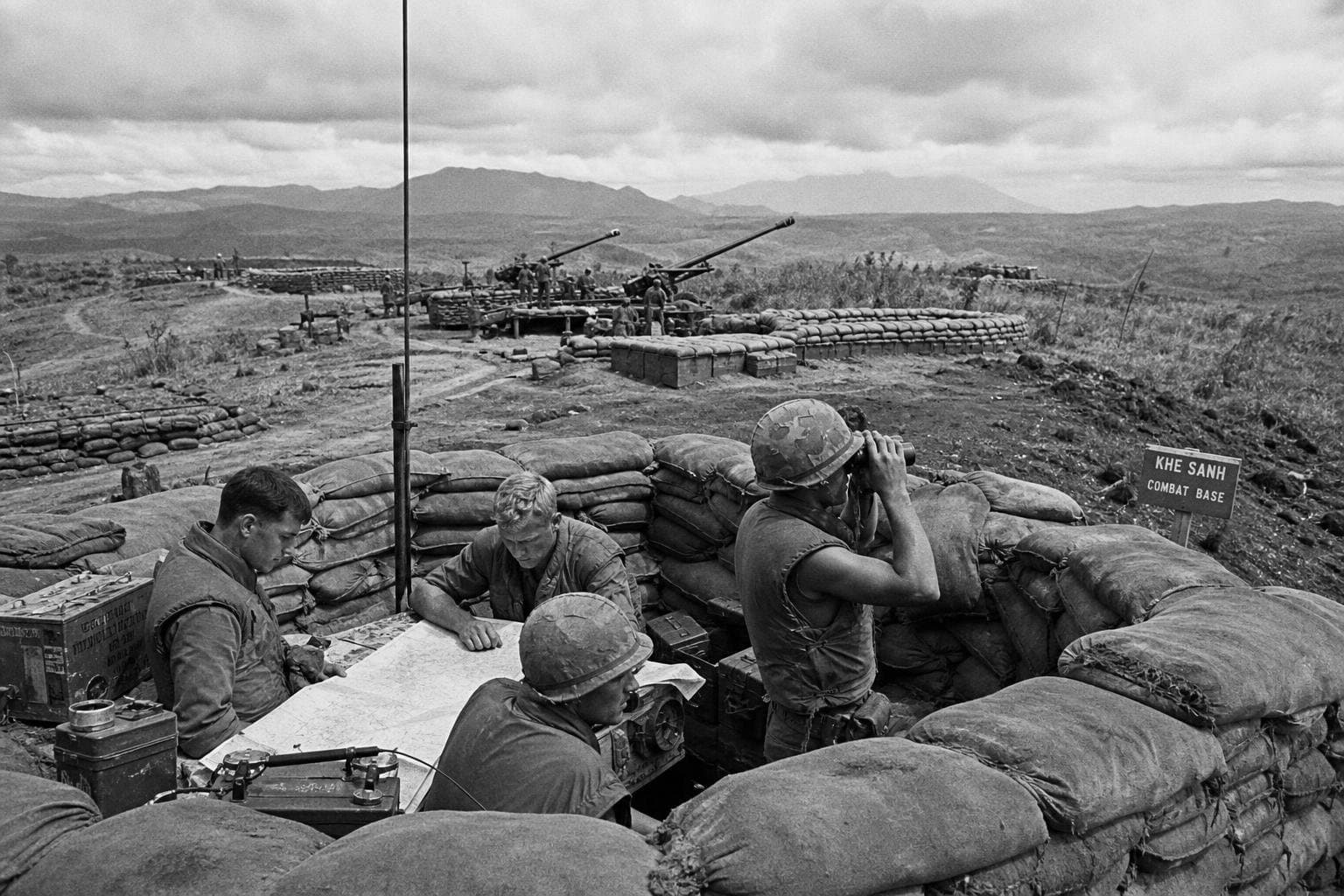

For two and a half months in early 1968, the American public watched a single hilltop base in the Vietnamese highlands as if the whole war hinged on it. General William Westmoreland believed it did. He read the North Vietnamese buildup around Khe Sanh — eventually estimated at somewhere between 15,000 and 30,000 troops surrounding a garrison of roughly 6,000 Marines — as the opening move of a conventional invasion across the DMZ, with Khe Sanh as the opening salvo, a rerun of Dien Bien Phu he intended to win this time with air power instead of abandon it to siege Flickr archive summary.
He was wrong about the shape of the offensive. The siege was real, the fighting was real, but the main blow landed in the cities of South Vietnam three days after the first heavy attacks at Khe Sanh, part of a broader pattern of escalation and offensives that the standard Vietnam War chronology places across 1963–1969 as a single continuous campaign rather than a series of isolated battles Wikipedia. Whether Khe Sanh was ever meant to be the main event, or was always meant to pull American attention and firepower away from the cities, remains one of the genuinely contested questions of the war — and it's worth being honest about why it's still contested rather than picking the version that makes the best story.
The Diversion Thesis Has a Problem: Nobody on the American Side Knew What They Didn't Know
The case for Khe Sanh as deliberate diversion rests on timing and scale. The buildup around the base was substantial enough, and sustained enough — artillery, armor, and multiple regiments arrayed against a modest combat base with a short runway — that it absorbed enormous intelligence attention and firepower in the weeks before Tet Flickr archive summary. American air power responded with a massive campaign built around B-52 strikes and coordinated air support, resources that were, by definition, not available elsewhere while Khe Sanh held American attention Flickr archive summary. If you wanted to convince Westmoreland to stare at one spot on the map while you moved against two dozen others, that's roughly what you'd build — and the base's position overlooking supply routes from Laos and the Ho Chi Minh Trail gave the North Vietnamese a plausible non-diversionary reason to mass forces there regardless, since that corridor had drawn fighting for most of the preceding year Flickr archive summary.
That overlap with the Ho Chi Minh Trail corridor also explains why American special operations units were running reconnaissance into Laos and along the border well before the siege began — the same terrain the North Vietnamese used to mass at Khe Sanh was already a covert battleground, run by task forces whose missions remain only partially declassified decades later Wikipedia. None of that covert activity resolved the diversion question for Westmoreland's staff in January 1968; it just meant the border region was already crowded with American eyes that still failed to anticipate what was coming.
The case against treating the diversion question as settled is that intent is not the same as effect. A siege that functions as a diversion in hindsight is not necessarily one that was planned as a diversion. Westmoreland's own reasoning — that a contact near the base in early January confirmed his suspicion of a DMZ invasion — was a judgment made with the intelligence he had at the time, not a mistake he should have avoided given what was actually knowable that week Flickr archive summary. Historians disagree on this, and that disagreement is the honest state of the record, not a gap waiting for the right memoir to close it.
The Real Blind Spot Wasn't Troop Movements — It Was Hanoi's Internal Politics
What complicates the diversion question further is a piece of the story Americans weren't positioned to see at all. Journalist Carl Robinson, who covered the siege and its aftermath for the Associated Press, has argued that the assumption Ho Chi Minh and Vo Nguyen Giap were running the 1968 offensive may itself be wrong — that a hardline faction around Le Duan had sidelined more cautious voices inside the Communist Party well before Tet began, clearing the way for the urban-offensive strategy the Americans never saw coming from a political direction Carl Robinson. If that account holds up, American intelligence was tracking troop movements and infiltration routes around Khe Sanh with real sophistication while remaining almost entirely blind to the leadership struggle that determined what those troops were actually for. A diversion planned by a unified high command and a diversion that emerged from a factional compromise are two different objects, and the record doesn't yet let us say with confidence which one Khe Sanh was.
This isn't just a question for professional historians — it's the subject of ongoing amateur and podcast-level excavation too, including long-form discussions devoted specifically to untangling Khe Sanh's role in the broader offensive, a sign the question hasn't calcified into consensus even outside the academy Pete Hutter's notes.
That ambiguity is the lesson worth sitting with, more than any clean verdict about genius or decoy. The siege produced extraordinary tactical data — on resupply under fire, on the limits of fixed positions against artillery, on what sustained air support can and can't substitute for ground mobility. It produced far less clarity about intent, because intent lived in a Hanoi politburo room that neither Westmoreland's staff nor, it seems, most Western journalists at the time had any real window into. I covered the political fracture inside Hanoi's planning for Tet itself back in July (/p/tet-1968-the-politburo-knew-it-was-losing-the-war-it-was-fightin); Khe Sanh is the half of that story told from the American side of the wire, and it's no less foggy for being better photographed.


