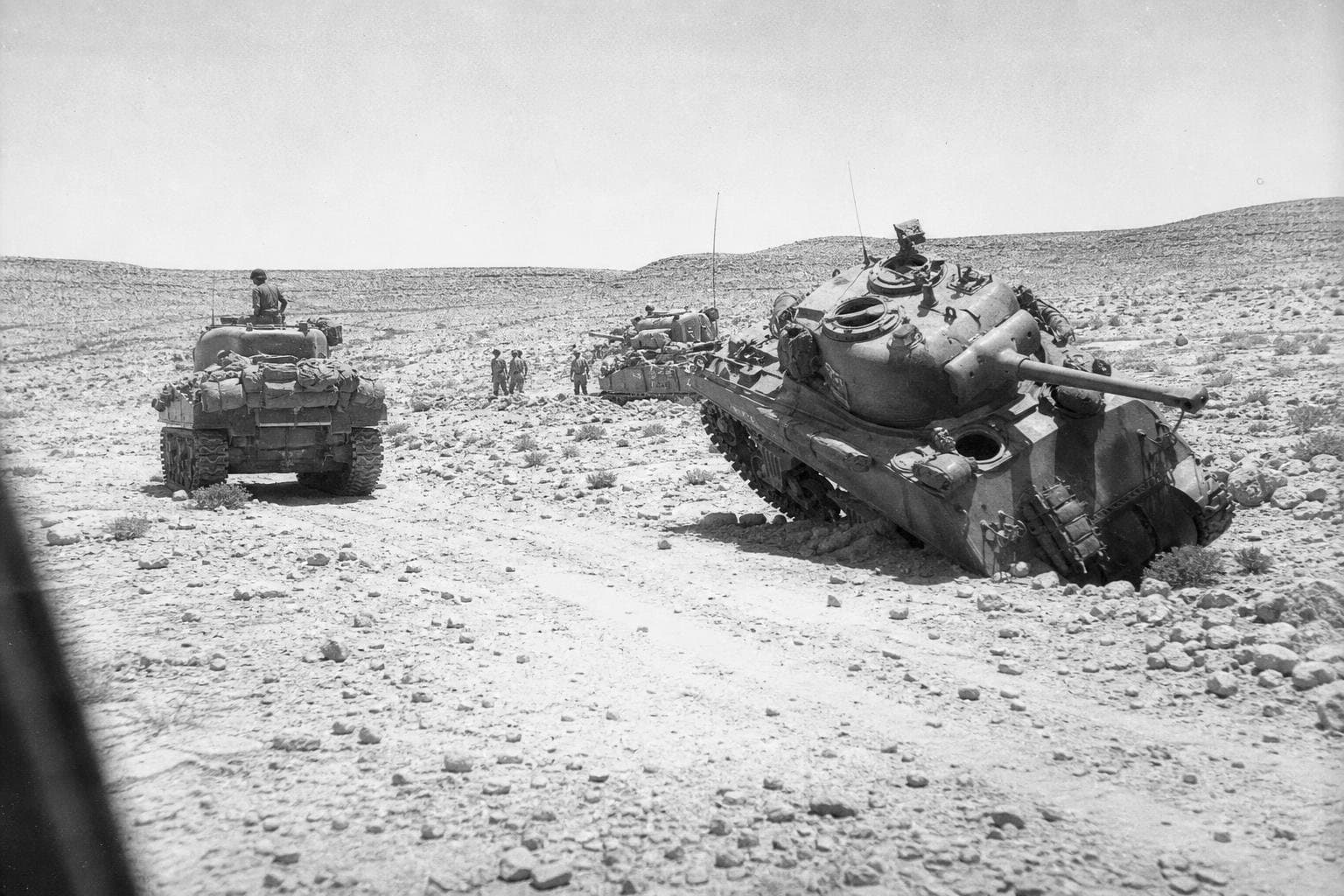

I covered the American armor problem in North Africa back in May — specifically how Kasserine exposed the gap between prewar tank doctrine and battlefield reality. What I didn't fully develop was the institutional dimension: the defeat wasn't primarily about German tactical superiority. It was about an army that had sent men into combat without ensuring they could operate the weapons in their hands.
That distinction matters more than it might seem.
The Situation Before the Pass
By February 1943, the Allied position in Tunisia was already under strain. Axis troops had been arriving in Tunisia since November 9, 1942, and were reinforced until they numbered roughly 20,000 combat troops — a figure that grew substantially as Germany and Italy committed to holding the bridgehead. When Rommel fell back from Libya to the Mareth Line in mid-January, two German armies under Arnim and Rommel were holding the eastern littoral against pressure from both Anderson's 1st Army from the west and Montgomery's 8th Army from the southeast.
Rommel's logic was sound given what he knew: strike the weaker western flank before the Allied squeeze tightened. On February 14, Axis forces attacked U.S. positions between Faïd Pass and Gafsa. West of Faïd, the 21st Panzer Division under General Heinz Ziegler destroyed 100 U.S. tanks and drove the Americans back 50 miles. The figure of 100 tanks comes from Britannica's account; other sources vary, and the precise count should be treated as an approximation rather than a verified tally. What isn't contested is the scale of the rout.
The question worth asking is what made that rout so complete.
What the Americans Didn't Know How to Do
The honest answer is: quite a lot. The defeat at Kasserine was marked by "fundamental flaws in doctrine, command, and organization," and the specifics are damning. Units arrived in Tunisia not knowing how to use bazookas or mines. Flanks went unsecured. Night fighting procedures were absent. The 34th Infantry Division, mixed with National Guard units, was described as "ignorant of field manuals, unable to reconnoiter properly, and generally deficient in basic and small-unit training."
That source — a blog post drawing on Stephen Budiansky's work — sits below the publication's preferred tier, and I'm treating it accordingly: as a secondary synthesis rather than primary authority. But the pattern it describes is consistent with the operational record. Armored units were committed piecemeal rather than massed, which meant they were destroyed in detail. This wasn't bad luck or terrain. It was a command culture that hadn't internalized combined-arms fundamentals.
Eisenhower, as theater commander, had been promoted by Marshall above officers who outranked him and had never commanded forces in combat before Tunisia. The National WWII Museum characterizes Kasserine as a "close call" — which is generous. The more precise description is a near-catastrophic institutional audit conducted at the cost of American lives.
The Correction Was Real, and It Was Fast
What redeems the Kasserine story — analytically, not sentimentally — is the speed of the institutional response. Eisenhower relieved Brigadier General Raymond McQuillin and replaced the overcautious II Corps commander Lloyd Fredendall with George Patton, who took command on March 6, 1943, inheriting a force of roughly 88,000 men. The figure comes from a secondary source and should be understood as an estimate.
What followed at El Guettar on March 23 was the same American force, reorganized and re-led, stopping the 10th Panzer Division cold. The German commanders who attacked that morning had seen American forces crumble at Kasserine and expected the same result. They were wrong — not because the Americans had become a fundamentally different army in four weeks, but because the specific failures that produced Kasserine had been identified and corrected at the command level.
That's the actual lesson, and it's more uncomfortable than the popular version. The popular version says Kasserine was where green American troops met battle-hardened Germans and got an education. True enough. But the harder version says the education should have happened before Tunisia, and that men died at Kasserine because the institutional machinery for producing combat-ready soldiers had failed to do its job. The Germans didn't expose a gap — they walked through one that American doctrine and training had left open.
The broader Tunisian campaign ended with roughly a quarter million Axis troops surrendering, which made the whole episode look like a learning curve with a satisfying conclusion. It was. But learning curves have costs, and the costs at Kasserine were paid by soldiers who arrived in combat without knowing how to use their weapons. That's not a battlefield failure. That's a system failure that expressed itself on a battlefield.
The distinction is worth holding onto, because armies have been making it ever since.


